

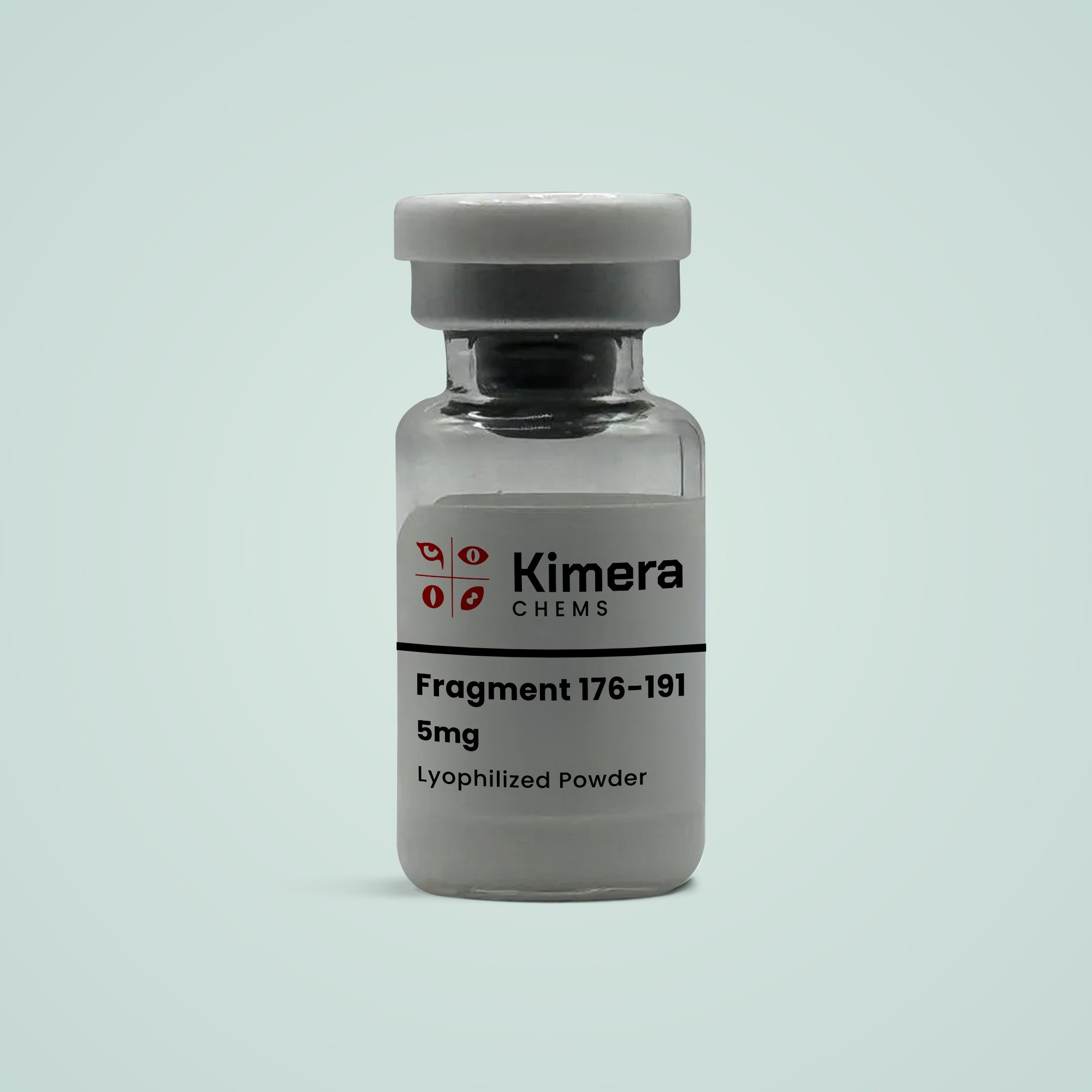


Fragment 176-191
Fragment 176-191 (also recognized in metabolic literature as hGH Fragment 176-191 or its stabilized tyrosine-modified variant, AOD9604) is a synthetic polypeptide fragment replicating the terminal C-terminus region of human growth hormone (somatotropin). Composed of a distinct 16-amino acid sequence, this molecule is highly utilized in endocrinology and lipolysis research models.
Because it represents an isolated region of the parent hormone, it completely lacks the growth-promoting, IGF-1-mediated, and insulin-sensitizing binding domains found on the full somatotropin structure. This structural restriction allows investigators to safely study the independent, localized lipid-regulatory behaviors of the growth hormone molecule in isolated in vitro configurations.
Technical Specifications
| Property | Specification |
| Product Name | Fragment 176-191 |
| Synonyms | hGH Fragment 176-191, AOD9604 analog, Lipolytic Fragment |
| Amino Acid Sequence | H-Tyr-Leu-Arg-Ile-Val-Gln-Cys-Arg-Ser-Val-Glu-Gly-Ser-Cys-Gly-Phe-OH |
| Molecular Formula | C₇₈H₁₂₅N₂₃O₂₃S₂ |
| Molecular Weight | 1812.12 g/mol |
| Chemical Class | Synthetic Polypeptide Fragment / Cyclic Disulfide Peptide |
| Assay Purity Baseline | ≥98.0% (HPLC-UV & MS verified) |
| Physical Format | Lyophilized white to off-white solid powder |
Research Applications & Mechanism of Interest
The primary value of Fragment 176-191 in laboratory settings is its highly localized action on cellular fat matrices without triggering generalized systemic growth cascades.
Primary fields of in vitro and cell culture laboratory investigation include:
-
Lipid Pathway Mapping: Observing how the C-terminal sequence interacts with lipid-dense matrices in cultured adipocyte lines. Researchers utilize this compound to track beta-3 adrenergic receptor cross-talk and subsequent changes in cyclic adenosine monophosphate (cAMP) levels.
-
Disulfide Stability Studies: Evaluating the chemical stability and cleavage rate of the internal disulfide loop formed between the Cys7 and Cys14 residues. This loop creates a specific rigid cyclic conformation that is heavily scrutinized under shifting electrochemical, pH, and enzymatic conditions.
-
Enzymatic Degradation Analysis: Tracking the susceptibility of the linear peptide bonds to ambient serum peptidases, allowing researchers to evaluate structural modifications that might extend the compound’s analytical lifespan.
-
Secondary Messenger Translocation: Monitoring the movement of intracellular molecules across cell membranes following compound introduction to map the precise cascade of non-growth hormone receptor (GHR) signaling loops.
Storage & Handling Guidelines
To secure complete peptide chain uniformity, shield the terminal amino acids from enzymatic breakdown, and ensure high cross-batch reproducibility:
-
Lyophilized Powder Management: The dry, solid reference powder is stable at room temperature (15–25°C) for short intervals if kept out of direct light. For long-term chemical archiving, the material must be stored continuously in a frozen state at -20°C or below.
-
Reconstituted Assay Solutions: Once dissolved in ultra-pure molecular water or sterile laboratory saline lines, store liquid stocks inside a regulated refrigeration environment at 2–8°C. Use solutions within 10–14 days to prevent gradual hydrolytic degradation.
-
Atmospheric Protection: Keep all container caps tightly and hermetically sealed within a desiccated environment to isolate the lyophilized cake from atmospheric moisture ingress.
-
Aseptic Manipulation: Always deploy sterile laboratory equipment, clean working surfaces, and calibrated pipettes during reconstitution to ensure the product remains free of bacterial or chemical contaminants.
-
Analytical Auditing Validation: Kimera Chems subjects every batch to a strict dual-method verification protocol combining High-Performance Liquid Chromatography (HPLC) and Mass Spectrometry (MS) to independently audit structural identity, precise mass distribution, and an absolute purity baseline of ≥98.0%.
Research Use Only Disclaimer: This product is developed, synthesized, and distributed strictly as a Research Use Only (RUO) laboratory reference material designed exclusively for non-clinical analytical and scientific investigation. It is not an FDA-approved drug formulation, active pharmaceutical ingredient, or dietary supplement, and is strictly prohibited for direct human or veterinary consumption. Kimera Chems supplies these high-purity peptide batches solely to accredited institutional laboratories, academic departments, and certified investigators.
| CAS Number | 66004-57-7 |
| Other Names | Somatotropin (176-191), DTXSID10216216, L-Phenylalanine, L-phenylalanyl-L-leucyl-L-arginyl-L-isoleucyl-L-valyl-L-glutaminyl-L-cysteinyl-L-arginyl-L-seryl-L-valyl-L-alpha-glutamylglycyl-L-seryl-L-cysteinylglycyl-, cyclic (7-14)-disulfide |
| IUPAC Name | [(2S)-2-[[(2S,3S)-2-[[(2S)-2-[[(2S)-2-[[(2S)-2-amino-3-phenylpropanoyl]amino]-4-methylpentanoyl]amino]-5-carbamimidamidopentanoyl]amino]-3-methylpentanoyl]amino]-3-methylbutanoyl] (4S)-5-[[2-[(2S)-2-[[2-[[(2R)-2-[[(2S)-2-amino-3-hydroxypropanoyl]amino]-3-sulfanylpropanoyl]amino]acetyl]amino]-3-phenylpropanoyl]oxy-2-oxoethyl]amino]-4-[[(2S)-2-[[(2S)-2-[[(2S)-5-carbamimidamido-2-[[(2R)-2-[[(2S)-2,5-diamino-5-oxopentanoyl]amino]-3-sulfanylidenepropanoyl]amino]pentanoyl]amino]-3-hydroxypropanoyl]amino]-3-methylbutanoyl]amino]-5-oxopentanoate |
| Molecular Formula | C₇₈H₁₂₅N₂₃O₂₃S₂ |
| Molecular Weight | 1812.12 |
Related products

Peptides


Peptides

Peptides


Peptides
Peptides


Peptides

Peptides

Peptides