


Fenbendazole

Price range: $46.99 through $56.99
Kimerachems Fenbendazole for sale. Intended for controlled laboratory and analytical research only.
Review available formats, product specifications and batch documentation before ordering. Not for human consumption.
Kimerachems Fenbendazole for sale. This material is supplied exclusively for controlled laboratory and analytical research. Review available formats, technical specifications and batch documentation before ordering. Not for human consumption.
Fenbendazole
Fenbendazole is a synthetic small molecule belonging to the benzimidazole chemical class. Structurally composed of a central benzimidazole core substituted with a phenylsulfanyl (phenylthio) group and a methyl carbamate ester, this compound is highly regarded in structural biology and oncology research. Within controlled in vitro laboratory setups, Fenbendazole serves as a high-precision tool compound for investigating microtubule stability, competitive tubulin binding kinetics, and the disruption of mitotic spindle configurations under isolated experimental conditions.
Technical Specifications
| Property | Specification |
| Product Name | Fenbendazole |
| CAS Number | 43210-67-9 |
| IUPAC Name | methyl N-(6-phenylsulfanyl-1H-benzimidazol-2-yl)carbamate |
| Molecular Formula | C₁₅H₁₃N₃O₂S |
| Molecular Weight | 299.35 g/mol |
| Chemical Class | Benzimidazole Derivative / Carbamate Ester |
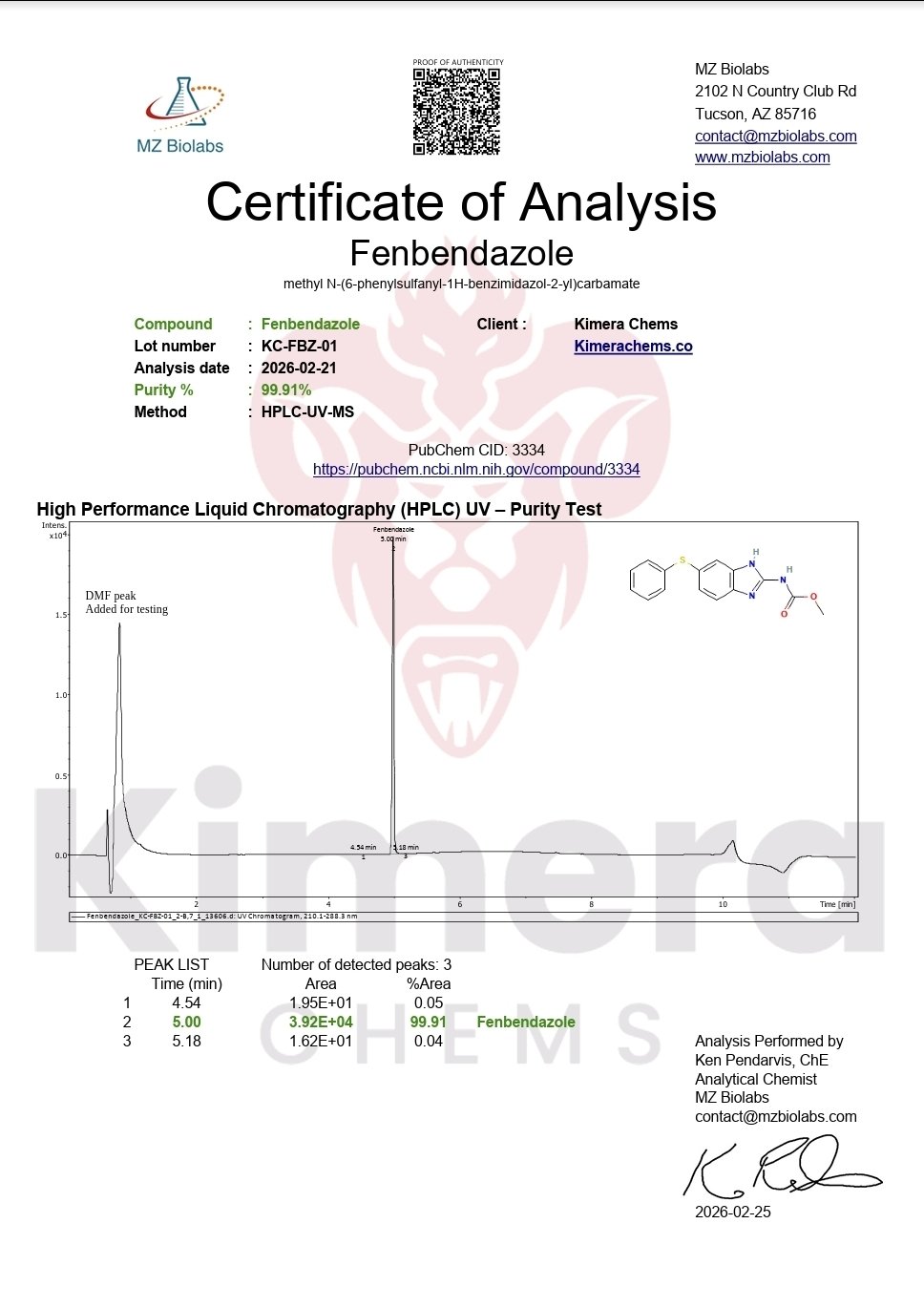
| Assay Purity | ≥98.0% (HPLC-UV verified) |
| Physical Format | White to off-white solid powder |
| Available Research Forms | Pure Bulk Powder (20g) | Dry-Filled Analytical Capsules (222mg) |
Research Applications & Mechanism of Interest
The primary focus of Fenbendazole in modern preclinical science centers on its ability to target structural protein assembly without altering baseline nucleic acid configurations.
Primary fields of in vitro and cell-free laboratory investigation include:
-
Tubulin Binding Cross-talk: Measuring competitive ligand interactions at the colchicine-binding domain of purified tubulin dimers. The carbamate group forms highly localized hydrogen bonds with specific amino acid residues, stabilizing the target site.
-
Microtubule Polymerization Inhibition: Utilizing real-time turbidimetric or fluorescence assays to monitor how the molecule arrests tubulin protofilament elongation, effectively shutting down structural assembly mechanisms.
-
Proteasomal and Glycolytic Stress Modeling: Investigating the compound’s secondary capacity to alter glucose uptake kinetics and downregulate GLUT transporters in cell culture profiles, leading to proteasomal stress pathways.
-
Co-Crystallography & Docking Validation: Serving as an organic reference ligand in protein X-ray crystallography to align and test computational molecular docking algorithms against real-world physical coordinates.
Storage & Handling Guidelines
To eliminate any risk of environmental breakdown and preserve standard chemical stability across longitudinal assay groups:
-
Thermal Management: Store both bulk powder and dry-filled research capsules at stable room temperature (15–25°C). Avoid exposing the inventory to extreme localized temperature spikes.
-
Atmospheric Safeguards: Keep all containment caps hermetically sealed to isolate the chemical from persistent air exposure, oxygen degradation, and moisture ingress.
-
Photolytic Barriers: Protect from direct sunlight arrays and intensive laboratory ultraviolet (UV) radiation by utilizing original opaque containers or amber glass containment vessels.
-
Analytical Quality Controls: Kimera Chems subjects every batch to a strict dual-method verification protocol combining High-Performance Liquid Chromatography (HPLC) and CHN elemental analysis to independently confirm absolute identity, structural purity parameters, and complete compound safety baselines before distribution.
Research Use Only Disclaimer: This product is developed, synthesized, and distributed strictly as a Research Use Only (RUO) laboratory reference chemical intended exclusively for non-clinical analytical and scientific investigation. It is not an FDA-approved drug formulation, active pharmaceutical ingredient, or dietary supplement, and is strictly prohibited for human or veterinary consumption. Kimera Chems supplies these high-purity compounds solely to accredited institutional laboratories and certified scientific investigators.
| CAS Number | 43210-67-9 |
| Other Names | N-[6-(phenylthio)-1H-benzimidazol-2-yl]-carbamic acid, methyl ester |
| IUPAC Name | Methyl 5-(phenylthio)-2-benzimidazolecarbamate |
| Molecular Formula | C15H13N3O2S |
| Molecular Weight | 299.3 |
Product FAQs
What is Fenbendazole supplied for?
This material is supplied strictly for controlled, non-clinical laboratory and analytical research. It is not intended for human or animal consumption.
Which formats are available for Fenbendazole?
The current listing shows these options: 20-grams-powder, dry-fill-capsules-222mg-60ct-13-32g. Availability can change, so confirm the selector above before ordering.
Where can I review product documentation?
Where available, batch documentation can be reviewed in the Certificate of Analysis library before ordering.
Research Documentation Guides
Review these supporting analytical guides before evaluating this material for a controlled research protocol:
Related products


Analytical Reagents


Analytical Reagents

Analytical Reagents


Analytical Reagents

Analytical Reagents


Analytical Reagents


Analytical Reagents


Analytical Reagents