


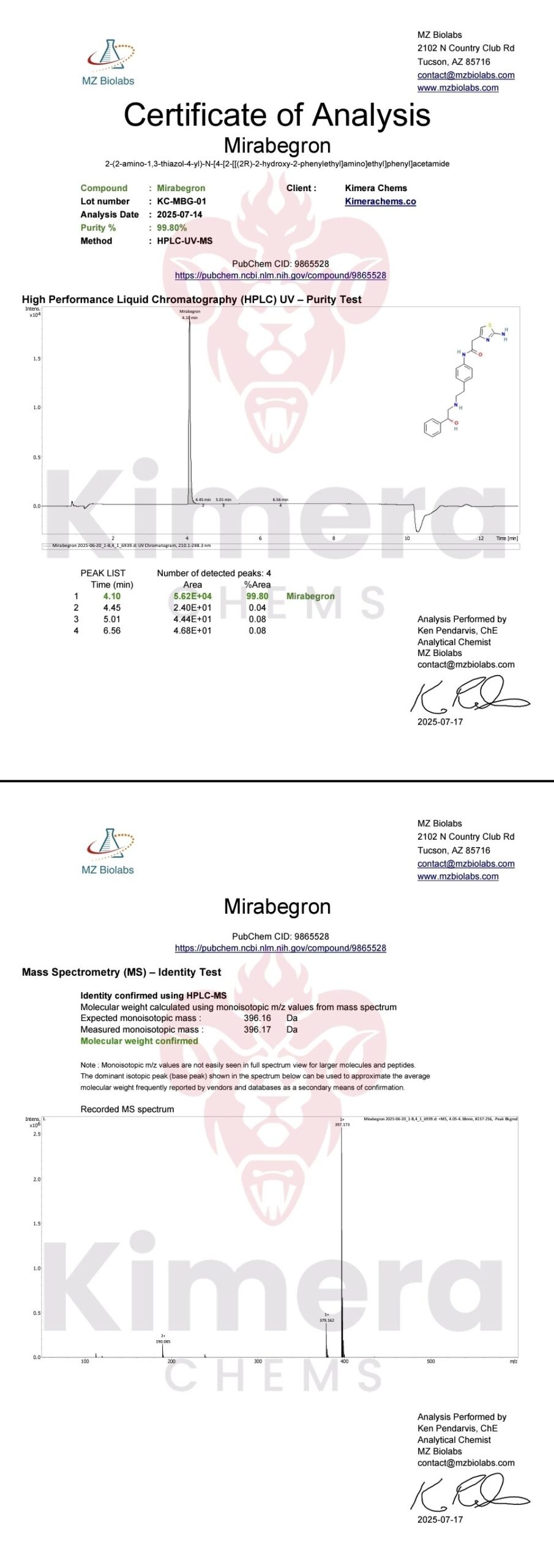

YM-178

Price range: $76.99 through $101.99
Kimerachems YM-178 for sale. Intended for controlled laboratory and analytical research only.
Review available formats, product specifications and batch documentation before ordering. Not for human consumption.
Kimerachems YM-178 for sale. This material is supplied exclusively for controlled laboratory and analytical research. Review available formats, technical specifications and batch documentation before ordering. Not for human consumption.
YM-178 (Mirabegron) Research Standard
YM-178 (Mirabegron) is a synthetic research compound classified as a highly selective beta-3 adrenergic receptor agonist. Characterized by a thiazole ring and an acetanilide group, the molecule exhibits a specific molecular geometry that facilitates high-affinity interaction with beta-3 receptor binding pockets. In controlled laboratory environments, YM-178 serves as a critical chemical probe for investigating beta-3 adrenergic signaling, receptor selectivity profiles, and the competitive dynamics of ligand binding in isolated membrane preparations.
Technical Specifications
| Property | Specification |
| Product Name | YM-178 (Mirabegron) |
| Synonyms | Betanis, Betmiga |
| Chemical Formula | C21H24N4O2S |
| Molecular Weight | 396.5 g/mol |
| Chemical Class | Beta-3 adrenergic receptor agonist |
| Physical Appearance | White to pale yellow solid |
| Assay Purity | 98-99% (HPLC verified) |
Mechanism of Action & Research Context
YM-178 is studied primarily for its interaction with beta-adrenergic receptor subtypes, with a focus on its high selectivity for the beta-3 receptor.
-
Receptor Interaction: The amine functional group within the molecule is essential for establishing hydrogen bonds with receptor residues. This interaction, coupled with the spatial orientation provided by the thiazole ring, allows for optimal fit within the binding pocket.
-
Selectivity Profiling: Researchers utilize YM-178 to distinguish beta-3 agonist activity from beta-1 and beta-2 receptor responses, providing a model for characterizing receptor subtype specificity.
-
Signaling Dynamics: The compound is employed in cell-free assays to map the binding kinetics and pharmacological profile of beta-3 adrenergic signaling pathways.
Research Applications
YM-178 is a specialized reagent essential for modern receptor-binding and pharmacology research.
Primary fields of in vitro laboratory investigation include:
-
Receptor Binding Assays: Quantifying the affinity of YM-178 for beta-3 adrenergic receptors in isolated membrane preparations.
-
Selectivity Studies: Comparing binding affinity across different adrenergic receptor subtypes to determine pharmacological specificity.
-
Competition Assays: Utilizing the compound to displace labeled tracers, thereby validating receptor site occupancy.
-
Stability & Degradation Testing: Evaluating the chemical stability of the thiazole/acetanilide structure under various buffer and temperature conditions.
Storage & Handling Guidelines
To maintain the chemical stability and experimental reliability of the compound, please adhere to the following protocols:
-
Powder Storage: Store at room temperature in a sealed container. Use a desiccant to maintain a low-humidity environment
-
Light Protection: Protect all formats from direct sunlight to prevent potential photo-degradation.
-
Container Integrity: Ensure the container is tightly closed after each use to minimize environmental exposure.
Research Use Disclaimer
Research Use Only Disclaimer: This product is developed and distributed strictly as a Research Use Only (RUO) laboratory reference chemical intended exclusively for non-clinical analytical and scientific investigation. It is not an FDA-approved drug, medical treatment, dietary supplement, or food ingredient, and is strictly prohibited for human or animal consumption. Kimera Chems supplies this high-purity research material solely to qualified institutions and professional investigators for authorized laboratory research.
| CAS Number | 223673-61-8 |
| Other Names | YM-178, Myrbetriq, Betanis, Betmiga |
| IUPAC Name | 2-amino-N-[4-[2-[[(2R)-2-hydroxy-2-phenylethyl]amino]ethyl]phenyl]-4-thiazoleacetamide |
| Molecular Formula | C21H24N4O2S |
| Molecular Weight | 396.5 |
| Liquid Concentration And Solution | 100mg/ml PEG400, Propylene Glycol, DMSO, Ethanol, PS80 |
| Aliquot Concentration And Solution | NA |
Product FAQs
What is YM-178 supplied for?
This material is supplied strictly for controlled, non-clinical laboratory and analytical research. It is not intended for human or animal consumption.
Which formats are available for YM-178?
The current listing shows these options: 5-grams-powder, liquid-30ml-100mg-per-ml-3g. Availability can change, so confirm the selector above before ordering.
Where can I review product documentation?
Where available, batch documentation can be reviewed in the Certificate of Analysis library before ordering.
Research Documentation Guides
Review these supporting analytical guides before evaluating this material for a controlled research protocol:
Related products

Analytical Reagents


Analytical Reagents


Analytical Reagents


Analytical Reagents
Analytical Reagents


Analytical Reagents
Analytical Reagents


Analytical Reagents