

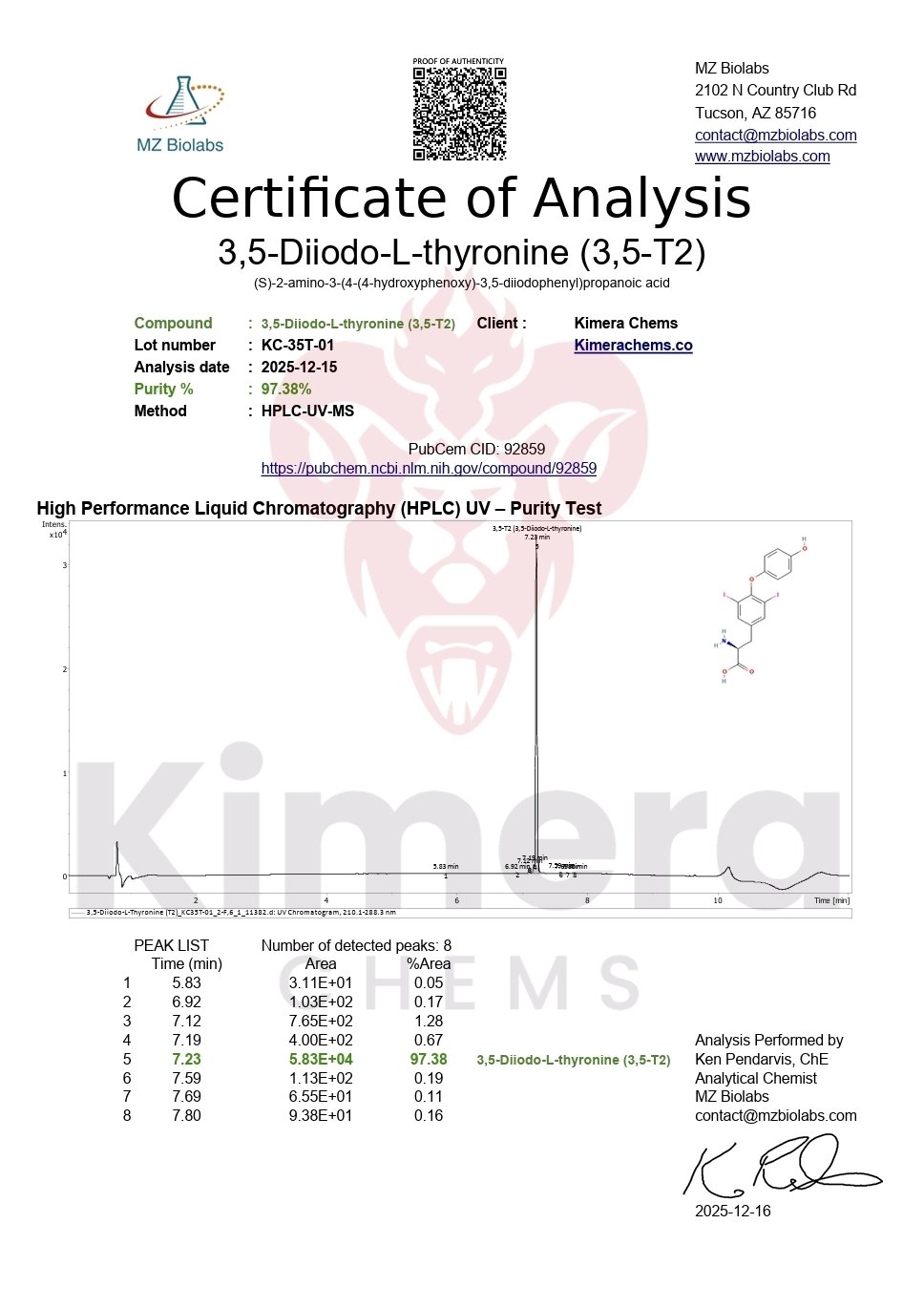


3,5-Diiodo-L-thyronine (T2)


$41.99
Kimerachems 3-5-Diiodo-L-thyronine (T2) for sale. Intended for controlled laboratory and analytical research only.
Review available formats, product specifications and batch documentation before ordering. Not for human consumption.
1000 in stock
Kimerachems 3-5-Diiodo-L-thyronine (T2) for sale. This material is supplied exclusively for controlled laboratory and analytical research. Review available formats, technical specifications and batch documentation before ordering. Not for human consumption.
3,5-Diiodo-L-thyronine (T2) Research Standard
3,5-Diiodo-L-thyronine (T2) is an endogenous metabolite of thyroid hormones. While historically considered a degradation product of triiodothyronine (T3), it is now recognized in laboratory research as a biologically active iodothyronine that exerts distinct, rapid metabolic effects. Unlike the classical genomic actions of T3/T4, T2 is primarily investigated for its non-genomic interactions, particularly its direct influence on mitochondrial bioenergetics, oxidative phosphorylation, and lipid metabolism. It serves as a specialized tool for researchers studying the modulation of energy balance and metabolic rate at the mitochondrial level.
Technical Specifications
| Property | Specification |
| Product Name | 3,5-Diiodo-L-thyronine (3,5-T2) |
| CAS Number | 1041-01-6 |
| Chemical Formula | C15H13I2NO4 |
| Molecular Weight | 525.08 g/mol |
| Chemical Class | Iodothyronine / Thyroid Hormone Metabolite |
| Physical Appearance | White to off-white powder |
| Assay Purity | >= 98% (HPLC verified) |
Mechanism of Action & Research Context
T2 is researched for its unique ability to modulate cellular energy expenditure, often independent of nuclear thyroid hormone receptors.
-
Mitochondrial Interaction: Research indicates that T2 interacts directly with the cytochrome c oxidase (COX) complex within the mitochondria. By binding to subunit Va of the COX complex, T2 can abolish the allosteric inhibition of respiration normally induced by ATP, thereby stimulating oxygen consumption.
-
Thermogenesis & Metabolism: T2 is studied for its role in stimulating fatty acid oxidation and mitochondrial uncoupling in skeletal muscle and liver tissues. This makes it a frequent subject in obesity and hepatic steatosis models, where researchers investigate its potential to enhance metabolic rate and lipid catabolism.
-
Non-Genomic Signaling: Unlike T3, T2 effects are often observed rapidly (within hours), suggesting non-genomic pathways that do not rely on protein synthesis, distinguishing it from the classical thyroid hormone receptor (TR) pathway.
Research Applications
T2 is a critical reagent for endocrine and metabolic research.
Primary fields of in vitro and laboratory investigation include:
-
Mitochondrial Bioenergetics: Utilizing isolated mitochondria or cell-line models to measure the effect of T2 on COX activity and oxidative phosphorylation rates.
-
Lipid Metabolism Research: Evaluating the inhibitory effects of T2 on de novo lipogenesis and its role in enhancing fatty acid beta-oxidation.
-
Comparative Pharmacology: Benchmarking T2 against T3 to differentiate between genomic (nuclear-mediated) and non-genomic (mitochondrial-mediated) thyroid hormone responses.
-
Metabolic Syndrome Models: Using cell-based models of insulin resistance or hepatic steatosis to explore the therapeutic potential of T2 in modulating energy balance.
Storage & Handling Guidelines
To maintain the chemical stability and experimental reliability of the compound:
-
Storage Environment: Maintain at -20°C for long-term stability.
-
Environmental Control: The compound should be kept in a dry, cool environment. Protect strictly from light, as iodinated compounds can be sensitive to photo-degradation.
-
Handling: Utilize standard laboratory safety practices. Allow the container to reach room temperature before opening to prevent moisture accumulation (condensation) inside the vial.
-
Aseptic Technique: Use sterile, dry equipment to prevent contamination, especially when working with biological assays.
Research Use Disclaimer
Research Use Only Disclaimer: This product is developed and distributed strictly as a Research Use Only (RUO) laboratory reference chemical intended exclusively for non-clinical analytical and scientific investigation. It is not an FDA-approved drug, medical treatment, dietary supplement, or food ingredient, and is strictly prohibited for human or animal consumption. Kimera Chems supplies this high-purity research material solely to qualified institutions and professional investigators for authorized laboratory research.
| CAS Number | 1041-01-6 |
| Other Names | -(4-Hydroxyphenyl)-3,5-diiodo-L-tyrosine; 3-[4-(p-Hydroxyphenoxy)-3,5-diiodophenyl]-L-alanine; L-T2 |
| IUPAC Name | 2-amino-3-[4-(4-hydroxyphenoxy)-3,5-diiodophenyl]propanoic acid |
| Molecular Formula | C15H13I2NO4 |
| Molecular Weight | 525.08 |
Product FAQs
What is 3,5-Diiodo-L-thyronine (T2) supplied for?
This material is supplied strictly for controlled, non-clinical laboratory and analytical research. It is not intended for human or animal consumption.
Which formats are available for 3,5-Diiodo-L-thyronine (T2)?
Available formats or options are shown in the product selector above. Current availability can change.
Where can I review product documentation?
Where available, batch documentation can be reviewed in the Certificate of Analysis library before ordering.
Research Documentation Guides
Review these supporting analytical guides before evaluating this material for a controlled research protocol:
Related products
Analytical Reagents


Analytical Reagents


Analytical Reagents


Analytical Reagents

Analytical Reagents

Analytical Reagents


Analytical Reagents


Analytical Reagents