


GC-1 Sobetirome

$79.99
Kimerachems GC-1 Sobetirome for sale. Intended for controlled laboratory and analytical research only.
Review available formats, product specifications and batch documentation before ordering. Not for human consumption.
1000 in stock
Kimerachems GC-1 Sobetirome for sale. This material is supplied exclusively for controlled laboratory and analytical research. Review available formats, technical specifications and batch documentation before ordering. Not for human consumption.
GC-1 (Sobetirome)
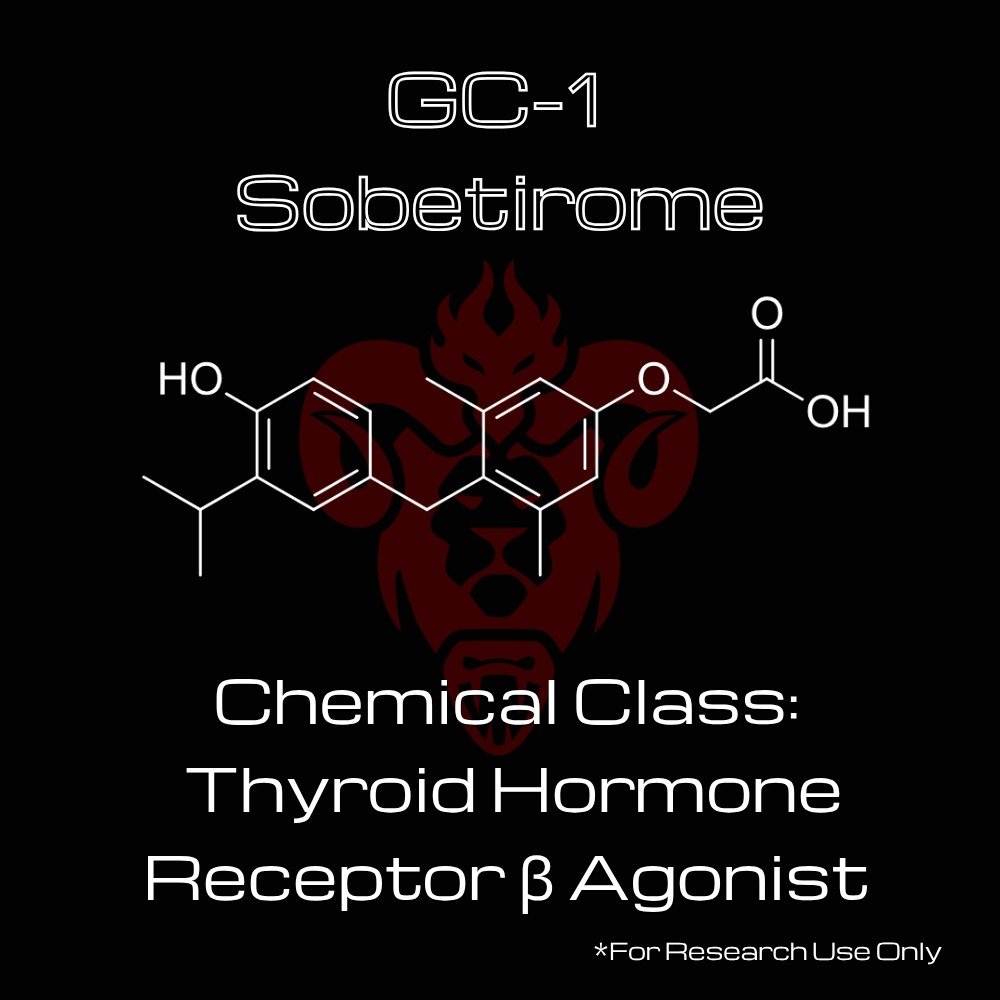
GC-1 (Sobetirome) is a highly selective, non-iodinated thyromimetic agent designed as a small-molecule agonist of the thyroid hormone receptor beta (TRβ) isoform. By demonstrating high selectivity for TRβ over TRα, GC-1 is extensively studied as a tool compound for investigating the uncoupling of beneficial metabolic pathways—such as cholesterol regulation and lipid catabolism—from the traditional thyrotoxic side effects typically induced by systemic thyroid hormone receptor activation in cardiac and skeletal tissues.
Structural Attributes to Note: The chemical structure consists of a diarylmethane scaffold with a substituted phenoxyacetic acid side chain. This arrangement allows for deep, selective binding within the ligand-binding pocket of the TRβ isoform. Unlike native thyroid hormones (T3/T4), GC-1 lacks iodine atoms, which alters its metabolic profile and receptor affinity, making it an essential reference ligand for mapping the transcriptional pathways associated with hepatic lipid homeostasis.
Technical Specifications
| Property | Specification |
| Product Name | GC-1 (Sobetirome) |
| CAS Number | 211110-63-3 |
| IUPAC Name | 2-[4-[(4-hydroxy-3-propan-2-ylphenyl)methyl]-3,5-dimethylphenoxy]acetic acid |
| Synonyms | Sobetirome, QRX-431 |
| Molecular Formula | $C_{20}H_{24}O_4$ |
| Molecular Weight | 328.40 g/mol |
| Chemical Class | Selective Thyromimetic / Diarylmethane Derivative |
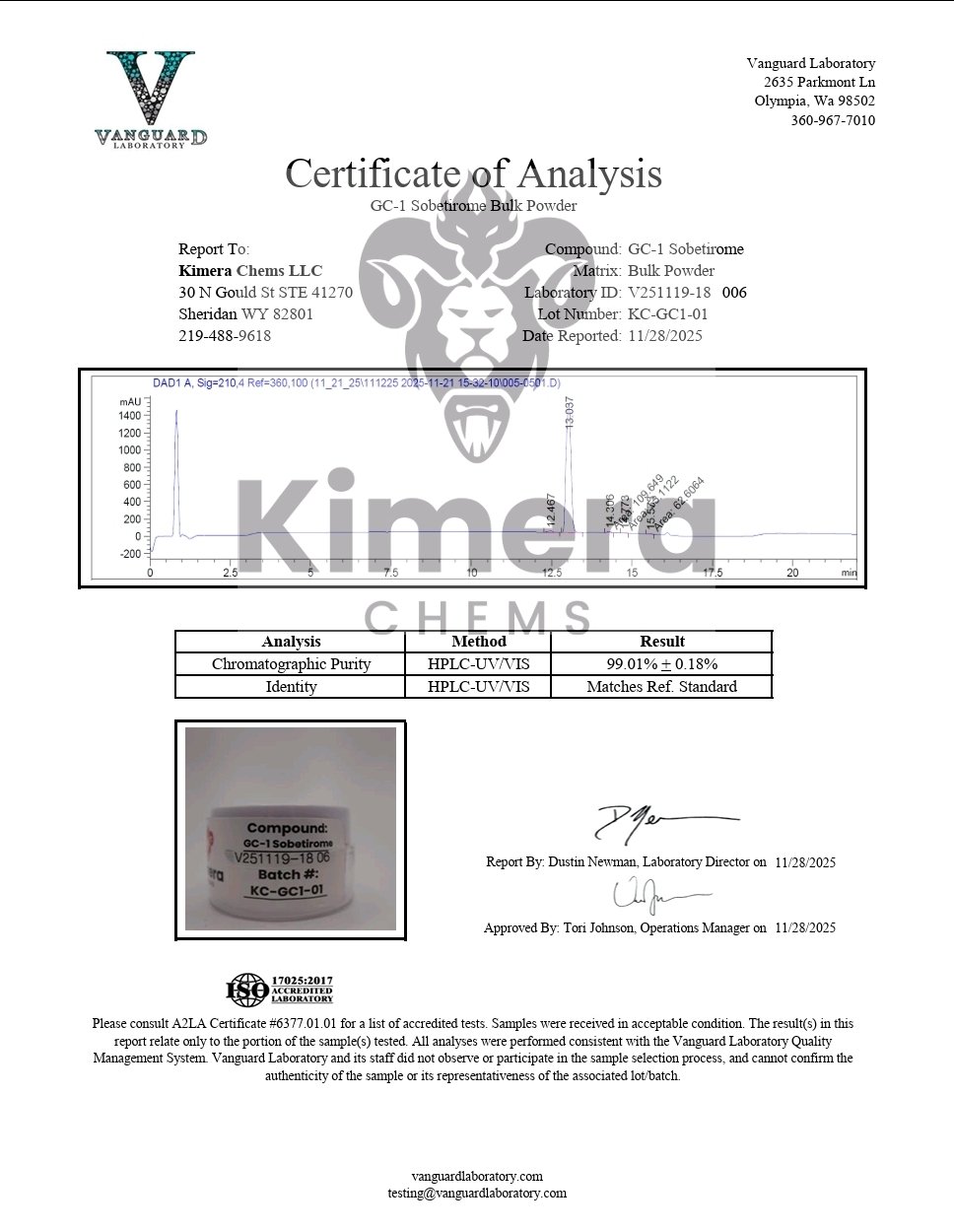
| Assay Purity | $ge$98.0% (HPLC-UV verified) |
| Physical Appearance | White to off-white crystalline solid |
Research Applications & Mechanism of Interest
The utility of GC-1 within metabolic and endocrinological research focuses on its ability to mimic specific thyroid hormone functions while avoiding systemic hyperthyroid-like cascades.
Primary fields of in vitro and preclinical laboratory investigation include:
-
TRβ Selective Signaling: Mapping the transcriptional pathways recruited upon selective binding to TRβ1. Researchers utilize GC-1 to isolate hepatic metabolic responses from those modulated by the alpha-isoform (TRα1), which is predominantly expressed in the heart and skeletal muscle.
-
Lipid & Cholesterol Homeostasis: Evaluating the upregulation of genes involved in bile acid synthesis, cholesterol efflux (e.g., SR-B1), and triglyceride catabolism within hepatic cell models.
-
Metabolic Energy Expenditure: Investigating the compound’s capacity to stimulate localized energy expenditure and mitochondrial respiration pathways in diet-induced obesity models without increasing heart rate or systemic oxygen consumption.
-
Regenerative Signaling: Studying the role of TRβ-mediated Wnt/β-catenin signaling in promoting hepatocyte regeneration and proliferation in chronic liver damage models.
Storage & Handling Guidelines
To maintain complete molecular integrity and guarantee reproducible experimental results across multi-batch studies:
-
Thermal Logistics: For permanent archiving, store the solid reference powder in a deeply frozen environment at -20°C. For routine laboratory access, the compound may be held at 4°C, provided it remains isolated from environmental moisture.
-
Atmospheric Protection: Keep containment vessels hermetically sealed to prevent localized oxidation of the phenolic hydroxyl groups and to maintain the physical integrity of the crystalline matrix.
-
Photolytic Barriers: The diarylmethane core can be sensitive to prolonged exposure to high-intensity light arrays. Protect reference material by using original opaque containers or high-grade amber laboratory vials.
-
Analytical Quality Standards: Every batch is verified through a rigorous dual-method validation protocol, combining High-Performance Liquid Chromatography (HPLC) and Mass Spectrometry (MS) to independently audit chemical identity, stereochemical consistency, and an absolute purity baseline of $ge$98.0% before distribution.
Research Use Only Disclaimer: This product is developed, synthesized, and distributed strictly as a Research Use Only (RUO) laboratory reference chemical intended exclusively for non-clinical analytical and scientific investigation. It is not an FDA-approved drug formulation, active pharmaceutical ingredient, or dietary supplement, and is strictly prohibited for human or veterinary consumption. Kimera Chems provides these high-purity chemical batches solely to accredited institutional laboratories and qualified scientific investigators.
| CAS Number | 211110-63-3 |
| Other Names | GC 1 compound | GC-1 | QRX-431 |
| IUPAC Name | 2-[4-[[4-hydroxy-3-(1-methylethyl)phenyl]methyl]-3,5-dimethylphenoxy]-acetic acid |
| Molecular Formula | C20H24O4 |
| Molecular Weight | 328.4 |
| Liquid Concentration And Solution | 200mcg/ml (PEG-400, DMSO) |
| Aliquot Concentration And Solution | NA |
Product FAQs
What is GC-1 Sobetirome supplied for?
This material is supplied strictly for controlled, non-clinical laboratory and analytical research. It is not intended for human or animal consumption.
Which formats are available for GC-1 Sobetirome?
Available formats or options are shown in the product selector above. Current availability can change.
Where can I review product documentation?
Where available, batch documentation can be reviewed in the Certificate of Analysis library before ordering.
Research Documentation Guides
Review these supporting analytical guides before evaluating this material for a controlled research protocol:
Related products


Analytical Reagents
Analytical Reagents
Analytical Reagents

Analytical Reagents


Analytical Reagents


Analytical Reagents


Analytical Reagents


Analytical Reagents