

Chlodantane


Price range: $51.99 through $71.99
Kimerachems Chlodantane for sale. Intended for controlled laboratory and analytical research only.
Review available formats, product specifications and batch documentation before ordering. Not for human consumption.
Kimerachems Chlodantane for sale. This material is supplied exclusively for controlled laboratory and analytical research. Review available formats, technical specifications and batch documentation before ordering. Not for human consumption.
Chlodantane
Chlodantane (investigational code name ADK-910 or Chlodantan) is a synthetic adamantane derivative classified in chemical literature as an actoprotector and synthetic adaptogen. Closely related to bromantane, Chlodantane features a highly rigid, three-dimensional lipophilic cage core linked directly to a halogenated aromatic ring via a stable amide bond. Within preclinical chemical and cell-free environments, this compound serves as an essential benchmark molecule for exploring steric hindrance kinetics, nucleophilic displacement pathways, and the structure-activity relationships (SAR) of benzoylaminoadamantane scaffolds.
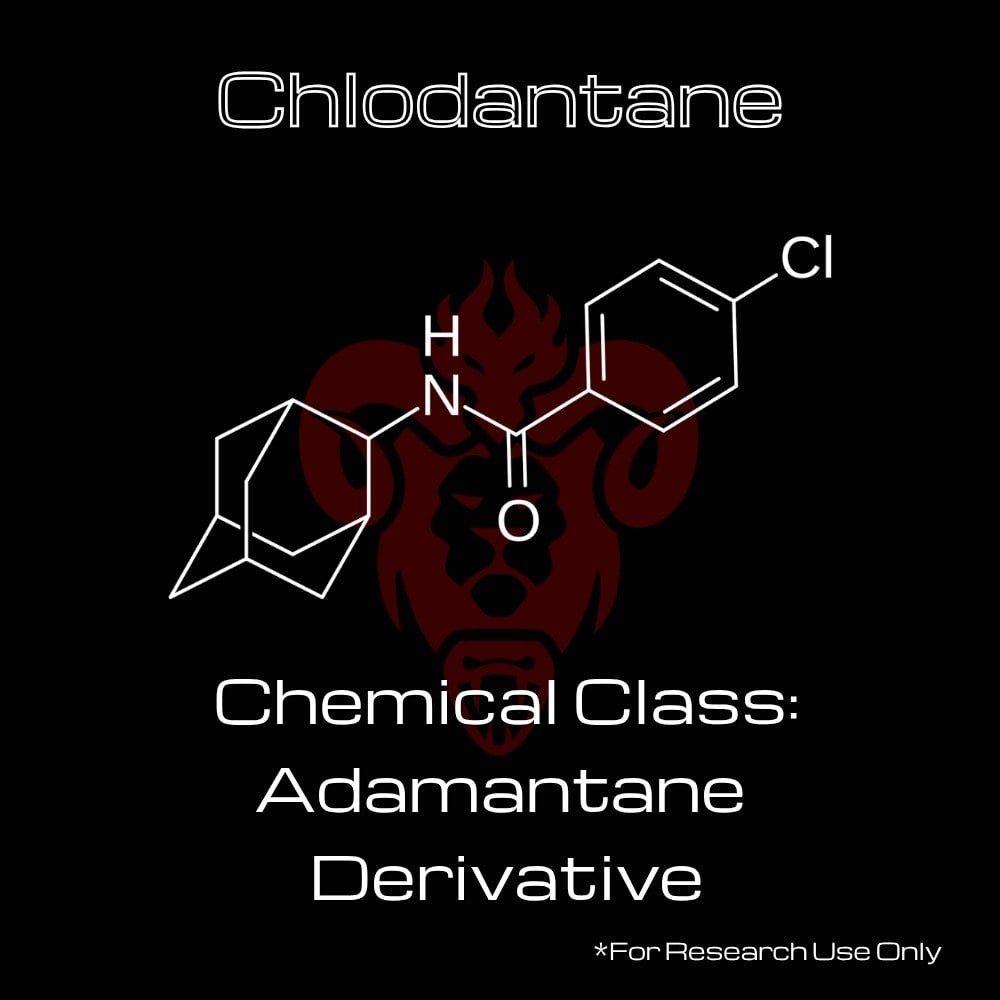
Structural Nuances to Observe: The structural diagram above highlights the distinct spatial orientation of Chlodantane. On the left sits the symmetric, lipophilic adamantyl cage, which introduces massive steric bulk to the molecular environment. This core is coupled via a central amide bridge to a para-substituted chlorobenzene ring on the right. The chlorine atom serves as an electron-withdrawing center, creating a localized polar footprint that researchers leverage to analyze nucleophilic reactivity and bond-cleavage rates compared to brominated analogues.
Technical Specifications
| Property | Specification |
| Product Name | Chlodantane (ADK-910) |
| CAS Number | 185384-80-9 |
| IUPAC Name | N-(2-adamantyl)-4-chlorobenzamide |
| Molecular Formula | C₁₇H₂₀ClNO |
| Molecular Weight | 289.80 g/mol |
| Chemical Class | Benzoylaminoadamantane / Actoprotector derivative |
| Assay Purity | ≥98% (HPLC & CHN verified) |
Research Applications & Chemical Dynamics
In advanced laboratory testing, Chlodantane provides an exceptional framework for examining how bulky polycyclic rings impact adjacent functional groups. Its chemical reactivity is heavily studied under variable thermodynamic profiles.
Primary fields of investigative laboratory research include:
-
Amide Bond Hydrolysis Kinetics: Measuring the precise rate of amide linkage cleavage in the presence of strong acid or base catalysts. Investigators exploit the adjacent adamantyl structure to calculate how localized steric shielding alters activation energy parameters.
-
Nucleophilic Halogen Substitution: Tracking displacement parameters where the para-positioned chlorine atom on the aromatic ring serves as a target site for nucleophilic exchange under controlled, cell-free laboratory settings.
-
Comparative Actoprotector Profiling: Benchmarking Chlodantane against legacy mono-substituent adamantanes to chart relative stability, anti-radical properties, and membrane-stabilization thresholds across lipophilic liquid matrices.
-
Analytical Detection Calibration: Deploying the compound as a high-purity reference standard to calibrate liquid chromatography (HPLC-UV) and gas chromatography-mass spectrometry (GC-MS) screening panels for synthetic adaptogen matrices.
Storage & Handling Guidelines
To maintain exact chemical uniformity and preserve the compound against structural degradation or moisture-driven clumping:
-
Thermal Regulation: Store the reference material in a cool, dry location (refrigerated at 2–8°C or frozen at -20°C for multi-year baseline preservation).
-
Desiccant Integrity: Because polycyclic powders can attract trace atmospheric moisture, keep the container tightly sealed with an active desiccant matrix.
-
Photolytic Protections: Shield completely from direct light arrays and ultraviolet (UV) radiation by maintaining the compound inside opaque or high-grade amber laboratory containment vessels.
-
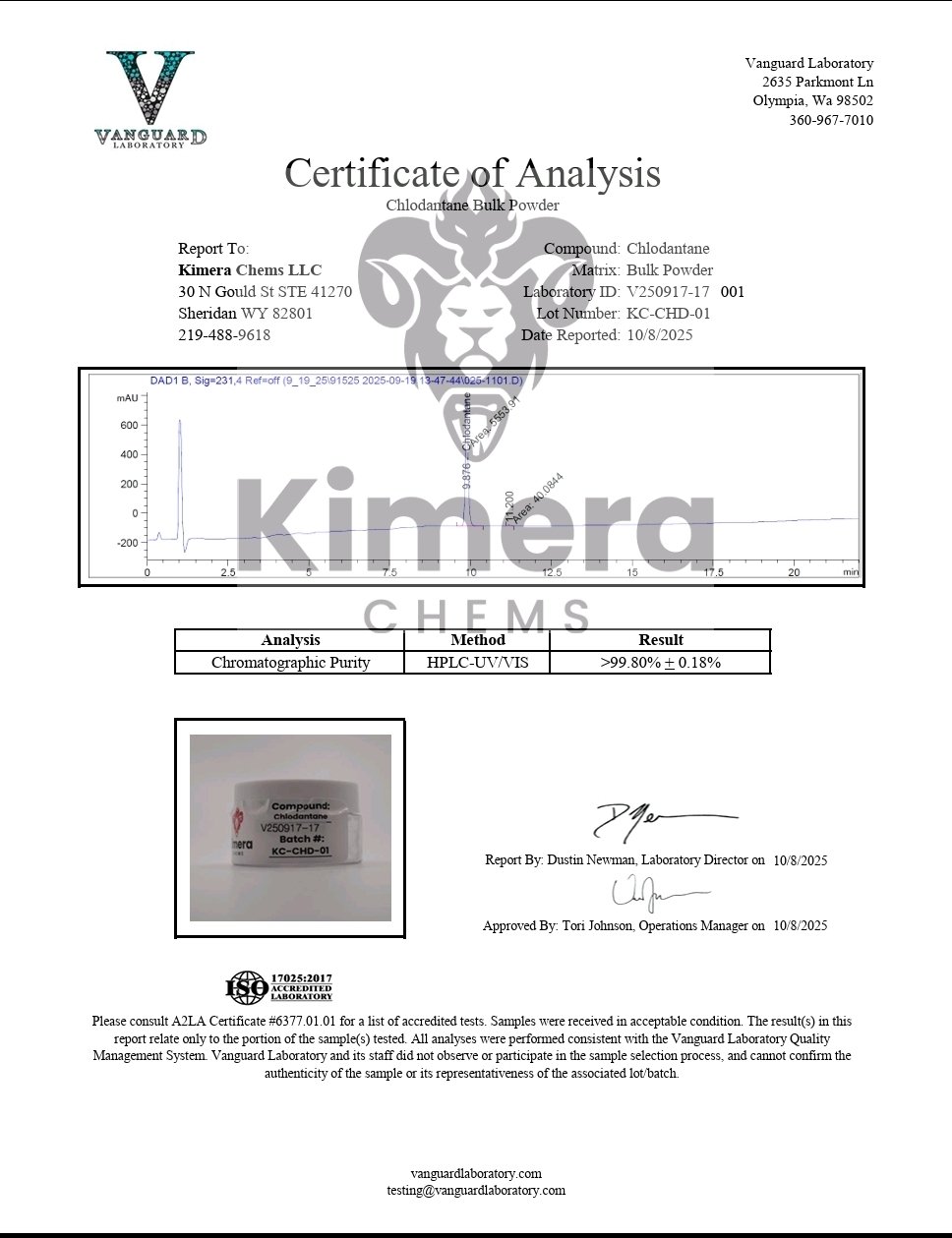
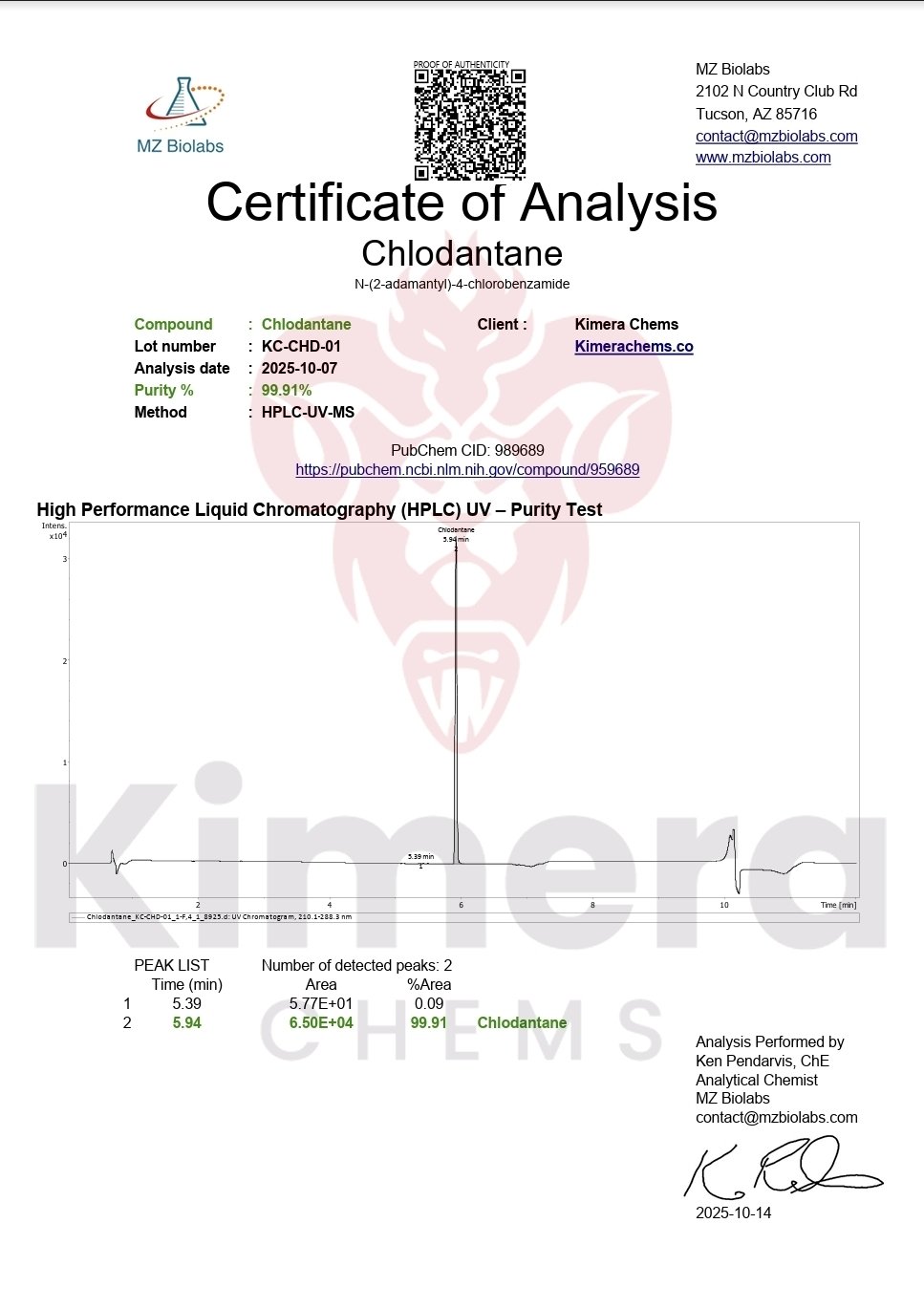
Analytical Quality Control: Kimera Chems implements a rigorous multi-laboratory verification protocol, auditing every batch through independent third-party analysis to confirm identity, compound homogeneity, and an absolute purity threshold of ≥98%.
Research Use Only Disclaimer: This product is distributed, manufactured, and sold strictly as a Research Use Only (RUO) laboratory reference chemical. It is not an FDA-approved drug, licensed medication, active pharmaceutical ingredient, or dietary supplement, and is strictly prohibited for human or veterinary use. Kimera Chems provides these reference standards exclusively to accredited institutional laboratories and certified scientific investigators for in vitro analytical research.
Frequently Asked Research Questions
How does Chlodantane’s chemical bridge differ from Bromantane?
While Bromantane features a direct amine ($NH$) link bridging the adamantyl cage to a bromophenyl ring, Chlodantane integrates a full amide ($NH-C=O$) carbonyl link bonded to a chlorophenyl ring. This alteration changes the molecular weight, shifts the electron distribution across the aromatic ring, and provides a distinct layout for steric hindrance evaluations.
What are the solubility characteristics of Chlodantane in laboratory assays?
Due to the dominant lipophilicity of the nonpolar adamantane cage structure, Chlodantane displays very poor solubility in purely aqueous systems. For effective cell-free assays or liquid chromatography calibration, the material must be fully dissolved in organic solvents such as dimethyl sulfoxide (DMSO) or ethanol before introduction into working laboratory buffers.
Scientific References
-
Morozov, I. S., Ivanova, I. A., & Lukicheva, T. A. (2001). “Actoprotector and Adaptogen Properties of Adamantane Derivatives (A Review).” Pharmaceutical Chemistry Journal, 35(5), 235–238. DOI: 10.1023/A:1011905302667.
-
Oliynyk, S., & Oh, S. (2012). “The pharmacology of actoprotectors: practical application for improvement of mental and physical performance.” Biomolecules & Therapeutics, 20(5), 446–456. DOI: 10.4062/biomolther.2012.20.5.446.
| CAS Number | 185384-80-9 |
| Other Names | ADK-910; Chlodantan |
| IUPAC Name | N-(2-Adamantyl)-N-(para-chlorobenzoyl)amine; 2-(para-Chlorobenzoylamino)adamantane |
| Molecular Formula | C17H20ClNO |
| Molecular Weight | 289.80 |
| Liquid Concentration And Solution | N/A |
| Aliquot Concentration And Solution | N/A |
Product FAQs
What is Chlodantane supplied for?
This material is supplied strictly for controlled, non-clinical laboratory and analytical research. It is not intended for human or animal consumption.
Which formats are available for Chlodantane?
The current listing shows these options: 5-grams-powder, dry-fill-capsule-50mg-60ct-3g. Availability can change, so confirm the selector above before ordering.
Where can I review product documentation?
Where available, batch documentation can be reviewed in the Certificate of Analysis library before ordering.
Research Documentation Guides
Review these supporting analytical guides before evaluating this material for a controlled research protocol:
Related products

Peptides
Peptides


Nootropics


Analytical Reagents

Nootropics
Peptides


Analytical Reagents

Peptides