


ODY (FCS)

$46.99
Kimerachems ODY (FCS) for sale. Intended for controlled laboratory and analytical research only.
Review available formats, product specifications and batch documentation before ordering. Not for human consumption.
1000 in stock
Kimerachems ODY (FCS) for sale. This material is supplied exclusively for controlled laboratory and analytical research. Review available formats, technical specifications and batch documentation before ordering. Not for human consumption.
ODY (FCS) – Bioenergetic & Neurotransmitter Research Formulation
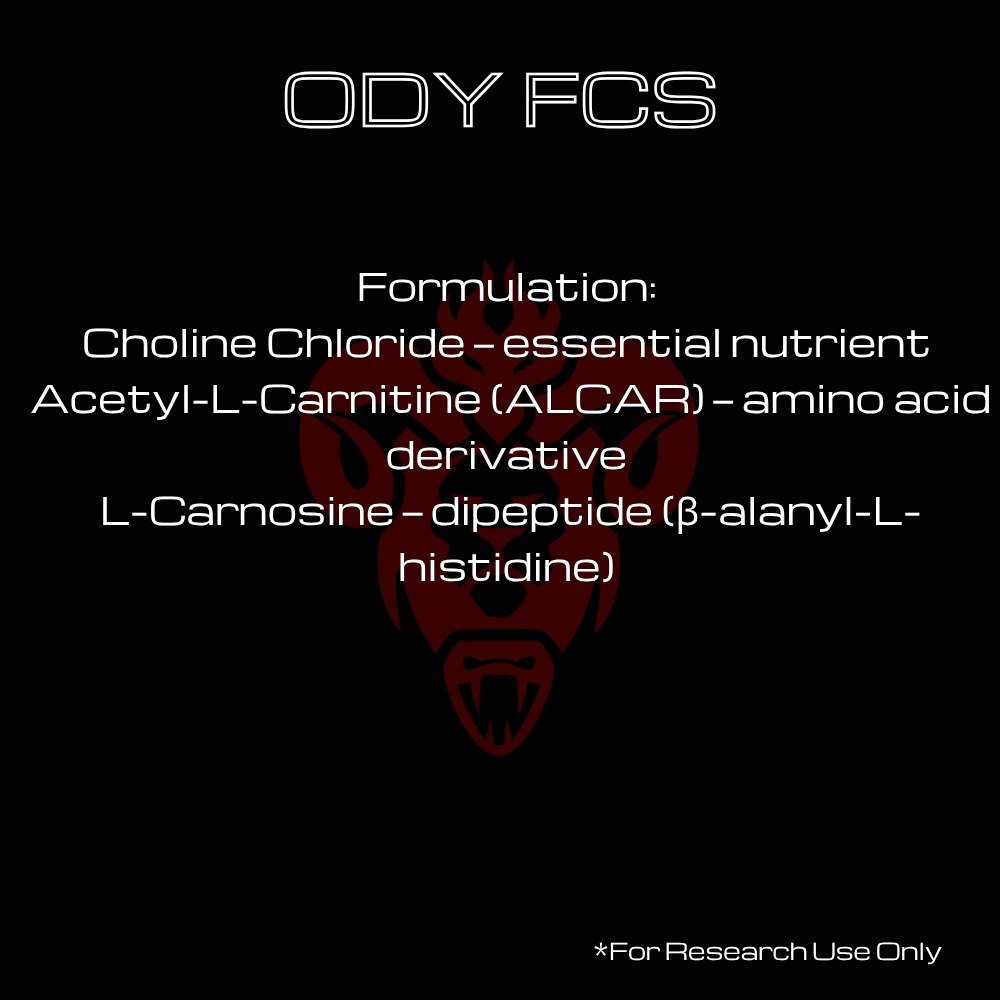
ODY (FCS) is a synergistic, compounded reagent solution designed to facilitate the simultaneous investigation of multiple biochemical pathways, including acetylcholine synthesis, mitochondrial fatty acid transport, and oxidative defense mechanisms. By integrating Choline Chloride, Acetyl L-Carnitine (ALCAR), and L-Carnosine into a single, sterile-ready formulation, this reagent provides researchers with a platform to study multi-variable bioenergetic interactions within isolated cellular models. It is utilized primarily for high-precision analytical research into cellular resilience, metabolic waste management, and neurochemical signaling.
Technical Specifications
| Component | Chemical Formula | Research Role |
| Choline Chloride | C₅H₁₄ClNO | Acetylcholine precursor |
| Acetyl L-Carnitine (ALCAR) | C₉H₁₇NO₄ | Mitochondrial fatty acid transport |
| L-Carnosine | C₉H₁₄N₄O₃ | Antioxidant & anti-glycation agent |
-
Format: 20 mL ready-to-use liquid vials
-
Physical Appearance: Clear, stable aqueous solution
-
Purity: High-grade analytical components
Mechanism of Action & Research Context
ODY (FCS) is formulated to allow researchers to observe the interplay between these three distinct bioactive pathways:
-
Acetylcholine Signaling (Choline Chloride): Acts as a primary building block for acetylcholine synthesis. In research models, this is used to track signal transduction velocity between nerve cells in relation to substrate availability.
-
Mitochondrial Bioenergetics (ALCAR): Facilitates the transport of long-chain fatty acids into the mitochondrial matrix for $beta$-oxidation. This is studied as a mechanism to observe energy production efficiency in cells under metabolic stress.
-
Redox & Glycation Defense (L-Carnosine): Functions as an intracellular buffer against reactive oxygen species (ROS) and metabolic waste products. It is investigated for its potential to inhibit protein glycation and shield cellular structures from oxidative degradation.
Research Applications
ODY (FCS) serves as a specialized reagent for multi-variable testing in controlled in vitro environments.
Primary fields of in vitro laboratory investigation include:
-
Acetylcholine Pathway Mapping: Investigating the correlation between exogenous choline supply and neurotransmitter synthesis rates.
-
Mitochondrial Stress Modeling: Measuring energy-related activity and ATP output in cell cultures subjected to induced high-glucose or metabolic stress conditions.
-
Oxidative Buffer Research: Quantifying the protective efficacy of L-Carnosine against cellular metabolic byproducts and “rust” (oxidative damage) in aging models.
-
Cellular Metabolic Synergy: Observing how these components collectively impact cellular vitality in standardized research models.
Storage & Handling Guidelines
To maintain the chemical stability and experimental reliability of the formulation:
-
Temperature Stability: Store at controlled room temperature. Do not freeze, as low temperatures may induce crystallization of the amino acid components and compromise concentration accuracy.
-
Sterility: Each vial contains a high-grade rubber stopper. Utilize a fresh alcohol swab to disinfect the stopper before every draw to maintain the integrity of the remaining solution.
-
Photostability: The formulation should be kept in amber glass or opaque storage to protect the molecular bonds of ALCAR from light-induced degradation.
-
Atmospheric Integrity: Keep the safety seal covered or protected when the vial is not in active use, as prolonged exposure to air can alter liquid stability.
References
-
Kennedy DO. (2016) B Vitamins and the Brain: Mechanisms, Dose and Efficacy. Nutrients. 8(2):68.
-
Pettegrew JW, et al. (2000) Acetyl-L-carnitine physical-chemical, metabolic, and therapeutic properties: relevance for its mode of action in Alzheimer’s disease and geriatric depression. Molecular Psychiatry. 5(6):616–632.
-
Boldyrev AA, et al. (2013) Physiology and pathophysiology of carnosine. Physiological Reviews. 93(4):1803–1845.
Research Use Disclaimer
Research Use Only Disclaimer: This product is developed and distributed strictly as a Research Use Only (RUO) laboratory reference chemical intended exclusively for non-clinical analytical and scientific investigation. It is not an FDA-approved drug, medical treatment, dietary supplement, or food ingredient, and is strictly prohibited for human or animal consumption. Kimera Chems supplies this high-purity research material solely to qualified institutions and professional investigators for authorized laboratory research.
No product specifications available.
Product FAQs
What is ODY (FCS) supplied for?
This material is supplied strictly for controlled, non-clinical laboratory and analytical research. It is not intended for human or animal consumption.
Which formats are available for ODY (FCS)?
Available formats or options are shown in the product selector above. Current availability can change.
Where can I review product documentation?
Where available, batch documentation can be reviewed in the Certificate of Analysis library before ordering.
Research Documentation Guides
Review these supporting analytical guides before evaluating this material for a controlled research protocol:
Related products


Peptides


Aminos

Analytical Reagents

Peptides

Aminos

Nootropics


Nootropics


Analytical Reagents