


CL-316243

$121.99
Kimerachems CL-316243 for sale. Intended for controlled laboratory and analytical research only.
Review available formats, product specifications and batch documentation before ordering. Not for human consumption.
1000 in stock
Kimerachems CL-316243 for sale. This material is supplied exclusively for controlled laboratory and analytical research. Review available formats, technical specifications and batch documentation before ordering. Not for human consumption.
CL-316243 Article
CL-316243
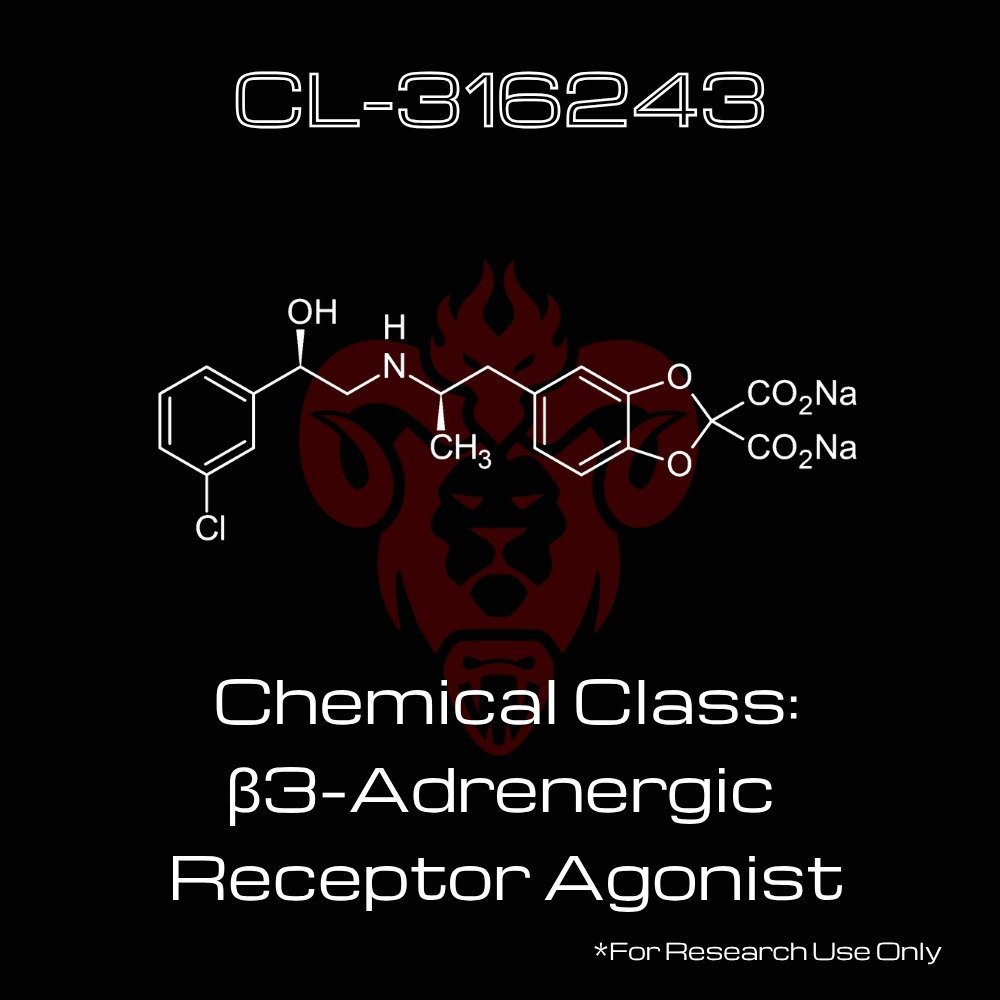
CL-316243 is a highly potent, synthetic small molecule recognized as one of the most selective β₃-adrenoceptor agonists available in modern pharmacology. By operating as a high-affinity target ligand, it serves as the universal gold-standard benchmark for isolating and studying β₃-mediated physiological effects.
The primary value of CL-316243 lies in its extreme selectivity profile—exhibiting over a 10,000-fold preference for the β₃ subtype over traditional β₁ and β₂ receptors. This virtually eliminates the confounding cardiotonic and smooth-muscle variables typically triggered by broad-spectrum adrenergic agonists, allowing investigators to study localized adipose tissue metabolism and bladder dynamics with clinical-grade precision.
Structural Elements to Observe: When analyzing the skeletal structure above, researchers should note the precise dual-chiral configuration (specifically the (R,R) diastereomer) that dictates its extreme binding selectivity. On the left sits the meta-chlorophenyl ring, which features a critical chlorine substituent that coordinates deep within the active binding pocket of the β₃ receptor. This aromatic system is joined via an ethanolamine linkage to a central methyl-substituted amine bridge. On the far right, the molecule features a unique benzodioxole ring capped with a dicarboxylate disodium core (CO₂Na), a bulky, highly polar configuration that prevents steric and electrostatic cross-reactivity with β₁ and β₂ receptor subtypes.
Technical Specifications
| Property | Specification |
| Product Name | CL-316243 (Disodium Salt) |
| CAS Number | 138908-40-4 |
| IUPAC Name | disodium;5-[(2R)-2-[[(2R)-2-(3-chlorophenyl)-2-hydroxyethyl]amino]propyl]-1,3-benzodioxole-2,2-dicarboxylate |
| Molecular Formula | C₂₀H₁₈ClNNa₂O₇ |
| Molecular Weight | 465.80 g/mol |
| Chemical Class | Arylethanolamine / Selective β₃-Adrenoceptor Agonist |
| Assay Purity | ≥98% (HPLC-UV & MS verified) |
| Solubility Profile | Soluble in water (~100 mM) and PBS (pH 7.2) |
Research Applications & Mechanism of Interest
In biological models, CL-316243 binds selectively to the β₃-adrenergic G-protein coupled receptor (GPCR). This binding stimulates adenylyl cyclase activity, triggering a cascade that elevates intracellular cyclic adenosine monophosphate (cAMP) levels.
Primary fields of preclinical and in vitro laboratory investigation include:
-
Mitochondrial Uncoupling & UCP1 Regulation: Researchers utilize the compound in brown adipocyte (fat cell) cultures to track the upregulation of Uncoupling Protein 1 (UCP1) within the inner mitochondrial membrane. This pathway is heavily studied to map how uncoupling the proton gradient dissipates energy directly as heat rather than storing it as ATP.
-
Adipose Lipolysis Kinetics: Deploying the agent in isolated white and brown adipocyte assays to measure the rates of cAMP-dependent lipolysis (the metabolic breakdown of stored triacylglycerols into free fatty acids and glycerol).
-
Glucose Homeostasis & Insulin Sensitivity: Investigating cellular glucose uptake mechanisms. Preclinical rodent models indicate that selective β₃ activation can significantly alter systemic glucose handling and lower circulating insulin concentrations, serving as a vital baseline model for type 2 diabetes and metabolic syndrome research.
-
Detrusor Muscle Relaxation: Evaluated within urological tissue models to study the role of the β₃ receptor in bladder compliance, detrusor muscle relaxation, and the mitigation of hyperreflexia (overactive bladder).
-
Receptor Subtype Profiling: Serving as a crucial, highly selective control ligand to map the comparative binding affinities of novel, uncharacterized sympathomimetic compounds across adrenergic receptor families.
Storage & Handling Guidelines
To preserve the delicate chiral centers of the arylethanolamine structure and protect the compound from humidity-induced salt degradation:
-
Thermal Regulation: Store the dry, solid reference material in a deeply frozen environment maintained at -20°C or below.
-
Desiccation Standards: CL-316243 disodium salt is hygroscopic (prone to absorbing moisture from the air). Keep the container tightly sealed in a desiccator directly after each use to protect the material from ambient humidity and structural clumping.
-
Solvent Reconstitution: Reconstitute using sterile, molecular-grade water, PBS (pH 7.2), or DMSO. Stock solutions should be aliquoted and frozen to avoid repeated freeze-thaw cycles, which can mechanically degrade the compound’s structure.
-
Photolytic Barriers: Shield the compound from direct sunlight and ultraviolet (UV) radiation by maintaining storage within opaque or high-grade amber laboratory containment vessels.
-
Analytical Auditing: Kimera Chems implements a strict dual-method verification protocol combining High-Performance Liquid Chromatography (HPLC) and CHN elemental analysis to independently audit the mass and purity of chemical products.
Research Use Only Disclaimer: This product is engineered, synthesized, and distributed strictly as a Research Use Only (RUO) laboratory reference chemical. It is not an FDA-approved drug, licensed medication, active pharmaceutical ingredient, or dietary supplement, and is strictly prohibited for human or veterinary consumption. Kimera Chems supplies these materials exclusively to accredited academic institutions, professional research laboratories, and certified investigators for in vitro and analytical applications.
Frequently Asked Research Questions
Why does CL-316,243 behave differently in rodent assays versus human tissue models?
The tissue distribution and molecular structure of the β₃-adrenoceptor differ significantly between species. While β₃ receptors are abundant and functionally dominant in rodent adipose tissues, they are far more sparse in adult humans, where β₁ and β₂ subtypes predominate. Consequently, while CL-316243 is highly effective for studying rodent thermogenesis, translating these exact receptor kinetics to human cellular models requires careful cross-species calibration.
What is the significance of the disodium salt form over the free acid?
The disodium salt formulation of CL-316243 dramatically increases its hydrophilic properties, making it freely soluble in aqueous buffers like PBS or pure laboratory-grade water. This eliminates the need for aggressive organic solvents (such as high concentrations of DMSO) which can be toxic to delicate cell cultures during in vitro lipolysis assays.
Scientific References
-
Bloom, J. D., Dutia, M. D., Johnson, B. D., et al. (1992). “Disodium (R,R)-5-[2-[[2-(3-chlorophenyl)-2-hydroxyethyl]-amino] propyl]-1,3-benzodioxole-2,2-dicarboxylate (CL 316,243). A potent beta-adrenergic agonist virtually specific for beta 3 receptors.” Journal of Medicinal Chemistry, 35(16), 3081–3084. DOI: 10.1021/jm00094a019.
-
Yoshida, T., et al. (1994). “Anti-obesity and anti-diabetic effects of CL 316,243, a highly specific beta 3-adrenoceptor agonist, in yellow KK mice.” Life Sciences, 54(7), 491-498. DOI: 10.1016/0024-3205(94)00824-6.
-
Woods, M., et al. (2001). “Efficacy of the beta3-adrenergic receptor agonist CL-316243 on experimental bladder hyperflexia and detrusor instability in the rat.” The Journal of Urology, 166(3), 1142–1147. DOI: 10.1016/S0022-5347(05)65939-5.
| CAS Number | 138908-40-4 |
| IUPAC Name | disodium 5-[(2R)-2-[[(2R)-2-(3-chlorophenyl)-2-hydroxyethyl]amino]propyl]-1,3-benzodioxole-2,2-dicarboxylate |
| Molecular Formula | C20H18CINNA2O7 |
| Molecular Weight | 465.80 |
Product FAQs
What is CL-316243 supplied for?
This material is supplied strictly for controlled, non-clinical laboratory and analytical research. It is not intended for human or animal consumption.
Which formats are available for CL-316243?
Available formats or options are shown in the product selector above. Current availability can change.
Where can I review product documentation?
Where available, batch documentation can be reviewed in the Certificate of Analysis library before ordering.
Research Documentation Guides
Review these supporting analytical guides before evaluating this material for a controlled research protocol:
Related products

Aminos


Aminos


Aminos
Aminos


Aminos


Aminos

Aminos


Aminos