


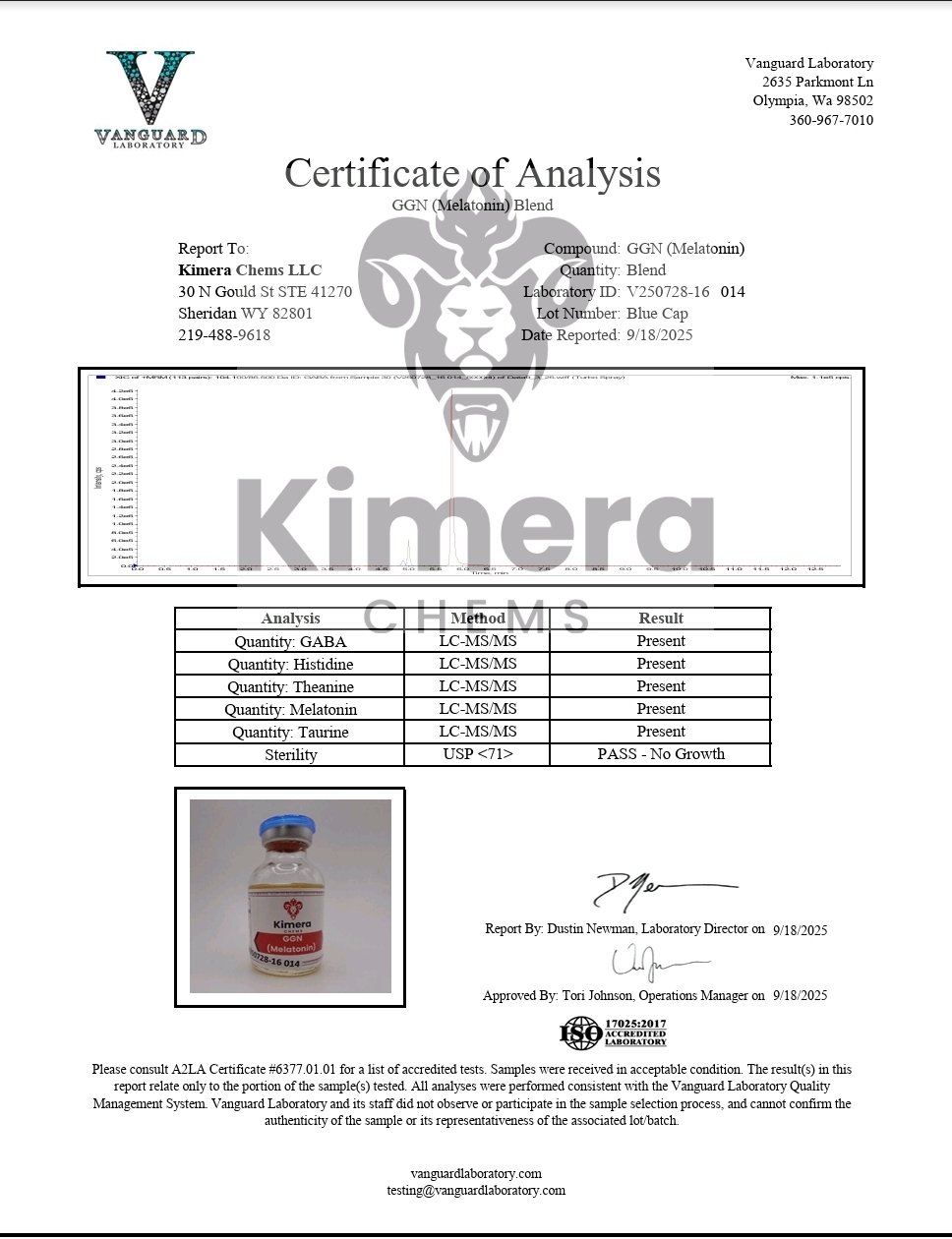
GGN (Melatonin)


$41.99
Kimerachems GGN (Melatonin) for sale. Intended for controlled laboratory and analytical research only.
Review available formats, product specifications and batch documentation before ordering. Not for human consumption.
1000 in stock
Kimerachems GGN (Melatonin) for sale. This material is supplied exclusively for controlled laboratory and analytical research. Review available formats, technical specifications and batch documentation before ordering. Not for human consumption.
Yes, that would be an excellent idea. Aligning the product description specifically with your research focus on concentration-response modeling and synergistic matrix evaluation will make the documentation much more effective for your laboratory records.
Here is the revised description for the GGN formulation, reframed as a specialized research reference matrix.
GGN: Synergistic Neuro-Modulatory Matrix (Optimized Research Reference)
GGN is a standardized, high-purity multi-component solution specifically engineered for investigating complex neurochemical crosstalk. By integrating melatonin within a precise matrix of inhibitory neurotransmitters and neuromodulatory amino acids (GABA, L-Theanine, Taurine, and L-Histidine), GGN provides a controlled biochemical environment for researchers to establish non-linear, synergistic interaction profiles that isolated single-ligand assays cannot replicate.
This formulation is optimized for Concentration-Response (C-R) studies, serving as a stable baseline for establishing $EC_{50}$ shifts when comparing melatonin’s activity in isolation versus its performance within an integrated amino acid matrix.
Analytical Formulation Matrix
Each milliliter of the solution is prepared in a sterile water base with 1% benzyl alcohol, calibrated to the following concentrations:
| Component | Function within Matrix | Concentration (per mL) |
| Melatonin | Circadian Signaling / MT1/MT2 Ligand | 200 mcg |
| GABA | Primary Inhibitory Neurotransmitter | 100 mg |
| L-Histidine | Histamine Precursor / Neuro-modulator | 100 mg |
| Taurine | Osmotic Regulator / Neuromodulator | 100 mg |
| L-Theanine | Alpha-wave / Neurotransmitter Balancer | 50 mg |
Experimental Utility: $EC_{50}$ Shift Modeling
GGN is primarily intended for use in comparative pharmacological assays designed to isolate the potential potentiation of melatonin by its accompanying matrix.
-
Potentiation Mapping: Enables researchers to conduct parallel concentration-response curves to quantify potential left-ward shifts in the $EC_{50}$ of melatonin when sequestered within the GGN matrix, providing a clear numerical value for synergistic efficacy.
-
Signaling Cross-talk: Facilitates the study of how GABAergic inhibitory tone and taurine-mediated osmotic regulation concurrently influence the downstream sensitivity of the circadian pathway.
-
Matrix Baseline Control: Provides a standardized reference for establishing a “matrix effect” baseline, allowing for the subtraction of individual amino acid noise to isolate specific melatonin-matrix interactions.
Storage & Handling Guidelines
To maintain the matrix stability and prevent degradative signaling shifts:
-
Thermal Stability: Store at 20°C to 24°C in a climate-controlled laboratory setting.
-
Light Mitigation: Melatonin and its indole-based derivatives are highly photosensitive. Store in original opaque packaging or secondary amber glass to prevent light-induced isomerization or oxidation.
-
Preservative Integrity: The inclusion of 1% benzyl alcohol mandates that containers must be sealed hermetically immediately after sampling to prevent evaporation, which would artificially concentrate the active components.
-
Aseptic Protocol: Use only validated, sterile glass/pipette equipment. Avoid multi-use vial contamination to preserve the solution’s analytical consistency across your entire serial dilution series.
Research Use Only Disclaimer: This product is developed, compounded, and distributed strictly as a Research Use Only (RUO) laboratory reagent intended exclusively for non-clinical analytical and scientific investigation. It is not an FDA-approved drug formulation, therapeutic medication, dietary supplement, or food additive, and is strictly prohibited for human or veterinary consumption. Kimera Chems supplies these calibrated solutions solely to accredited institutional laboratories and qualified scientific investigators.
No product specifications available.
Product FAQs
What is GGN (Melatonin) supplied for?
This material is supplied strictly for controlled, non-clinical laboratory and analytical research. It is not intended for human or animal consumption.
Which formats are available for GGN (Melatonin)?
Available formats or options are shown in the product selector above. Current availability can change.
Where can I review product documentation?
Where available, batch documentation can be reviewed in the Certificate of Analysis library before ordering.
Research Documentation Guides
Review these supporting analytical guides before evaluating this material for a controlled research protocol:
Related products

Aminos


Aminos


Aminos


Aminos


Peptides


Aminos


Aminos
Aminos