


RAD-140 (Testolone)

Price range: $71.99 through $76.99
Kimerachems RAD-140 (Testolone) for sale. Intended for controlled laboratory and analytical research only.
Review available formats, product specifications and batch documentation before ordering. Not for human consumption.
Kimerachems RAD-140 (Testolone) for sale. This material is supplied exclusively for controlled laboratory and analytical research. Review available formats, technical specifications and batch documentation before ordering. Not for human consumption.
RAD-140 (Vosilasarm / Testolone) Research Standard
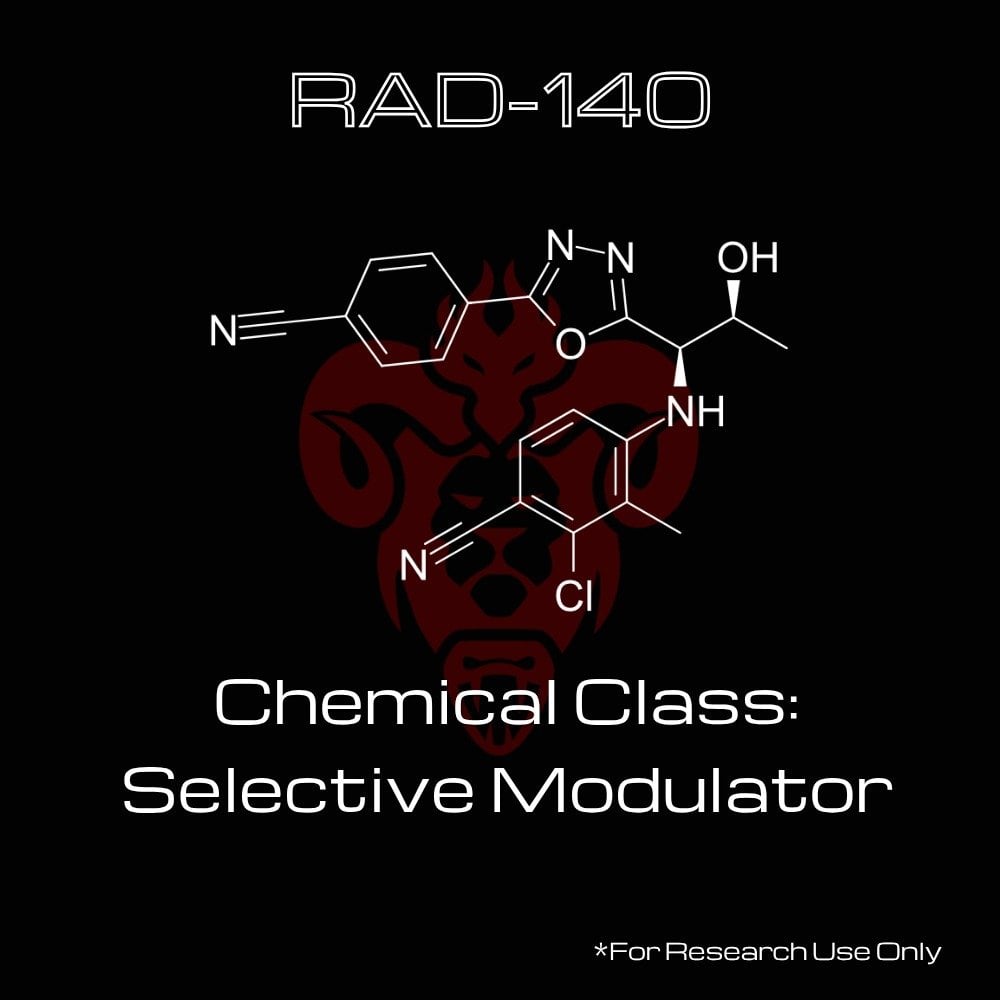
RAD-140, also known as Vosilasarm (Testolone), is a synthetic nonsteroidal selective androgen receptor modulator (SARM) with high-affinity binding characteristics for the androgen receptor (AR). Originally developed for its tissue-specific anabolic properties, it has advanced into clinical investigation, particularly for the treatment of AR-positive hormone-sensitive breast cancer. In laboratory settings, RAD-140 serves as a high-precision reference standard for studying nuclear receptor signaling, structure-activity relationships (SAR) within the benzonitrile-oxadiazole class, and the development of analytical methods for detecting Selective Modulators in complex matrices.
Technical Specifications
| Property | Specification |
| Product Name | RAD-140 (Vosilasarm / Testolone) |
| IUPAC Name | 2-Chloro-4-[[(1R,2S)-1-[5-(4-cyanophenyl)-1,3,4-oxadiazol-2-yl]-2-hydroxypropyl]amino]-3-methylbenzonitrile |
| CAS Number | 1182367-47-0 |
| Chemical Formula | C₂₀H₁₆ClN₅O₂ |
| Molecular Weight | 393.83 g/mol |
| Chemical Class | Nonsteroidal benzonitrile / 1,3,4-oxadiazole SARM |
| Physical Appearance | White to off-white solid |
| Binding Affinity | Ki ≈ 7 nM |
Mechanism of Action & Research Context
RAD-140 functions as a tissue-differential ligand, meaning it elicits distinct transcriptional outcomes depending on the receptor environment and coregulator recruitment.
-
Receptor Binding: RAD-140 exhibits high affinity for the androgen receptor ligand-binding domain. Its interaction promotes a unique conformational shift distinct from endogenous steroidal androgens, which is a primary focus of structural biology studies.
-
Transcriptional Output: Research demonstrates full-agonist activity in muscle- and bone-derived cell models, while exhibiting partial-agonist or suppressive activity in other tissue types.
-
Oncology Research: In AR+/ER+ breast cancer research, the compound is studied for its dual role: acting as an AR agonist while simultaneously suppressing ER-mediated signaling and downregulating ESR1 mRNA expression.
-
Metabolic Profile: Preclinical data identifies hepatic metabolism via oxidation and conjugation pathways, providing a framework for ADME (Absorption, Distribution, Metabolism, and Excretion) studies in isolated liver models.
Research Applications
RAD-140 is a widely recognized reference standard for advanced pharmacological and analytical research.
Primary fields of in vitro laboratory investigation include:
-
Androgen Receptor Signaling: Utilizing competitive binding and transactivation assays to map AR-ligand interaction dynamics.
-
Oncology & Nuclear Receptor Crosstalk: Investigating the interaction between AR and ER pathways in hormone-sensitive breast cancer models.
-
Analytical Method Development: Serving as a primary reference standard for LC-MS/MS protocols in anti-doping forensic toxicology.
-
SAR Analysis: Evaluating how the oxadiazole heterocycle and nitrile substituents contribute to receptor selectivity and metabolic stability.
-
Toxicological Assessment: Analyzing hepatotoxicity potential and cellular stress markers in response to prolonged ligand exposure.
Storage & Handling Guidelines
To maintain the chemical stability and experimental reliability of the compound:
-
Long-Term Storage: Store in a dry, cool environment. For maximum stability, maintain at -20 °C.
-
Atmospheric Control: Keep the container tightly sealed to prevent degradation.
-
Light Sensitivity: Protect from direct light to preserve the integrity of the benzonitrile-oxadiazole scaffold.
-
Aseptic Technique: Utilize clean, non-reactive laboratory equipment to prevent contamination, particularly when preparing stock solutions for binding assays.
Regulatory & Research Note
RAD-140 is designated as a prohibited substance on the World Anti-Doping Agency (WADA) list. Researchers involved in anti-doping analytical chemistry use this compound as a certified reference material for developing detection methods for non-medical use. The compound is under active clinical study (e.g., EP0062) for oncological indications; it is not approved for any consumer, medical, or dietary application.
Research Use Disclaimer
Research Use Only Disclaimer: This product is developed and distributed strictly as a Research Use Only (RUO) laboratory reference chemical intended exclusively for non-clinical analytical and scientific investigation. It is not an FDA-approved drug, medical treatment, dietary supplement, or food ingredient, and is strictly prohibited for human or animal consumption. Kimera Chems supplies this high-purity research material solely to qualified institutions and professional investigators for authorized laboratory research.
| CAS Number | 1182367-47-0 |
| Other Names | Testolone, RAD140, RAD 140, Vosilasarm, 4O87Q44KNC, CHEMBL1672635, D09ZLZ |
| IUPAC Name | 2-chloro-4-[[(1R,2S)-1-[5-(4-cyanophenyl)-1,3,4-oxadiazol-2-yl]-2-hydroxypropyl]amino]-3-methylbenzonitrile |
| Molecular Formula | C₂₀H₁₆ClN₅O₂ |
| Molecular Weight | 393.8 |
| Liquid Concentration And Solution | 30mg/ml PEG400, DMSO |
| Aliquot Concentration And Solution | 50mg/ml (PEG400, Propylene Glycol, Benzyl benzoate, Benzyl Alcohol) |
Product FAQs
What is RAD-140 (Testolone) supplied for?
This material is supplied strictly for controlled, non-clinical laboratory and analytical research. It is not intended for human or animal consumption.
Which formats are available for RAD-140 (Testolone)?
The current listing shows these options: 1 Gram Powder, Aliquot 10ml Vial (Advanced Carrier Blend) 10ml/50mg Per ml/500mg, Dry-Fill Capsule 10mg/60ct/600mg, Liquid 30ml/30mg Per ml/900mg, tablets-20mg-30ct-600mg. Availability can change, so confirm the selector above before ordering.
Where can I review product documentation?
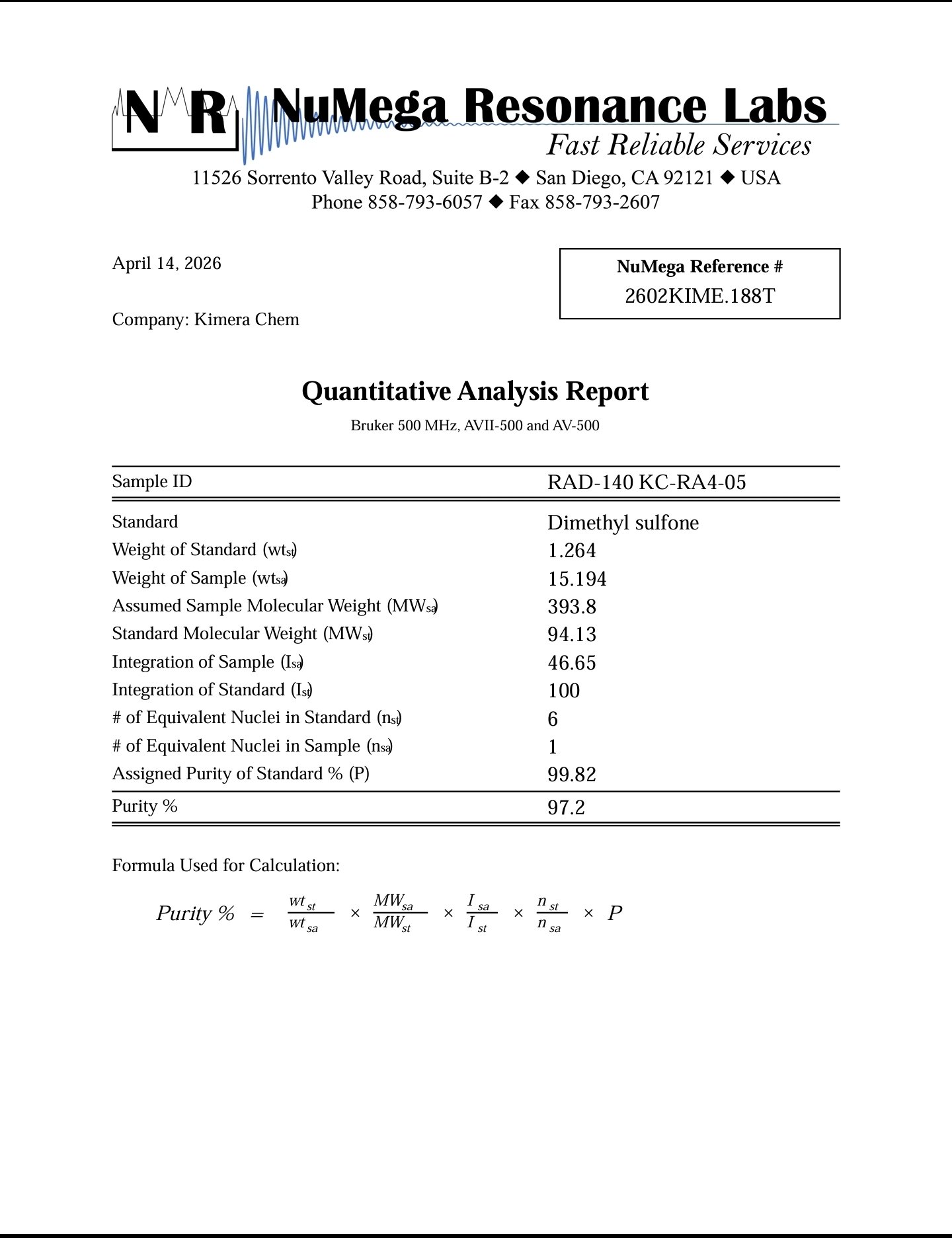
Where available, batch documentation can be reviewed in the Certificate of Analysis library before ordering.
Research Documentation Guides
Review these supporting analytical guides before evaluating this material for a controlled research protocol:
Related products

Selective Modulators


Selective Modulators

Selective Modulators

Selective Modulators

Selective Modulators

Selective Modulators


Selective Modulators


Selective Modulators