


RAD-150 (TLB-150)

Price range: $71.99 through $76.99
Kimerachems RAD-150 (TLB-150) for sale. Intended for controlled laboratory and analytical research only.
Review available formats, product specifications and batch documentation before ordering. Not for human consumption.
Kimerachems RAD-150 (TLB-150) for sale. This material is supplied exclusively for controlled laboratory and analytical research. Review available formats, technical specifications and batch documentation before ordering. Not for human consumption.
RAD-150 (TLB-150 Benzoate) Research Standard
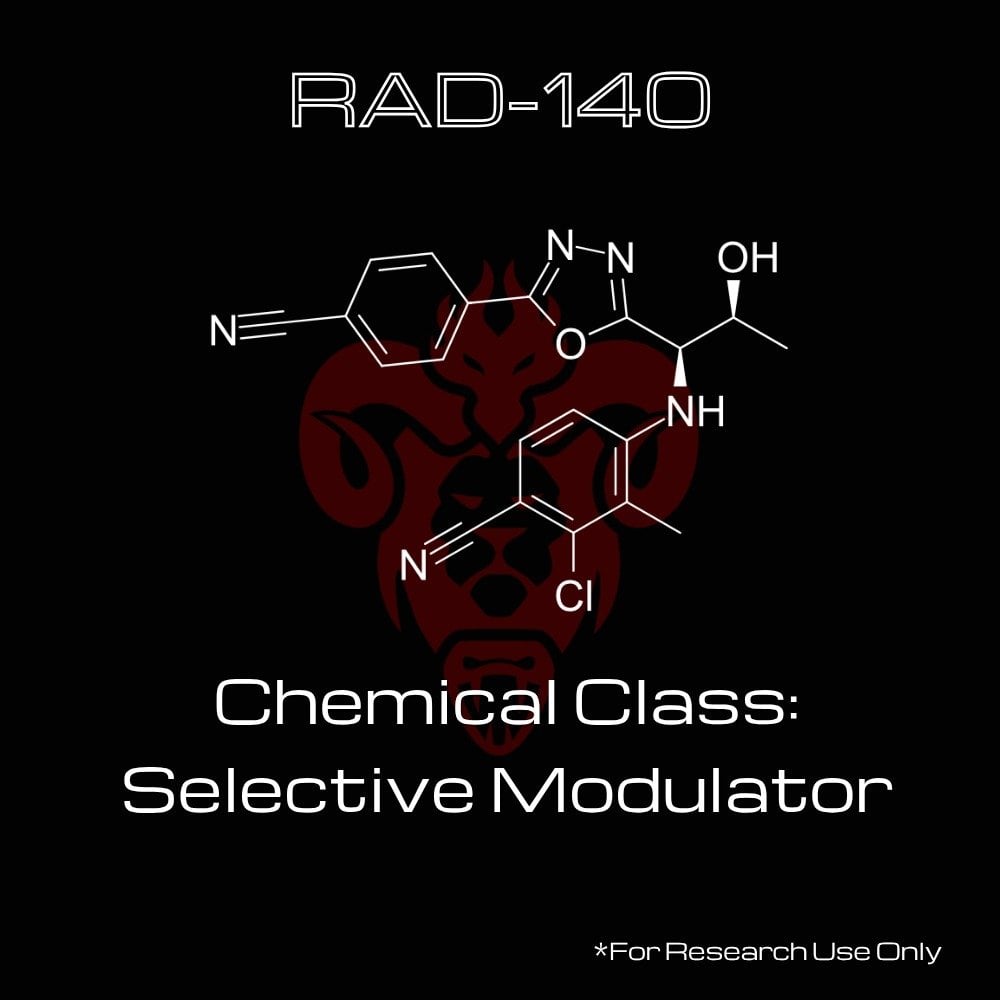
RAD-150 (TLB-150 Benzoate) is a synthetic benzoate ester derivative of the nonsteroidal selective androgen receptor modulator (SARM) RAD-140 (vosilasarm / Testolone). By modifying the 2-hydroxy position of the parent scaffold with a benzoate group, this compound exhibits significantly altered lipophilicity and pharmacokinetic properties. In laboratory research, RAD-150 functions as a prodrug-like analog utilized to investigate ester hydrolysis kinetics, comparative metabolic profiling, and the structural influence of esterification on the benzonitrile-oxadiazole SARM class.
Technical Specifications
| Property | Specification |
| Product Name | RAD-150 (TLB-150 Benzoate) |
| IUPAC Name | (1R,2S)-1-[(3-Chloro-4-cyano-2-methylphenyl)amino]-1-[5-(4-cyanophenyl)-1,3,4-oxadiazol-2-yl]propan-2-yl benzoate |
| CAS Number | 1208070-53-4 |
| Chemical Formula | C27H20ClN5O3 |
| Molecular Weight | 497.93 g/mol |
| Exact Mass | 497.126 g/mol |
| Chemical Class | Benzoate ester derivative of benzonitrile-oxadiazole SARM |
| Physical Appearance | White to off-white solid |
Mechanism of Action (Research Context)
RAD-150 is studied primarily as a prodrug analog of RAD-140. Its utility in research is defined by its pharmacokinetic evolution rather than a distinct receptor-binding mechanism independent of the parent compound.
-
Ester Hydrolysis: The compound is subject to enzymatic hydrolysis via systemic esterases (found in plasma, hepatic, and intestinal tissues) to yield the parent molecule, RAD-140. Researchers use this conversion rate to model the hydrolytic stability of ester-modified SARM compounds.
-
Pharmacokinetic Profiling: The benzoate modification increases the molecule’s lipophilicity compared to the parent RAD-140. This alters the partition coefficient and membrane permeability, providing researchers with a tool to compare tissue distribution and cellular uptake dynamics.
-
Receptor Pharmacology: Following hydrolysis to RAD-140, the molecule acts as a high-affinity ligand for the androgen receptor (AR). RAD-150 serves as a critical benchmark for studying how the esterification process influences the temporal delivery and metabolic activation of AR-signaling pathways in in vitro models.
Research Applications
RAD-150 is a specialized reagent essential for analytical benchmarking and structure-activity relationship (SAR) investigations within the SARM class.
Primary fields of in vitro laboratory investigation include:
-
Ester Hydrolysis Kinetics: Mapping the rate and pathway of conversion from RAD-150 to RAD-140 across diverse esterase-containing biological systems.
-
Analytical Method Development: Establishing definitive MS/MS fragmentation patterns—specifically monitoring the characteristic loss of the benzoyl group (e.g., m/z 497.1 -> m/z 393.8)—to confirm identity in complex matrices.
-
Forensic and Toxicological Research: Providing a certified reference standard for the identification of ester-modified Selective Modulators in chemical, pharmaceutical, and anti-doping forensic matrices.
-
Comparative SAR Analysis: Evaluating how the addition of the bulky benzoate moiety influences the steric and electronic fit of the benzonitrile-oxadiazole scaffold within the AR ligand-binding domain.
Storage & Handling Guidelines
To maintain the chemical stability and experimental integrity of the ester:
-
Long-Term Storage: Store in a dry, cool environment. For maximum stability, maintain at -20 °C.
-
Environmental Control: The ester bond is susceptible to cleavage; protect strictly from moisture and basic conditions. Keep the container tightly sealed to prevent atmospheric hydrolysis.
-
Light Sensitivity: Store in a dark, light-protected area to prevent photo-degradation of the aromatic scaffold.
-
Aseptic Technique: Utilize clean, non-reactive laboratory tools when weighing the material to prevent contamination of the reference standard.
Regulatory & Research Note
As a benzoate ester precursor to RAD-140 (a substance listed on the WADA Prohibited List), RAD-150 is treated as a chemically equivalent precursor in regulated research environments. Analytical investigators should maintain rigorous records, as ester-modified precursors are often investigated in forensic toxicology and anti-doping method validation.
Research Use Disclaimer
Research Use Only Disclaimer: This product is developed and distributed strictly as a Research Use Only (RUO) laboratory reference chemical intended exclusively for non-clinical analytical and scientific investigation. It is not an FDA-approved drug, medical treatment, dietary supplement, or food ingredient, and is strictly prohibited for human or animal consumption. Kimera Chems supplies this high-purity research material solely to qualified institutions and professional investigators for authorized laboratory research.
| CAS Number | 1208070-53-4 |
| Other Names | RAD150, RAD 150, TLB150, TLB-150, TLB 150, DTXSID40183806 |
| IUPAC Name | 2-[5-chloropentyl(methyl)amino]-N-(2,6-dimethylphenyl)acetamide |
| Molecular Formula | C₂₇H₂₀ClN₅O₃ |
| Molecular Weight | 497.94 |
| Liquid Concentration And Solution | 20mg/ml (PEG400) |
| Aliquot Concentration And Solution | 30mg/ml (PEG400, Propylene Glycol, Benzyl Benzoate, Benzyl Alcohol) |
Product FAQs
What is RAD-150 (TLB-150) supplied for?
This material is supplied strictly for controlled, non-clinical laboratory and analytical research. It is not intended for human or animal consumption.
Which formats are available for RAD-150 (TLB-150)?
The current listing shows these options: 1 Gram Powder, aliquot-advanced-carrier-blend-10ml-50mg-per-ml-500mg, Dry-Fill Capsule 10mg/60ct/600mg. Availability can change, so confirm the selector above before ordering.
Where can I review product documentation?
Where available, batch documentation can be reviewed in the Certificate of Analysis library before ordering.
Research Documentation Guides
Review these supporting analytical guides before evaluating this material for a controlled research protocol:
Related products

Selective Modulators

Selective Modulators

Selective Modulators


Selective Modulators

Selective Modulators


Selective Modulators

Selective Modulators

Selective Modulators