


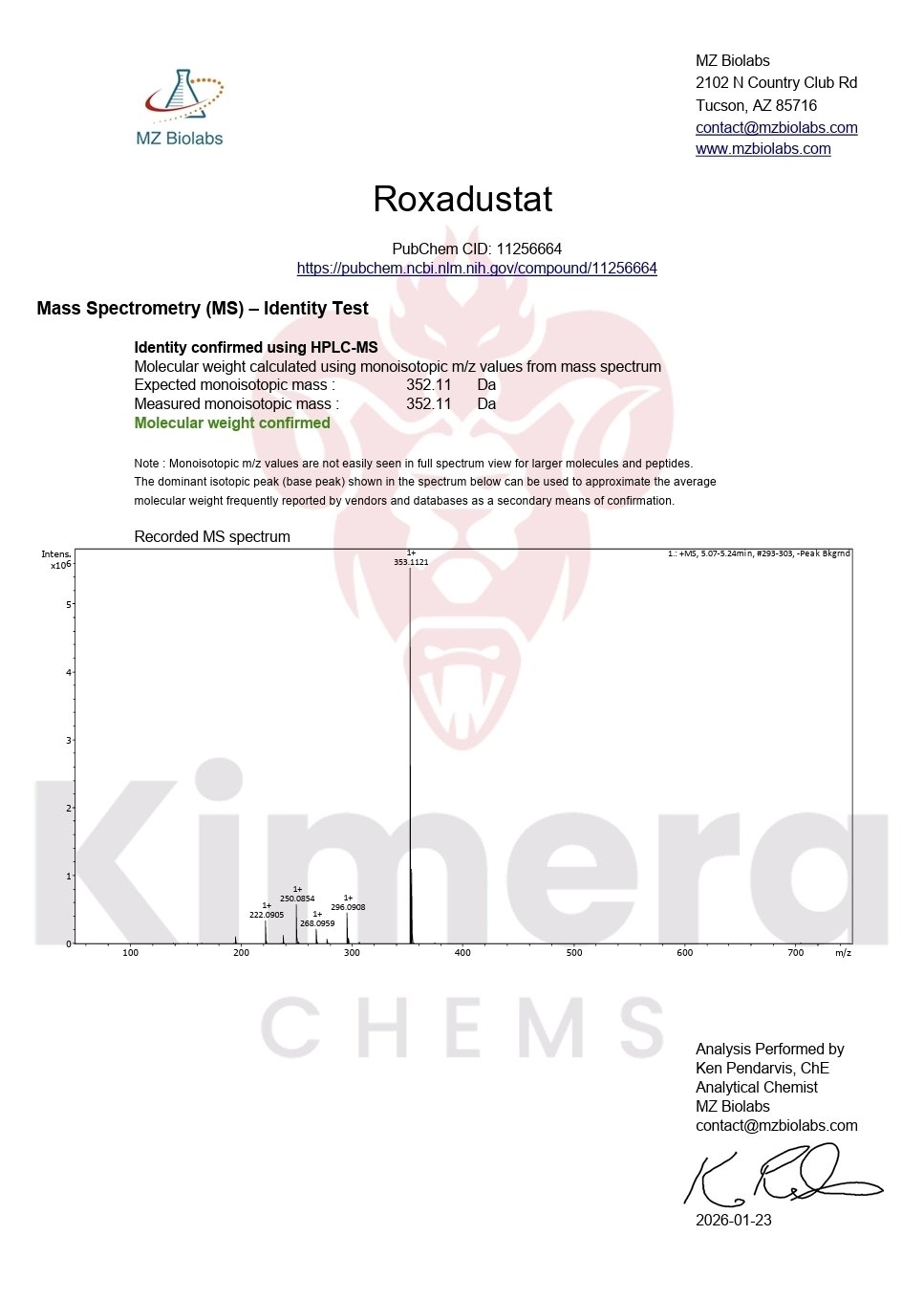


Roxadustat FG-4592


Price range: $91.99 through $111.99
Kimerachems Roxadustat FG-4592 for sale. Intended for controlled laboratory and analytical research only.
Review available formats, product specifications and batch documentation before ordering. Not for human consumption.
Kimerachems Roxadustat FG-4592 for sale. This material is supplied exclusively for controlled laboratory and analytical research. Review available formats, technical specifications and batch documentation before ordering. Not for human consumption.
Roxadustat (FG-4592) Research Standard
Roxadustat (FG-4592, ASP 1517) is a potent, synthetic small-molecule inhibitor of the hypoxia-inducible factor prolyl hydroxylase (HIF-PH) enzymes. Characterized by an isoquinoline carboxamide scaffold, this compound serves as a critical biochemical tool for investigating oxygen-sensing pathways and cellular responses to hypoxia. In laboratory research, it is utilized as a competitive inhibitor to map enzyme-substrate interactions, assess binding affinity through kinetic assays, and probe the biochemical regulation of HIF-alpha subunit stability in isolated enzyme systems.
Technical Specifications
| Property | Specification |
| Product Name | Roxadustat (FG-4592) |
| Chemical Formula | $C_{19}H_{16}N_2O_5$ |
| Molecular Weight | 352.3 g/mol |
| Chemical Class | Isoquinoline carboxamide derivative |
| Physical Appearance | White to pale green solid |
| Assay Purity | > 98% (HPLC verified) |
Mechanism of Action & Research Context
Roxadustat functions as a competitive inhibitor of the HIF-prolyl hydroxylase (PH) enzymes, which are responsible for the degradation of Hypoxia-Inducible Factor (HIF) under normoxic conditions.
-
Substrate Mimicry: The glycine amide group within the Roxadustat molecule acts as a mimetic of natural substrates, allowing the compound to occupy the enzyme’s active site.
-
Active Site Binding: By binding to the site where oxygen and 2-oxoglutarate would normally interact, the molecule prevents the hydroxylation of HIF-alpha subunits.
-
Structural Stabilization: The phenoxy acetic acid moiety provides additional stability to the ligand-enzyme complex, allowing for the precise measurement of binding kinetics in cell-free assays.
Research Applications
Roxadustat is a specialized reagent used to investigate the kinetics and regulatory mechanisms of prolyl hydroxylase enzymes.
Primary fields of in vitro laboratory investigation include:
-
Enzyme Binding Assays: Measuring the efficacy of HIF-PH inhibition in isolated protein preparations and cell-free assay systems.
-
Competition Studies: Observing the displacement of natural substrates by Roxadustat to determine competitive binding characteristics.
-
Binding Affinity (Kinetics): Utilizing kinetic methods to establish inhibition constants and understand the stability of the enzyme-inhibitor complex.
-
Stability & Degradation Testing: Monitoring the chemical degradation of the compound under diverse environmental and solvent conditions to refine laboratory protocol standards.
Storage & Handling Guidelines
To maintain the chemical stability and experimental reliability of the compound:
-
General Storage: Keep the powder and capsules in a sealed, dry container at room temperature.
-
Environmental Control: Protect from direct sunlight; store in a dark cabinet or opaque container to preserve molecular integrity.
-
Moisture Protection: Store powder with an appropriate desiccant to prevent hydration and ensure the accuracy of weight measurements.
-
Container Integrity: Always close the container tightly immediately after each use to minimize atmospheric exposure.
Research Use Disclaimer
Research Use Only Disclaimer: This product is developed and distributed strictly as a Research Use Only (RUO) laboratory reference chemical intended exclusively for non-clinical analytical and scientific investigation. It is not an FDA-approved drug, medical treatment, dietary supplement, or food ingredient, and is strictly prohibited for human or animal consumption. Kimera Chems supplies this high-purity research material solely to qualified institutions and professional investigators for authorized laboratory research.
| CAS Number | 808118-40-3 |
| Other Names | Evrenzo, FG-4592, ASP1517, AZD9941 |
| IUPAC Name | 2-[(4-Hydroxy-1-methyl-7-phenoxyisoquinoline-3-carbonyl)amino]acetic acid |
| Molecular Formula | C₁₉H₁₆N₂O₅ |
| Molecular Weight | 352.11 |
| Liquid Concentration And Solution | NA |
| Aliquot Concentration And Solution | NA |
Product FAQs
What is Roxadustat FG-4592 supplied for?
This material is supplied strictly for controlled, non-clinical laboratory and analytical research. It is not intended for human or animal consumption.
Which formats are available for Roxadustat FG-4592?
The current listing shows these options: 5-grams-powder, dry-fill-capsule-75mg-30ct-2-25g. Availability can change, so confirm the selector above before ordering.
Where can I review product documentation?
Where available, batch documentation can be reviewed in the Certificate of Analysis library before ordering.
Research Documentation Guides
Review these supporting analytical guides before evaluating this material for a controlled research protocol:
Related products


Analytical Reagents

Analytical Reagents
Analytical Reagents

Analytical Reagents


Analytical Reagents
Analytical Reagents


Analytical Reagents
Analytical Reagents