


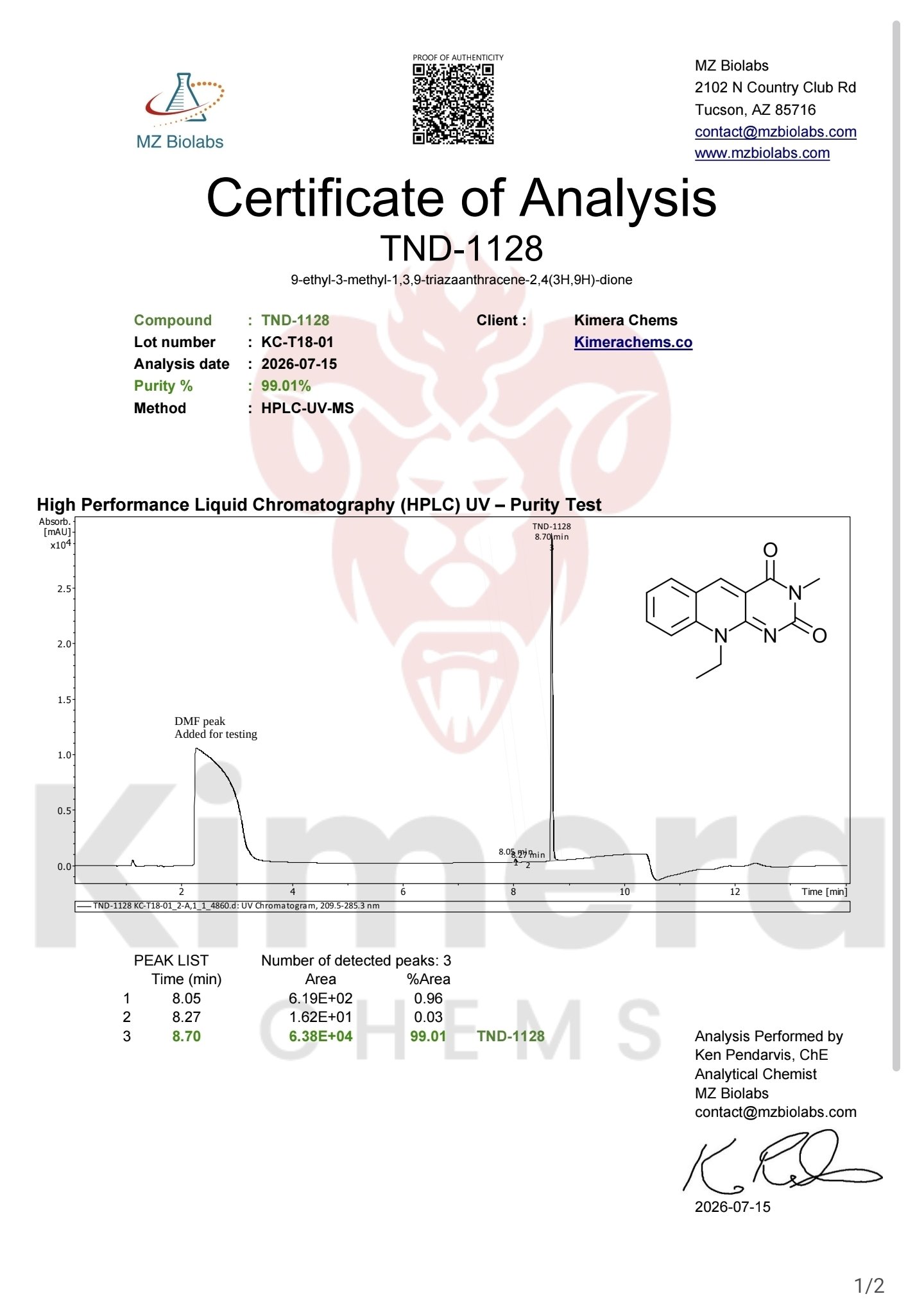
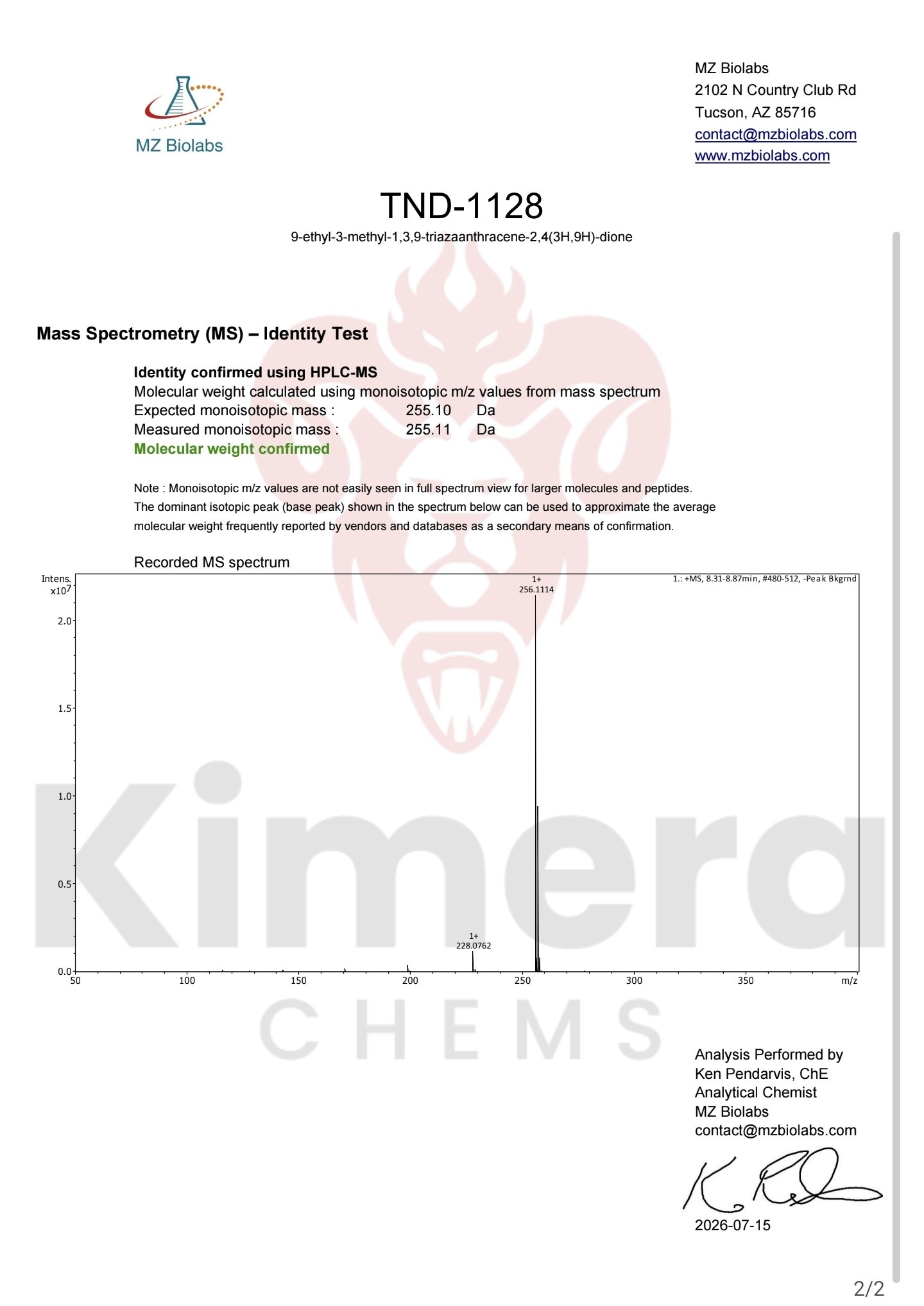
TND1128

Price range: $29.99 through $34.99
Kimerachems TND1128 for sale. Intended for controlled laboratory and analytical research only.
Review available formats, product specifications and batch documentation before ordering. Not for human consumption.
Kimerachems TND1128 for sale. This material is supplied exclusively for controlled laboratory and analytical research. Review available formats, technical specifications and batch documentation before ordering. Not for human consumption.
TND1128 (3-Methyl-10-ethyl-Deazaflavin) Research Standard
TND1128 (3-Methyl-10-ethyl-Deazaflavin) is a synthetic small molecule belonging to the 5-deazaflavin class (pyrimido[4,5-b]quinoline-2,4-diones). By replacing the nitrogen at the 5-position of the flavin scaffold with carbon, TND1128 exhibits a self-redox capability analogous to nicotinamide cofactors, but with significantly increased lipophilicity compared to water-soluble precursors like β-NMN. In laboratory research, TND1128 is utilized as a potent mitochondrial activator and redox-active chemical probe, facilitating the study of cellular bioenergetics, oxidative stress resilience, and neurobiology.
Technical Specifications
| Property | Specification |
| Product Name | TND1128 |
| IUPAC Name | 10-ethyl-3-methylpyrimido[4,5-b]quinoline-2,4(3H,10H)-dione |
| CAS Number | 59997-14-7 |
| Chemical Formula | C14H13N3O2 |
| Molecular Weight | 255.27 g/mol |
| Chemical Class | 5-deazaflavin derivative |
| Physical Appearance | Yellow crystalline powder |
| Assay Purity | ≥ 98% (HPLC verified) |
Mechanism of Action & Research Context
TND1128 acts as a structural and functional mimic of redox cofactors, offering unique advantages for metabolic and neural research.
-
Self-Redox Capability: The deazaflavin core allows for efficient electron transfer, acting as a functional analog to nicotinamide cofactors. Its specific structural modification (C5 substitution) ensures stability and activity in biological redox cycles.
-
Mitochondrial Bioenergetics: The compound is investigated for its role as a mitochondrial activator. Research models, including rodent brain-slice preparations and neuronal cultures, utilize TND1128 to measure improvements in ATP-synthesis indices and the maintenance of mitochondrial membrane potential under oxidative stress.
-
Hydrophobic Character: Unlike β-NMN, which is hydrophilic, TND1128’s lipophilic profile facilitates study in central nervous system models, allowing researchers to explore its potential influence on neuronal morphology and cellular resilience in tissues with limited permeability to polar compounds.
Research Applications
TND1128 is a specialized reagent essential for investigating mitochondrial function and redox homeostasis.
Primary fields of in vitro and preclinical laboratory investigation include:
-
Cellular Bioenergetics: Quantifying changes in mitochondrial membrane potential and total ATP production.
-
Neuronal Resilience Studies: Evaluating the compound’s effect on cellular protection against oxidative injury and physiological stress.
-
Neurobiology: Mapping the effects of redox-active cofactors on neuronal morphology and synaptic maintenance in CNS models.
-
Comparative Redox Research: Utilizing TND1128 as a benchmark alongside NMN and other NAD+ precursors to characterize differential metabolic activation pathways.
Storage & Handling Guidelines
To maintain the chemical stability and experimental reliability of the compound:
-
Storage Environment: Store desiccated at -20°C.
-
Environmental Control: Protect strictly from light and moisture, which may impact the stability of the flavin scaffold.
-
Equilibration: To prevent condensation on the material, allow the sealed container to equilibrate to room temperature before opening.
-
Handling: Treat as a research chemical with an undetermined toxicological profile; utilize standard laboratory safety protocols, including appropriate PPE.
Research Use Disclaimer
Research Use Only Disclaimer: This product is developed and distributed strictly as a Research Use Only (RUO) laboratory reference chemical intended exclusively for non-clinical analytical and scientific investigation. It is not an FDA-approved drug, medical treatment, dietary supplement, or food ingredient, and is strictly prohibited for human or animal consumption. Kimera Chems supplies this high-purity research material solely to qualified institutions and professional investigators for authorized laboratory research.
| CAS Number | 59997-14-7 |
| Other Names | 3-Methyl-10-ethyl-Deazaflavin; 3-methyl-10-ethyl-5-deazaflavin |
| IUPAC Name | 10-ethyl-3-methylpyrimido[4,5-b]quinoline-2,4(3H,10H)-dione |
| Molecular Formula | C₁₄H₁₃N₃O₂ |
| Molecular Weight | 255.27 |
Product FAQs
What is TND1128 supplied for?
This material is supplied strictly for controlled, non-clinical laboratory and analytical research. It is not intended for human or animal consumption.
Which formats are available for TND1128?
The current listing shows these options: 1 Gram Powder, dry-fill-capsule-60ct-15mg-900mg. Availability can change, so confirm the selector above before ordering.
Where can I review product documentation?
Where available, batch documentation can be reviewed in the Certificate of Analysis library before ordering.
Research Documentation Guides
Review these supporting analytical guides before evaluating this material for a controlled research protocol:
Related products


Analytical Reagents


Analytical Reagents

Analytical Reagents


Analytical Reagents
Analytical Reagents
Analytical Reagents
Analytical Reagents


Analytical Reagents