
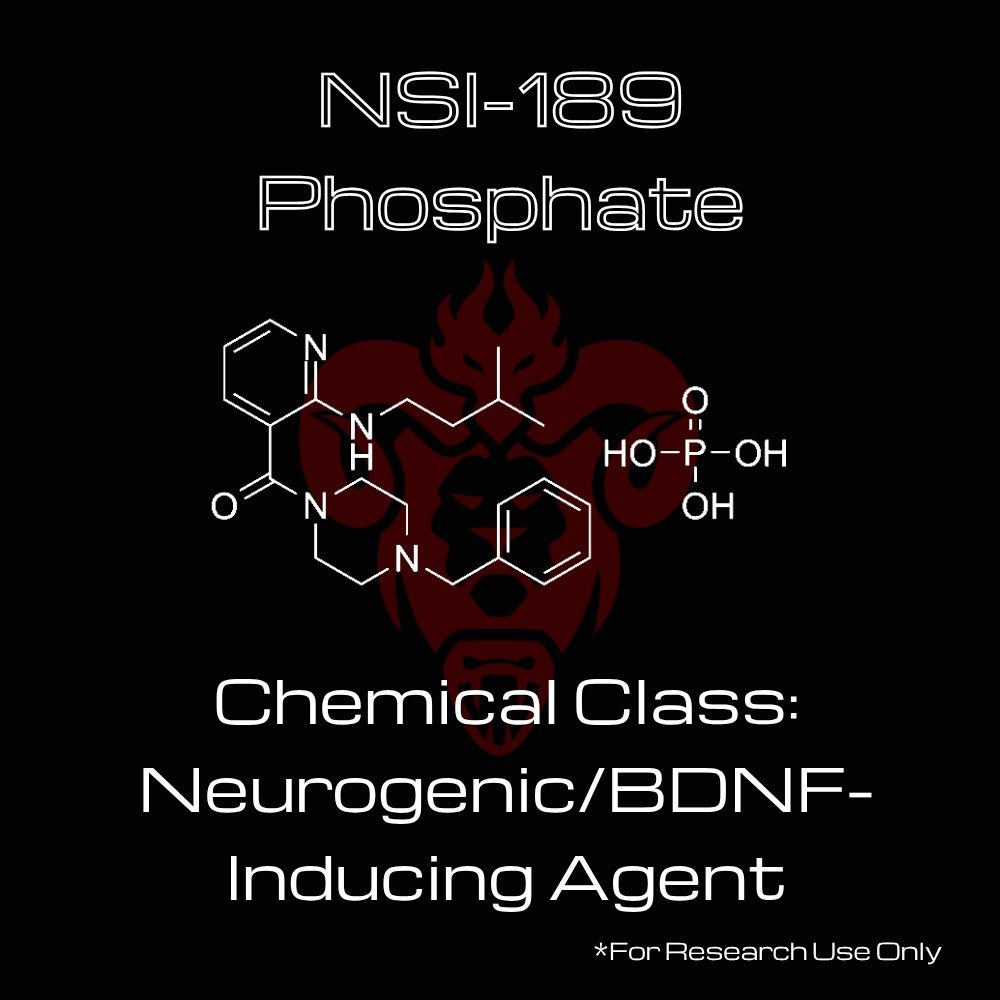


NSI-189 Phosphate
Price range: $51.99 through $81.99
Kimerachems NSI-189 Phosphate for sale. Intended for controlled laboratory and analytical research only.
Review available formats, product specifications and batch documentation before ordering. Not for human consumption.
Kimerachems NSI-189 Phosphate for sale. This material is supplied exclusively for controlled laboratory and analytical research. Review available formats, technical specifications and batch documentation before ordering. Not for human consumption.
NSI-189 Phosphate (Neural Growth Research Standard)
NSI-189 Phosphate is a synthetic benzylpiperazine-aminopyridine derivative developed to investigate neurogenic processes and structural synaptic changes within the central nervous system. By utilizing the phosphate salt form, the compound achieves enhanced stability and solubility for in vitro and laboratory experimentation. It is widely employed as a specialized research tool to map the mechanisms of hippocampal neurogenesis, synaptic density modulation, and the stimulation of neural connectivity in controlled cell-based models.
Technical Specifications
| Property | Specification |
| Product Name | NSI-189 Phosphate |
| Chemical Formula | C₂₂H₃₃N₄O₅P |
| Molecular Weight | ~464.49 g/mol |
| Chemical Class | Benzylpiperazine-aminopyridine derivative |
| Physical Appearance | Fine white to off-white/beige powder |
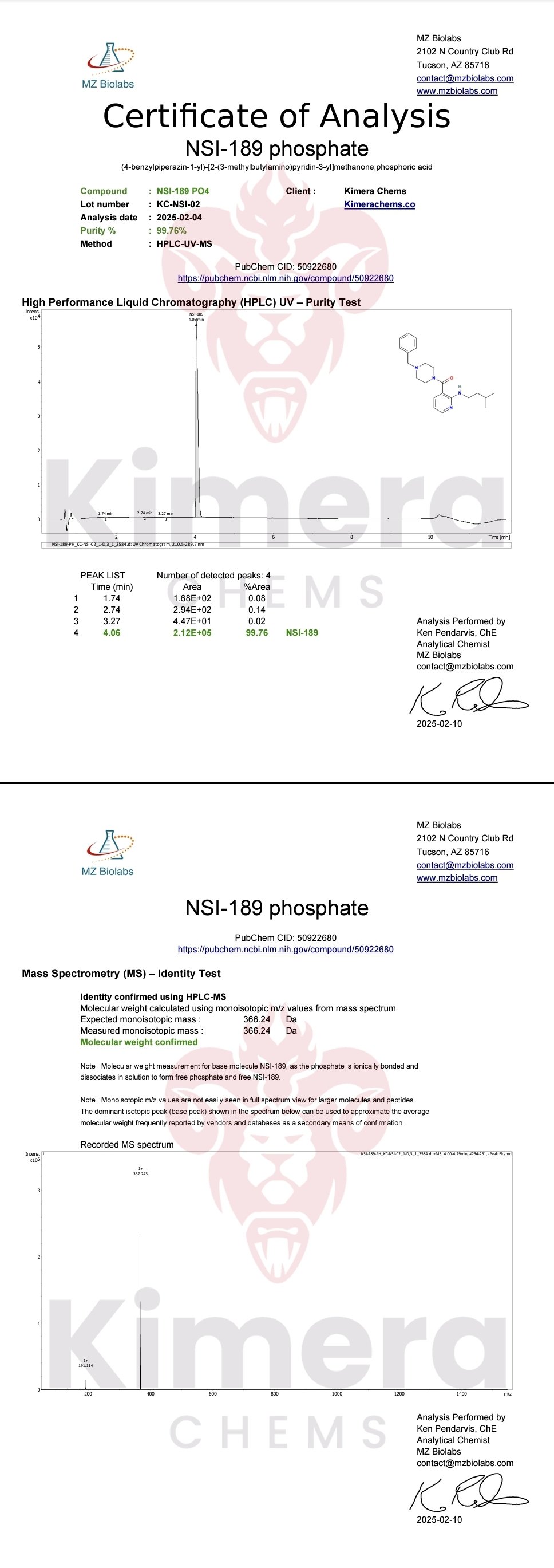
| Assay Purity | ≥ 98% (HPLC verified) |
Mechanism of Action & Research Context
NSI-189 Phosphate is studied primarily for its potential to stimulate neural cell proliferation and differentiation, particularly within hippocampal tissue models.
-
Neurogenic Signaling: Research focuses on its ability to promote the formation of new neurons, tracking neurogenesis via specific biomarkers.
-
Synaptic Density Modulation: Investigators utilize the compound to measure changes in synaptic markers, providing insights into the preservation and enhancement of neural connectivity.
-
Hippocampal Activation: By applying NSI-189 in in vitro hippocampal tissue models, researchers can examine the up-regulation of signaling pathways associated with long-term potentiation and structural neuroplasticity.
-
Stability: The phosphate salt formulation is specifically chosen in research contexts to provide a stable delivery vehicle, ensuring consistent molecular availability during prolonged cellular assays.
Research Applications
NSI-189 Phosphate is a focused reference standard for studies exploring neurogenesis and neural repair mechanisms.
Primary fields of in vitro laboratory investigation include:
-
Neurogenesis Mapping: Tracking new cell formation and differentiation trajectories in hippocampal tissue cultures.
-
Synaptic Density Assessment: Measuring shifts in pre- and post-synaptic protein expression in neural models.
-
Cellular Marker Analysis: Examining the biochemical signaling cascades induced by NSI-189 in cell-based assays.
-
Neural Connectivity Research: Observing the morphological changes and axonal growth patterns of neurons in controlled laboratory environments.
Storage & Handling Guidelines
To maintain the chemical stability and experimental viability of the compound:
-
Storage Environment: Store in a cool, dry place. Ensure the storage location is free of excess moisture.
-
Light Protection: Store in a dark spot away from direct light exposure to prevent potential photo-degradation.
-
Container Integrity: Keep the cap tightly closed after every use to protect the integrity of the powder. The container should not be left open for extended periods to avoid environmental exposure.
-
Handling: Use clean, sterile laboratory equipment when weighing or transferring the material to prevent contamination.
References
-
Fava M, et al. (2016) A Phase 1B, Randomized, Double-Blind, Placebo-Controlled, Multiple-Dose Escalation Study of NSI-189 Phosphate in Patients With Major Depressive Disorder. Molecular Psychiatry. 21(10): 1372–1380.
-
Bansal M, et al. (2016) NSI-189, a novel neurogenic compound, prevents cognitive deficit in a rat model of depression. Journal of Neurochemistry. 136(S1): 410.
-
Tajiri N, et al. (2014) NSI-189, a novel neurogenic compound, promotes hippocampal neurogenesis and improves cognitive function in mice. CNS Neuroscience & Therapeutics. 20(8): 777–783.
Research Use Disclaimer
Research Use Only Disclaimer: This product is developed and distributed strictly as a Research Use Only (RUO) laboratory reference chemical intended exclusively for non-clinical analytical and scientific investigation. It is not an FDA-approved drug, medical treatment, dietary supplement, or food ingredient, and is strictly prohibited for human or animal consumption. Kimera Chems supplies this high-purity research material solely to qualified institutions and professional investigators for authorized laboratory research.
| CAS Number | 1270138-41-4 |
| Other Names | 1270138-41-4, UNII-HX0VO60T62, HX0VO60T62, CHEMBL4297309, BCP30291 |
| IUPAC Name | (4-benzylpiperazin-1-yl)-[2-(3-methylbutylamino)pyridin-3-yl]methanone;phosphoric acid |
| Molecular Formula | C₂₂H₃₃N₄O₅P |
| Molecular Weight | 464.495 |
Product FAQs
What is NSI-189 Phosphate supplied for?
This material is supplied strictly for controlled, non-clinical laboratory and analytical research. It is not intended for human or animal consumption.
Which formats are available for NSI-189 Phosphate?
The current listing shows these options: 5-grams-powder, dry-fill-capsules-60ct-20mg-1-2g. Availability can change, so confirm the selector above before ordering.
Where can I review product documentation?
Where available, batch documentation can be reviewed in the Certificate of Analysis library before ordering.
Research Documentation Guides
Review these supporting analytical guides before evaluating this material for a controlled research protocol:
Related products


Analytical Reagents


Nootropics

Nootropics


Nootropics


Nootropics

Nootropics


Nootropics


Nootropics