


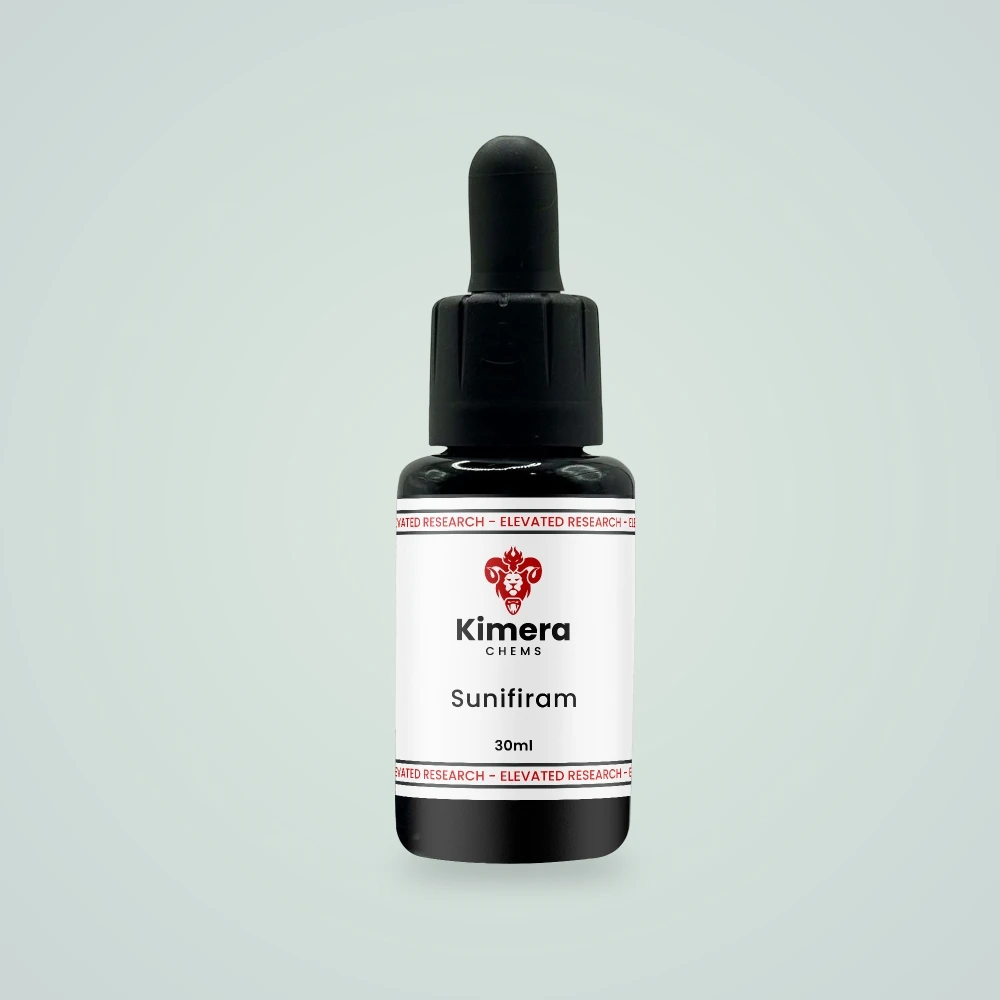


Sunifiram

Price range: $31.99 through $41.99
Kimerachems Sunifiram for sale. Intended for controlled laboratory and analytical research only.
Review available formats, product specifications and batch documentation before ordering. Not for human consumption.
Kimerachems Sunifiram for sale. This material is supplied exclusively for controlled laboratory and analytical research. Review available formats, technical specifications and batch documentation before ordering. Not for human consumption.
Sunifiram (DM-235) Research Standard
Sunifiram (DM-235) is a highly potent synthetic compound belonging to the racetam class of chemicals. Distinguishable by its significantly increased potency compared to earlier molecules such as piracetam, Sunifiram is utilized in laboratory research as a powerful tool for investigating excitatory amino acid receptor signaling. In in vitro models, it serves as a reference material for probing the modulation of AMPA and NMDA receptors and observing the resulting changes in nerve cell activity, synaptic signaling, and cognitive-related neuroplasticity pathways.
Technical Specifications
| Property | Specification |
| Product Name | Sunifiram (DM-235) |
| Chemical Formula | C14H18N2O2 |
| Chemical Class | Racetam derivative |
| Physical Appearance | Fine white or off-white powder |
| Assay Purity | >= 99% (HPLC verified) |
Mechanism of Action & Research Context
Sunifiram is primarily investigated for its pharmacological impact on glutamatergic signaling systems in neural tissue.
-
Receptor Modulation: The compound is characterized by its activity at both AMPA and NMDA receptors. It is hypothesized to function as a positive allosteric modulator, which enhances the signaling efficiency of these receptors in isolated cell preparations.
-
Potency Profile: Due to its high binding affinity and potency relative to first-generation racetams, Sunifiram allows for the use of micro-gram scale dosing in experimental models, facilitating precise control over receptor activation concentrations.
-
Signaling Pathways: Research utilizing Sunifiram focuses on its ability to potentiate synaptic transmission, making it a critical reagent for studying the mechanisms of long-term potentiation (LTP) and synaptic plasticity.
Research Applications
Sunifiram is a specialized reagent used to explore the dynamics of glutamatergic signaling and cognitive neurobiology.
Primary fields of in vitro laboratory investigation include:
-
Memory & Plasticity Studies: Examining changes in hippocampal tissue model activity to understand the mechanisms of neuroplasticity.
-
Synaptic Activity: Monitoring real-time signal propagation and movement between nerve cells in culture.
-
Focus & Pathway Research: Observing pathway activity in attention-related research models.
-
Receptor Signaling: Characterizing the dose-response relationship of AMPA/NMDA receptor activity in controlled nerve tissue environments.
-
Comparative Racetam Analysis: Utilizing Sunifiram as a high-potency benchmark when comparing the efficacy of structurally diverse racetam-class compounds.
Storage & Handling Guidelines
To maintain the chemical stability and experimental reliability of the powder:
-
Storage Environment: Store in a cool, dry place at temperatures below 25°C.
-
Light Sensitivity: Protect the container from direct light or sunlight, which may induce degradation.
-
Container Integrity: Ensure the lid is twisted on tightly immediately after weighing the sample to prevent moisture ingress.
-
Aseptic Technique: Use clean laboratory tools for every handling event. Maintain a dust-free workspace to prevent contamination of the high-purity powder.
Research Use Disclaimer
Research Use Only Disclaimer: This product is developed and distributed strictly as a Research Use Only (RUO) laboratory reference chemical intended exclusively for non-clinical analytical and scientific investigation. It is not an FDA-approved drug, medical treatment, dietary supplement, or food ingredient, and is strictly prohibited for human or animal consumption. Kimera Chems supplies this high-purity research material solely to qualified institutions and professional investigators for authorized laboratory research.
| CAS Number | 314728-85-3 |
| Other Names | 314728-85-3, DM 235, DM-235, 1-(4-benzoylpiperazin-1-yl)propan-1-one, 66924E735K, DM235 cpd, Lopac-D-5689 |
| IUPAC Name | 1-(4-benzoylpiperazin-1-yl)propan-1-one |
| Molecular Formula | C₁₄H₁₈N₂O₂ |
| Molecular Weight | 246.31 |
| Liquid Concentration And Solution | 20mg Per mL, Phosphate Buffered Solution, EDTA |
| Aliquot Concentration And Solution | NA |
Product FAQs
What is Sunifiram supplied for?
This material is supplied strictly for controlled, non-clinical laboratory and analytical research. It is not intended for human or animal consumption.
Which formats are available for Sunifiram?
The current listing shows these options: 1 Gram Powder, Liquid 30mL/20mg Per mL/600mg, tablets-20mg-30ct-600mg. Availability can change, so confirm the selector above before ordering.
Where can I review product documentation?
Where available, batch documentation can be reviewed in the Certificate of Analysis library before ordering.
Research Documentation Guides
Review these supporting analytical guides before evaluating this material for a controlled research protocol:
Related products
Nootropics

Nootropics

Nootropics


Nootropics
Nootropics


Nootropics

Nootropics


Nootropics