


Nefiracetam

Price range: $51.99 through $76.99
Kimerachems Nefiracetam for sale. Intended for controlled laboratory and analytical research only.
Review available formats, product specifications and batch documentation before ordering. Not for human consumption.
Kimerachems Nefiracetam for sale. This material is supplied exclusively for controlled laboratory and analytical research. Review available formats, technical specifications and batch documentation before ordering. Not for human consumption.
Nefiracetam Research Standard
Nefiracetam is an N-phenyl-substituted pyrrolidone derivative belonging to the racetam family of compounds. Its unique chemical structure—characterized by high lipophilicity—facilitates distinct pharmacological interactions within neural tissues. In laboratory research, it is primarily utilized to investigate mechanisms of neuroplasticity, cholinergic neurotransmission, and calcium channel modulation. Unlike foundational racetams, Nefiracetam acts as a potent tool for studying the fine-tuning of synaptic signaling and the mitigation of cellular stress responses in neuronal models.
Technical Specifications
| Property | Specification |
| Product Name | Nefiracetam |
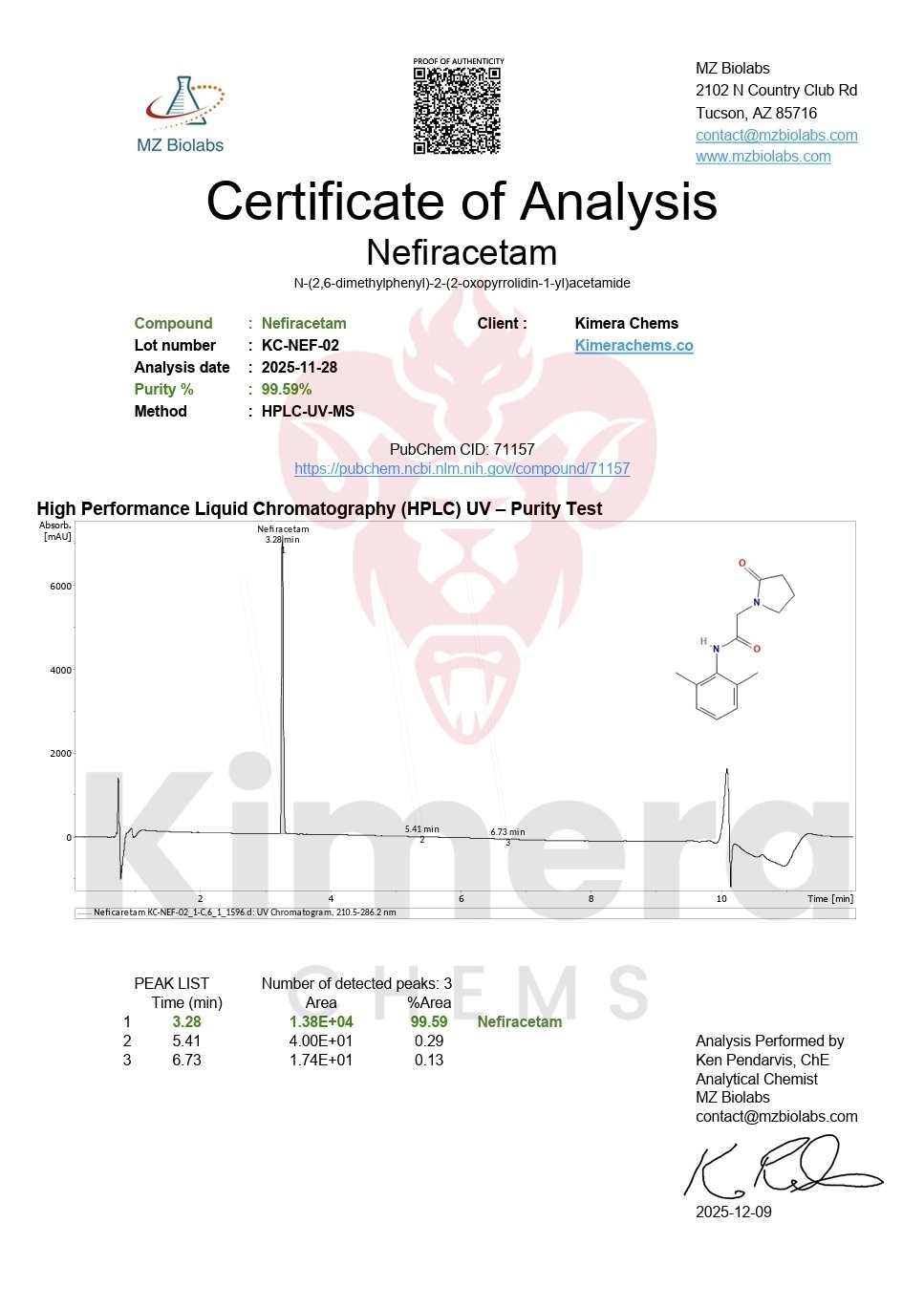
| Chemical Formula | C₁₄H₁₈N₂O₂ |
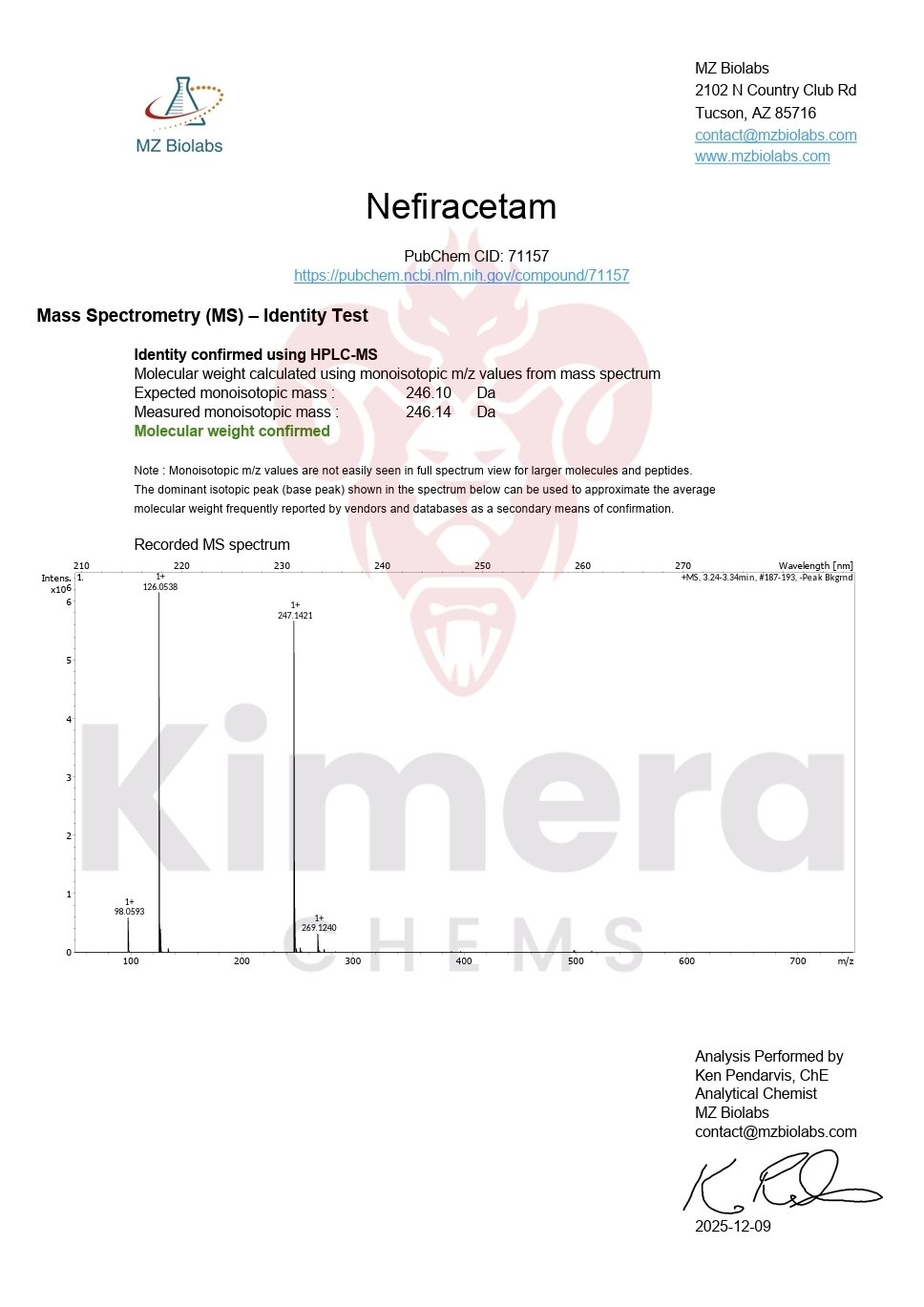
| Molecular Weight | 246.31 g/mol |
| Chemical Class | N-phenyl-substituted pyrrolidone (Racetam) |
| Physical Appearance | White to off-white / light yellow crystalline powder |
| Assay Purity | ≥ 98% (HPLC verified) |
Mechanism of Action & Research Context
Nefiracetam is researched for its multi-target interactions within the central nervous system, particularly its influence on excitatory and inhibitory signaling pathways.
-
Calcium Channel Modulation: Research highlights its ability to facilitate the activity of voltage-dependent calcium channels (specifically N-type and L-type), which is central to its role in enhancing neurotransmitter release.
-
Cholinergic Enhancement: The compound is widely used to study the sustained enhancement of acetylcholine (ACh) release in the hippocampus, a pathway critical for studying memory formation and synaptic plasticity.
-
GABAergic & Glutamatergic Signaling: Investigations utilize Nefiracetam to observe its modulatory effects on GABA receptors and its potential to counteract excitotoxicity via glutamate pathway regulation.
-
Neuroplasticity: Through these mechanisms, the compound serves as a probe for observing structural changes in neuronal connections and the molecular basis of long-term potentiation (LTP).
Research Applications
Nefiracetam is a specialized reference compound for studying cognitive pharmacology and neuroprotection.
Primary fields of in vitro laboratory investigation include:
-
Synaptic Plasticity Studies: Exploring cellular models of learning and information processing by measuring changes in synaptic efficiency.
-
Calcium Channel Dynamics: Quantifying ion flux through nerve cell membranes in the presence of N-phenyl-substituted pyrrolidones.
-
Neuroprotective Research: Observing cellular responses to oxidative or metabolic stress to evaluate the potential of racetam-class molecules to mitigate nerve cell damage.
-
Receptor Signaling: Examining the interaction between the pyrrolidone nucleus and various neurotransmitter sites (GABA, ACh).
Storage & Handling Guidelines
To maintain the chemical stability and experimental consistency of the compound:
-
Storage Environment: Keep in a cool, dry place.
-
Environmental Control: Protect from heat, high moisture, and direct sunlight to prevent degradation of the pyrrolidone scaffold.
-
Vial Integrity: Close the lid tightly as soon as the material is accessed to prevent atmospheric oxidation.
-
Handling: Utilize a clean, stainless steel or sterile spatula to dispense the powder. Avoid returning unused material to the original container to prevent cross-contamination.
References
-
Nishizaki T, et al. (1999) “Nefiracetam facilitates neurotransmission by stimulating the activity of N-type Ca2+ channels.” Journal of Biological Chemistry. 274(2): 895–902.
-
Moriguchi S, et al. (2003) “Nefiracetam enhances long-term potentiation and synaptic transmission in the hippocampus.” Neuropharmacology. 45(4): 509–518.
-
Karasawa J, et al. (1997) “Nefiracetam: a novel cognitive enhancer.” CNS Drug Reviews. 3(2): 179–191.
Research Use Disclaimer
Research Use Only Disclaimer: This product is developed and distributed strictly as a Research Use Only (RUO) laboratory reference chemical intended exclusively for non-clinical analytical and scientific investigation. It is not an FDA-approved drug, medical treatment, dietary supplement, or food ingredient, and is strictly prohibited for human or animal consumption. Kimera Chems supplies this high-purity research material solely to qualified institutions and professional investigators for authorized laboratory research.
| CAS Number | 77191-36-7 |
| Other Names | Translon, DM 9384, DMPPA, Nefiracetamum, Motiva, DM-9384, DZL-221, CCRIS 6729, NSC-759830, BRN 6848330, UNII-1JK12GX30N |
| IUPAC Name | N-(2,6-dimethylphenyl)-2-(2-oxopyrrolidin-1-yl)acetamide |
| Molecular Formula | C₁₄H₁₈N₂O₂ |
| Molecular Weight | 246.3 |
Product FAQs
What is Nefiracetam supplied for?
This material is supplied strictly for controlled, non-clinical laboratory and analytical research. It is not intended for human or animal consumption.
Which formats are available for Nefiracetam?
The current listing shows these options: dry-fill-capsule-120ct-100mg-12g, powder-20-grams. Availability can change, so confirm the selector above before ordering.
Where can I review product documentation?
Where available, batch documentation can be reviewed in the Certificate of Analysis library before ordering.
Research Documentation Guides
Review these supporting analytical guides before evaluating this material for a controlled research protocol:
Related products


Nootropics

Nootropics

Nootropics

Nootropics

Nootropics


Nootropics

Nootropics


Nootropics