
Research Guides
HPLC System Suitability Testing: Resolution, Tailing and Repeatability
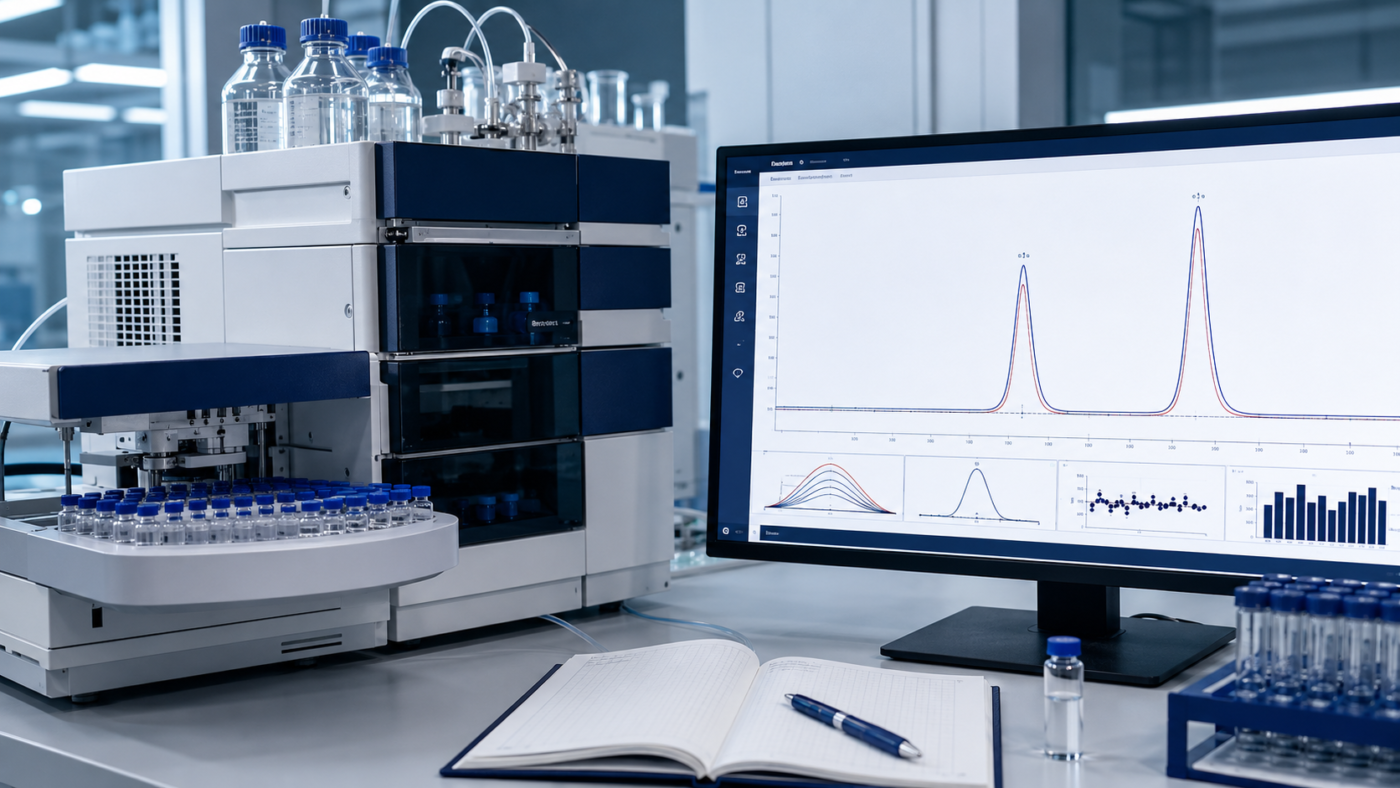
Sep
HPLC system suitability testing verifies that a chromatographic system is performing adequately when an analytical procedure is used. It evaluates the combined performance of the instrument, column, mobile phase, detector, reference preparation and operating conditions rather than examining the instrument in isolation.
A calibration curve or sample result may appear acceptable even when the chromatographic system has deteriorated. System-suitability criteria help identify inadequate resolution, unstable response, excessive peak tailing, poor efficiency or inconsistent injections before analytical conclusions are accepted.
This guide is intended exclusively for controlled laboratory and analytical research. It does not replace validated procedures, laboratory protocols, applicable standards or professional analytical review. The materials discussed are not intended for human consumption, diagnostic use, therapeutic use or clinical application.
What Is HPLC System Suitability Testing?
A system suitability test is a documented check that an analytical system is capable of producing data of acceptable quality for a specific procedure. It is normally performed using a defined reference, standard or suitability solution.
The test may be conducted before sample analysis, at intervals during a sequence or at both stages. The applicable analytical procedure should define the required preparation, injection sequence, calculations and acceptance criteria.
| Parameter | What it evaluates | Possible problem indicated |
|---|---|---|
| Repeatability | Consistency of repeated injections | Injection, preparation or detector instability |
| Resolution | Separation between relevant peaks | Co-elution or inadequate selectivity |
| Peak tailing | Symmetry of a chromatographic peak | Column, chemistry or sample-loading problems |
| Column efficiency | Band broadening and peak sharpness | Column deterioration or unsuitable conditions |
| Retention behavior | Consistency of analyte elution | Flow, mobile-phase or temperature changes |
| Signal-to-noise | Analyte response relative to background noise | Insufficient sensitivity or excessive noise |
Why System Suitability Matters
An HPLC result depends on many interacting components. These include the pump, injector, tubing, column, mobile phase, detector, software, standard preparation and analyst technique.
System suitability provides evidence that these elements are functioning together as required at the time of analysis. It can help detect:
- Changes in mobile-phase composition
- Incorrect flow rate
- Leaks or pressure instability
- Column deterioration
- Temperature variation
- Autosampler inconsistency
- Detector drift or excessive noise
- Poorly prepared standards
- Carryover or contamination
Passing system suitability does not prove that every sample result is correct. It establishes that defined performance checks were met under the analytical conditions used.
System Suitability vs Instrument Calibration
Instrument calibration and system suitability are related but different controls.
- Instrument calibration evaluates whether an instrument component performs according to established measurement requirements.
- System suitability evaluates whether the complete analytical system is capable of performing a particular procedure.
For example, an HPLC pump may have a current flow-rate calibration, but the analytical procedure may still fail system suitability because two important peaks are not adequately separated.
System Suitability vs an HPLC Calibration Curve
A calibration curve establishes a relationship between analyte concentration and detector response. System suitability verifies that the chromatographic system can generate suitable data during the analytical sequence.
A high calibration correlation coefficient does not override failed system suitability. Calibration points may still produce an apparently orderly response when peak separation, injection repeatability or chromatographic efficiency is unacceptable.
For more information, see HPLC Calibration Curves Explained.
Injection Repeatability
Injection repeatability evaluates the consistency of responses produced by repeated injections of the same solution. The analytical procedure commonly assesses the relative standard deviation of peak areas, peak heights or response ratios.
Variation may originate from:
- Autosampler-volume inconsistency
- Air bubbles
- Sample evaporation
- Incomplete vial mixing
- Needle or injection-port problems
- Detector instability
- Standard degradation
- Inadequate system equilibration
The number of replicate injections and the applicable acceptance limit should be defined in the analytical procedure.
Relative Standard Deviation
Relative standard deviation, commonly abbreviated as RSD, expresses the standard deviation relative to the mean response:
RSD (%) = standard deviation ÷ mean × 100
A lower RSD generally indicates more consistent repeated responses. However, an acceptable RSD does not demonstrate peak identity, adequate separation or quantitative accuracy by itself.
Identical but incorrect injections could produce a low RSD. Repeatability must therefore be considered alongside other system-suitability and analytical controls.
Chromatographic Resolution
Resolution describes how effectively two chromatographic peaks are separated. It is particularly important when an analyte must be measured in the presence of a related compound, impurity, degradation product or internal standard.
Resolution is influenced by:
- Column selectivity
- Column efficiency
- Retention behavior
- Mobile-phase composition
- Gradient conditions
- Flow rate
- Column temperature
- Sample solvent and concentration
If two components are inadequately resolved, their responses can overlap. This may affect integration, impurity reporting, assay calculations and peak assignment.
Why Resolution Cannot Be Judged Only by Appearance
Two peaks may look separate on a displayed chromatogram while still failing a defined resolution requirement. Conversely, display scaling may make acceptable separation appear less clear.
A documented resolution calculation provides a more consistent assessment than visual inspection alone. The procedure should identify which peaks are used and where the acceptance criterion applies.
Peak Tailing and Symmetry
An ideal chromatographic peak is approximately symmetrical. Actual peaks may trail gradually after their apex or exhibit fronting before the apex.
Excessive tailing can make integration less reliable and reduce separation from nearby components. Causes may include:
- Interactions with active column sites
- Column contamination
- Unsuitable mobile-phase pH
- Excessive sample loading
- Sample-solvent mismatch
- Dead volume or poor connections
- Deteriorated stationary phase
Tailing factor or symmetry factor may be reported, depending on the procedure and calculation convention. The report should identify which measurement was used because the terms and equations are not always interchangeable.
Column Efficiency and Theoretical Plates
Column efficiency describes chromatographic band broadening. It is commonly expressed as a theoretical plate count calculated from retention time and peak width.
A higher plate count generally corresponds to a narrower peak under the defined conditions. However, values depend on the calculation method, analyte, retention, flow rate, column dimensions and system configuration.
Reduced efficiency may indicate:
- Column aging or contamination
- Void formation
- Extra-column volume
- Incorrect flow conditions
- Temperature problems
- Poor mobile-phase preparation
Plate-count values should only be compared when they were calculated under equivalent conditions.
Retention Time and Relative Retention
Retention time is the period between injection and detection of a chromatographic component. It can support peak assignment when a sample is compared with a suitable reference under the same conditions.
Retention can change with variations in:
- Mobile-phase composition
- Flow rate
- Column temperature
- Column chemistry
- Gradient timing
- System dwell volume
- Column equilibration
A minor retention-time shift does not automatically mean the compound has changed. The magnitude, direction and effect on peak separation should be evaluated.
Capacity Factor and Retention Factor
Retention factor compares the time an analyte spends retained by the chromatographic system with the time required for an unretained component to pass through it.
A very weakly retained peak may be difficult to separate from the solvent front or unretained components. Excessive retention can produce broad peaks and long analysis times.
Not every HPLC method uses retention factor as a routine suitability criterion, but it can provide useful information during method development and troubleshooting.
Signal-to-Noise Ratio
Signal-to-noise ratio compares the analytical signal with background fluctuation. It is particularly relevant near detection or quantitation limits.
Noise may be affected by:
- Mobile-phase impurities
- Detector condition
- Air bubbles
- Temperature instability
- Electrical interference
- Column bleed or contamination
- Inadequate equilibration
A visible peak is not necessarily quantitatively reliable. The procedure must establish acceptable performance for its intended reporting level.
Which Solution Is Used for System Suitability?
The composition of the system-suitability solution depends on the analytical purpose. It may contain:
- The principal analyte
- A closely eluting impurity
- A degradation product
- An internal standard
- A peak-position marker
- A mixture designed to challenge chromatographic separation
A suitability solution should challenge the performance characteristic that matters to the method. Repeated injections of a single well-separated analyte may evaluate precision but provide little evidence about separation from a critical impurity.
The materials used should be sufficiently characterized for their intended role. See Analytical Reference Standards Explained.
When Is System Suitability Performed?
System suitability is commonly evaluated before samples are accepted. Additional checks may be placed throughout a long sequence to confirm that performance remains controlled.
The procedure may require testing:
- Before the first sample
- After system equilibration
- After instrument maintenance
- After a column change
- At defined intervals within a sequence
- At the end of the analytical run
The timing should account for the likelihood of response drift, retention changes, standard instability and the total length of the sequence.
What Happens When System Suitability Fails?
When a system-suitability criterion fails, the associated sample results should not automatically be accepted. The laboratory should follow an established investigation procedure.
Relevant checks may include:
- Reviewing calculations and integration.
- Confirming that the correct solution was injected.
- Examining pressure and instrument logs.
- Checking mobile-phase preparation and age.
- Inspecting the column and connections.
- Confirming temperature and flow conditions.
- Evaluating solution stability.
- Checking for leaks, bubbles or carryover.
- Documenting the identified cause and corrective action.
Repeatedly injecting a failed solution until a passing result appears can conceal an unresolved problem. Reinjection or preparation replacement should be scientifically justified and documented.
Can System Suitability Be Adjusted After Failure?
Minor adjustments may sometimes be permitted by a procedure or applicable standard, but changes should remain within defined limits and should not alter the analytical intent.
Changing mobile-phase composition, temperature, flow rate or column conditions can affect selectivity and quantitative performance. Undocumented changes made solely to obtain passing results weaken the reliability of the analysis.
System Suitability and HPLC Purity
An HPLC purity result depends on adequate separation, stable detection and defensible integration. If system suitability fails, the apparent purity percentage may not accurately represent the chromatographic response.
For example, poor resolution can cause an impurity to co-elute with the principal peak. Excessive tailing can conceal a small adjacent peak or affect the selected integration boundaries.
Read HPLC Purity Percentage Explained for the limitations of area-normalization results.
System Suitability Is Not Method Validation
Method validation demonstrates that an analytical procedure is fit for its intended purpose. It may evaluate specificity, accuracy, precision, range, detection capability, quantitation capability and robustness.
System suitability is a routine performance check conducted when the validated or verified method is used. A passing suitability result does not replace method validation, and previous validation does not eliminate the need to verify current system performance.
How to Review System Suitability on a Report
When reviewing an analytical report, look for:
- The method or procedure identifier
- The instrument and column used
- The suitability-solution identity
- Reference-standard lot numbers
- The number and order of injections
- Each required performance parameter
- Acceptance criteria
- Actual calculated results
- Pass or fail conclusions
- Chromatograms and integration tables
- Documented deviations or investigations
- Analyst and review information
A statement reading “system suitability passed” provides less evidence than a report showing the criteria, calculations and supporting chromatograms.
For a wider documentation workflow, see How to Read a Research Compound COA and What to Look for in a Third-Party Laboratory Report.
Common System-Suitability Warning Signs
- No predefined acceptance criteria
- Criteria shown without actual results
- No suitability chromatograms
- Failed injections removed without explanation
- Repeated injections performed until passing
- Different standard lots across connected records
- Suitability results recorded after sample analysis
- Missing resolution for a critical peak pair
- Manual integration changes with no justification
- Acceptance criteria changed during the run
- Sample results reported despite failed suitability
Practical Review Checklist
- Confirm that the correct analytical procedure was used.
- Identify every required system-suitability parameter.
- Compare each result with its acceptance criterion.
- Review replicate-injection consistency.
- Check resolution for the critical peak pair.
- Review peak symmetry and efficiency.
- Confirm suitable retention behavior.
- Inspect the supporting chromatograms.
- Check whether suitability remained acceptable throughout the run.
- Review any failure, reinjection or corrective action.
Frequently Asked Questions
What is the purpose of HPLC system suitability?
It verifies that the complete chromatographic system can meet predefined performance requirements for a particular analytical procedure.
Is system suitability required before every HPLC run?
The applicable procedure should define when it is performed. It is commonly evaluated before samples are accepted and may be repeated during long sequences.
What is the difference between resolution and repeatability?
Resolution evaluates separation between peaks. Repeatability evaluates the consistency of responses obtained from repeated analysis of the same preparation.
Does a passing system-suitability test prove the sample result is correct?
No. It confirms that specified system-performance criteria were met. Sample preparation, identity, calculations, calibration and data review must also be suitable.
Can a high R² compensate for failed system suitability?
No. An acceptable calibration model does not compensate for inadequate resolution, unstable injections or other chromatographic failures.
What should happen after system suitability fails?
The laboratory should investigate the failure, identify the cause where possible, document corrective action and establish whether the analytical sequence remains valid.
Does one HPLC method use the same limits as another?
No. Acceptance criteria should be based on the method, analytes, critical separations and intended analytical result.
System-suitability results should be reviewed with the analytical method, chromatogram and applicable acceptance criteria. Researchers can compare materials in the Kimerachems analytical reagents category and review available batch reports through the certificate of analysis library.
Conclusion
HPLC system suitability testing provides evidence that the instrument, column, detector, solutions and method conditions are functioning together adequately at the time of analysis.
Resolution, repeatability, peak tailing, column efficiency, retention behavior and signal quality answer different performance questions. These results should be reviewed against predefined criteria and supported by complete chromatograms and calculations.
Technical References
- ICH Q2(R2): Validation of Analytical Procedures
- ICH Q14: Analytical Procedure Development
- FDA: Validation and Verification of Analytical Testing Methods
