




BPC-157/TB-500 Blend


Price range: $64.99 through $101.99
Kimerachems BPC-157/TB-500 Blend for sale. Intended for controlled laboratory and analytical research only.
Review available formats, product specifications and batch documentation before ordering. Not for human consumption.
Kimerachems BPC-157/TB-500 Blend for sale. This material is supplied exclusively for controlled laboratory and analytical research. Review available formats, technical specifications and batch documentation before ordering. Not for human consumption.
BPC-157 / TB-500
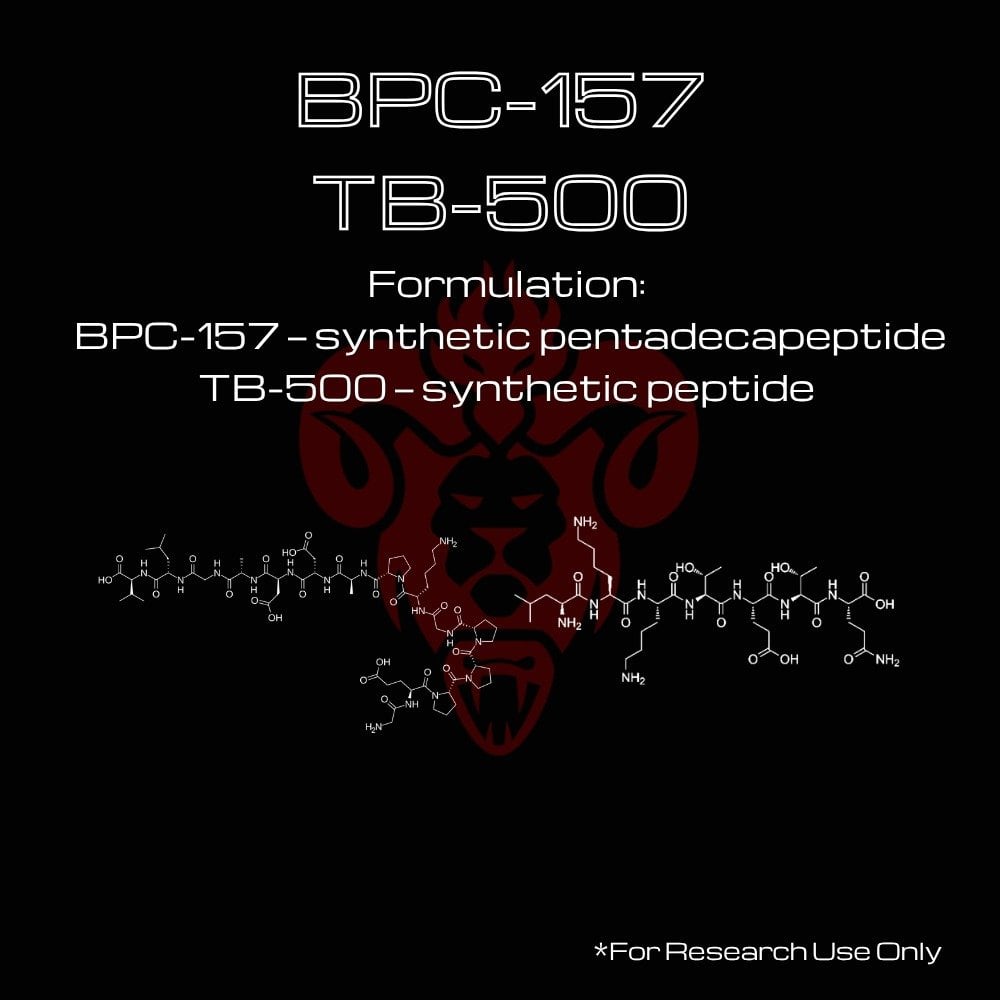
The BPC-157 / TB-500 Peptide Matrix is a precisely proportioned chemical combination of two synthetic investigational peptides designed specifically for multi-analyte calibration, chromatographic method development, and comparative laboratory evaluation. This formulation couples a gastric juice-derived pentadecapeptide fragment with a full-length, 43-amino acid actin-sequestering protein. By offering both compounds within a single analytical matrix, this product serves as a vital tool for researchers establishing advanced liquid chromatography-mass spectrometry (LC-MS) parameters, verifying blend homogeneity, and mapping distinct macromolecular properties within a unified experimental layout.
Technical Specifications
Because this formulation represents a dual-component peptide matrix, its chemical configuration is defined by its individual active constituents:
| Component | CAS Number | Molecular Formula | Molecular Weight | Chemical Class |
| BPC-157 | 137525-51-0 | C₆₂H₉₈N₁₆O₂₂ | 1419.56 g/mol | Synthetic Pentadecapeptide |
| TB-500 (Thymosin β4) | 77591-33-4 | C₂₁₂H₃₅₀N₅₆O₇₈S | 4963.50 g/mol | 43-Amino Acid Actin-Sequestering Peptide |
Component Amino Acid Sequences:
-
BPC-157: Gly-Glu-Pro-Pro-Pro-Gly-Lys-Pro-Ala-Asp-Asp-Ala-Gly-Leu-Val
-
TB-500 (Full-Length Thymosin β4): Ac-Ser-Asp-Lys-Pro-Asp-Met-Ala-Glu-Ile-Glu-Lys-Phe-Asp-Lys-Ser-Lys-Leu-Lys-Lys-Thr-Glu-Thr-Gln-Glu-Lys-Asn-Pro-Leu-Pro-Ser-Lys-Glu-Thr-Ile-Glu-Gln-Glu-Lys-Gln-Ala-Gly-Glu-Ser
Note on Structural Authenticity: The TB-500 component utilized in this matrix consists strictly of the authentic, full-length 43-residue Thymosin β4 chain. It is chemically distinct from the truncated 7-amino acid active fragment (LKKTETQ) frequently substituted in the research industry. Due to the fivefold mass variance between these two distinct structures, verifying full-length sequence integrity is critical for baseline experimental reproduction.
Research Applications & Analytical Context
The combination of BPC-157 and full-length Thymosin β4 is highly valued in analytical chemistry and method-development workflows. Because the two molecules exhibit a massive disparity in overall molecular mass, charge density, and retention characteristics, they present an ideal environment for optimizing multi-component peptide assays.
Primary areas of laboratory evaluation include:
-
Chromatographic Separation Workflows: Establishing baseline resolution parameters, mobile phase gradients, and column efficiency metrics during the high-performance liquid chromatography separation of co-eluting peptide analytes.
-
LC-MS Parameter Calibration: Tuning mass spectrometry ionization, fragmentation, and collision energy settings across a wide mass spectrum (1,419 g/mol vs. 4,963 g/mol) simultaneously.
-
Cytoskeletal & Monomer Interaction Research: Utilizing Thymosin β4 to evaluate G-actin monomer binding kinetics, a mechanism extensively documented in cellular architecture literature for its role in regulating filament polymerization pools.
-
Growth Factor Cascade Analysis: Evaluating BPC-157 within specialized in vitro frameworks to track its documented interactions with localized growth factor receptors and nitric oxide signaling pathways.
Experimental Design Advisory: This multi-component material is optimized for analytical, separation, and ratio-verification studies. For individual mechanistic or cell-specific pathway isolation, single-compound target references should be deployed, as a combined matrix prevents the absolute attribution of downstream biological effects to a single constituent.
Storage & Handling Guidelines
To maintain complete molecular uniformity, preserve the integrity of the peptide bonds, and secure reproducible analytical results:
-
Long-Term Preservation: Maintain the chemical matrix in a deeply frozen state at -20°C or lower to halt degradative mechanisms.
-
Short-Term Maintenance: Reconstituted working solutions or active assay baselines must be kept continuously refrigerated at 2–8°C.
-
Environmental Isolations: Keep the compound stored inside an airtight, moisture-free environment protected by a desiccant matrix. Store strictly inside opaque or amber laboratory vessels to fully eliminate light-induced or ultraviolet degradation.
-
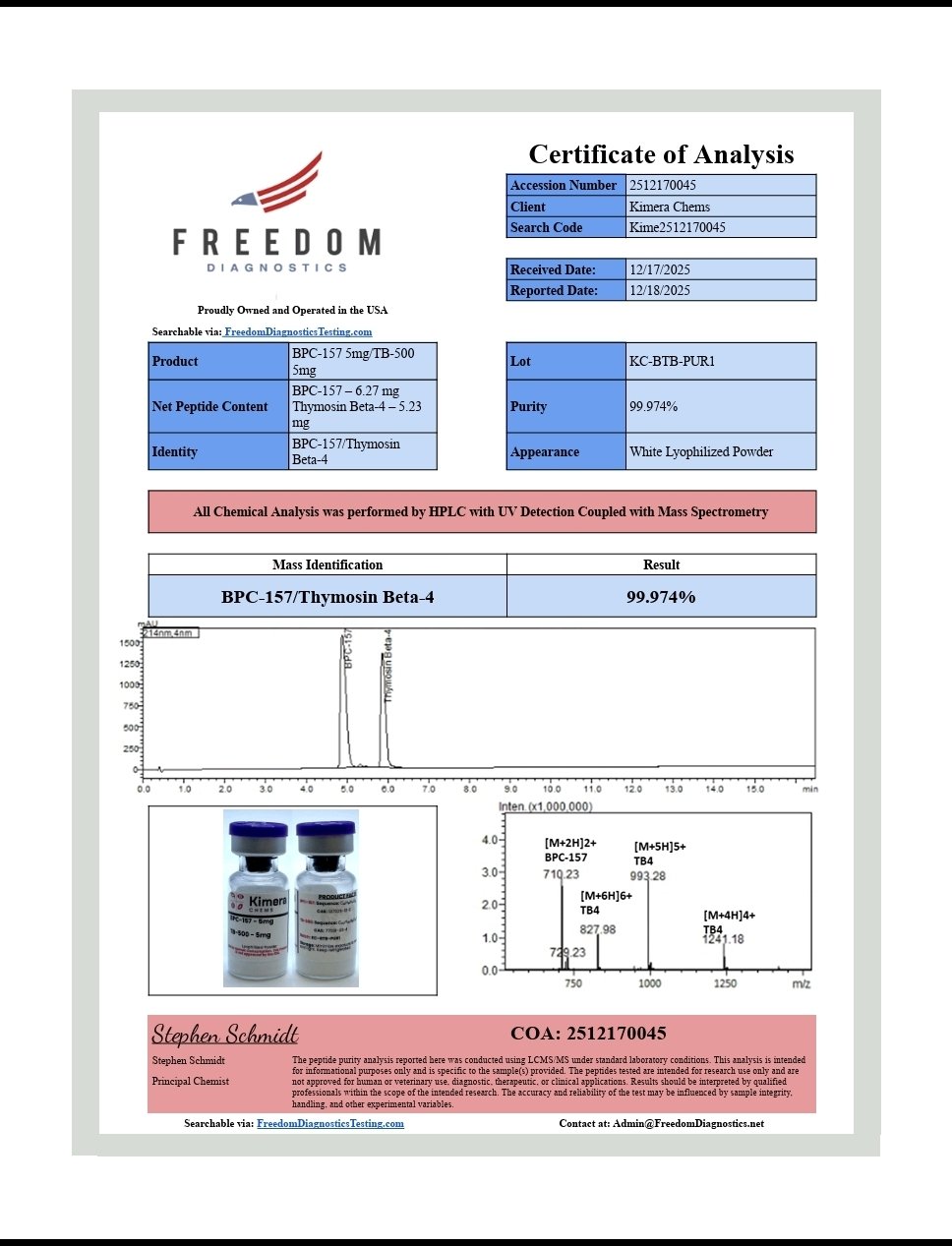
Quality Assurance Auditing: Kimera Chems subjects every production batch to a strict dual-method verification protocol, combining High-Performance Liquid Chromatography (HPLC) with CHN elemental analysis to independently audit compound identity, blend homogeneity, and absolute purity baselines.
Research Use Only Disclaimer: This product is engineered, manufactured, and distributed strictly as a Research Use Only (RUO) reference material intended exclusively for in vitro analytical laboratory applications and method development. It is not an FDA-approved drug, medication, food product, cosmetic, or dietary supplement, and is strictly prohibited for human or veterinary use. No clinical data, safety profiles, or dosing instructions are provided or implied. Accessory laboratory tools, including syringes, sterile delivery vectors, and bacteriostatic water, are neither included nor provided by Kimera Chems.
Frequently Asked Research Questions
Why does this matrix utilize full-length Thymosin β4 instead of the shorter TB-500 fragment?
Utilizing the full 43-amino acid chain ensures that the material possesses the native chemical characteristics, mass markers, and complete G-actin sequestering capabilities required for authentic cytoskeletal research and heavy-chain MS calibration, which cannot be simulated by the smaller 7-residue fragment.
How does the mass difference affect experimental calculations?
Because full-length Thymosin β4 has a molecular weight roughly 3.5 times greater than BPC-157, equal mass concentrations will result in significantly different molar ratios within an assay environment. Researchers must calibrate their liquid handling and dilution calculations based on the exact molar profiles provided in the lot-specific Certificate of Analysis.
Scientific References
-
Goldstein, A. L., Hannappel, E., & Kleinman, H. K. (2005). “Thymosin β4: actin-sequestering protein and more.” Expert Opinion on Biological Therapy, 5(2), 233–246. DOI: 10.1517/14712598.5.2.233.
-
Chang, C. H., Tsai, W. C., Lin, M. S., Hsu, Y. H., & Pang, J. H. (2011). “The promoting effect of pentadecapeptide BPC 157 on tendon healing involves tendon outgrowth, cell survival, and cell migration.” Journal of Applied Physiology, 110(3), 774–780. DOI: 10.1152/japplphysiol.00945.2010.
-
Sikiric, P., et al. (2013). “Toxicity by non-steroidal anti-inflammatory drugs (NSAIDs) and stable gastric pentadecapeptide BPC 157.” Current Pharmaceutical Design, 19(1), 76–83. DOI: 10.2174/138161213803802571.
Specification Set 1
| CAS Number | 137525-51-0 (BPC-157) |
| Other Names | BPC-157 5mg/5mg |
| IUPAC Name | (4S)-4-[(2-aminoacetyl)amino]-5-[(2S)-2-[(2S)-2-[(2S)-2-[[2-[[(2S)-6-amino-1-[(2S)-2-[[(2S)-1-[[(2S)-3-carboxy-1-[[(2S)-3-carboxy-1-[[(2S)-1-[[2-[[(2S)-1-[[(1S)-1-carboxy-2-methylpropyl]amino]-4-methyl-1-oxopentan-2-yl]amino]-2-oxoethyl]amino]-1-oxopropan-2-yl]amino]-1-oxopropan-2-yl]amino]-1-oxopropan-2-yl]amino]-1-oxopropan-2-yl]carbamoyl]pyrrolidin-1-yl]-1-oxohexan-2-yl]amino]-2-oxoethyl]carbamoyl]pyrrolidine-1-carbonyl]pyrrolidine-1-carbonyl]pyrrolidin-1-yl]-5-oxopentanoic acid |
| Molecular Formula | C₆₂H₉₈N₁₆O₂₂ |
| Molecular Weight | 1419.5 |
Specification Set 2
| CAS Number | 77591-33-4 (TB-500) |
| Other Names | TB-500 |
| IUPAC Name | (4S)-4-[[2-[[(2S)-2-[[(2S)-2-[[(2S)-2-[[(2S)-2-[[(2S)-2-[[(2S)-2-[[(2S,3S)-2-[[(2S,3R)-2-[[(2S)-2-[[(2S)-2-[[(2S)-2-[[(2S)-1-[(2S)-2-[[(2S)-1-[(2S)-2-[[(2S)-2-[[(2S)-2-[[(2S)-2-[[(2S,3R)-2-[[(2S)-2-[[(2S,3R)-2-[[(2S)-2-[[(2S)-2-[[(2S)-2-[[(2S)-2-[[(2S)-2-[[(2S)-2-[[(2S)-2-[[(2S)-2-[[(2S)-2-[[(2S)-2-[[(2S,3S)-2-[[(2S)-2-[[(2S)-2-[[(2S)-2-[[(2S)-2-[[(2S)-1-[(2S)-2-[[(2S)-2-[[(2S)-2-acetamido-3-hydroxypropanoyl]amino]-3-carboxypropanoyl]amino]-6-aminohexanoyl]pyrrolidine-2-carbonyl]amino]-3-carboxypropanoyl]amino]-4-methylsulfanylbutanoyl]amino]propanoyl]amino]-4-carboxybutanoyl]amino]-3-methylpentanoyl]amino]-4-carboxybutanoyl]amino]-6-aminohexanoyl]amino]-3-phenylpropanoyl]amino]-3-carboxypropanoyl]amino]-6-aminohexanoyl]amino]-3-hydroxypropanoyl]amino]-6-aminohexanoyl]amino]-4-methylpentanoyl]amino]-6-aminohexanoyl]amino]-6-aminohexanoyl]amino]-3-hydroxybutanoyl]amino]-4-carboxybutanoyl]amino]-3-hydroxybutanoyl]amino]-5-amino-5-oxopentanoyl]amino]-4-carboxybutanoyl]amino]-6-aminohexanoyl]amino]-4-amino-4-oxobutanoyl]pyrrolidine-2-carbonyl]amino]-4-methylpentanoyl]pyrrolidine-2-carbonyl]amino]-3-hydroxypropanoyl]amino]-6-aminohexanoyl]amino]-4-carboxybutanoyl]amino]-3-hydroxybutanoyl]amino]-3-methylpentanoyl]amino]-4-carboxybutanoyl]amino]-5-amino-5-oxopentanoyl]amino]-4-carboxybutanoyl]amino]-6-aminohexanoyl]amino]-5-amino-5-oxopentanoyl]amino]propanoyl]amino]acetyl]amino]-5-[[(1S)-1-carboxy-2-hydroxyethyl]amino]-5-oxopentanoic acid |
| Molecular Formula | C₂₁₂H₃₅₀N₅₆O₇₈S |
| Molecular Weight | 4963 |
Product FAQs
What is BPC-157/TB-500 Blend supplied for?
This material is supplied strictly for controlled, non-clinical laboratory and analytical research. It is not intended for human or animal consumption.
Which formats are available for BPC-157/TB-500 Blend?
The current listing shows these options: Dry-Fill Capsule 1000mcg/60ct/60mg, Peptide (Lypholized Powder). Availability can change, so confirm the selector above before ordering.
Where can I review product documentation?
Where available, batch documentation can be reviewed in the Certificate of Analysis library before ordering.
Research Documentation Guides
Review these supporting analytical guides before evaluating this material for a controlled research protocol:
Related products
Peptides


Peptides

Peptides

Peptides

Peptides

Peptides

Peptides


Peptides