



DIHEXA


Price range: $121.99 through $176.99
Kimerachems DIHEXA for sale. Intended for controlled laboratory and analytical research only.
Review available formats, product specifications and batch documentation before ordering. Not for human consumption.
Kimerachems DIHEXA for sale. This material is supplied exclusively for controlled laboratory and analytical research. Review available formats, technical specifications and batch documentation before ordering. Not for human consumption.
DIHEXA
DIHEXA (also recognized in pre-clinical literature as PNB-0408 or ATH-1001) is a synthetic, angiotensin IV-derived peptidomimetic compound engineered to investigate pathways regulating synaptic connectivity and neuroplasticity. Structurally optimized to act as a stable, small-molecule functional analog rather than a traditional short-lived oligopeptide, DIHEXA exhibits an exceptionally high binding affinity to pathways linked with target synapse formation and cellular communication. Within advanced laboratory models, this compound serves as a critical reference ligand for mapping the structural mechanics of growth-factor-mediated signaling cascades and cellular resilience markers under controlled in vitro configurations.
Technical Specifications
| Property | Specification |
| Product Name | DIHEXA |
| CAS Number | 1401708-83-5 |
| IUPAC Name | 6-[(2S,3S)-2-[(2S)-2-hexanamido-3-(4-hydroxyphenyl)propanamido]-3-methylpentanamido]hexanamide |
| Molecular Formula | C₂₇H₄₄N₄O₅ |
| Molecular Weight | 504.67 g/mol |
| Chemical Class | Angiotensin IV-Derived Peptidomimetic |
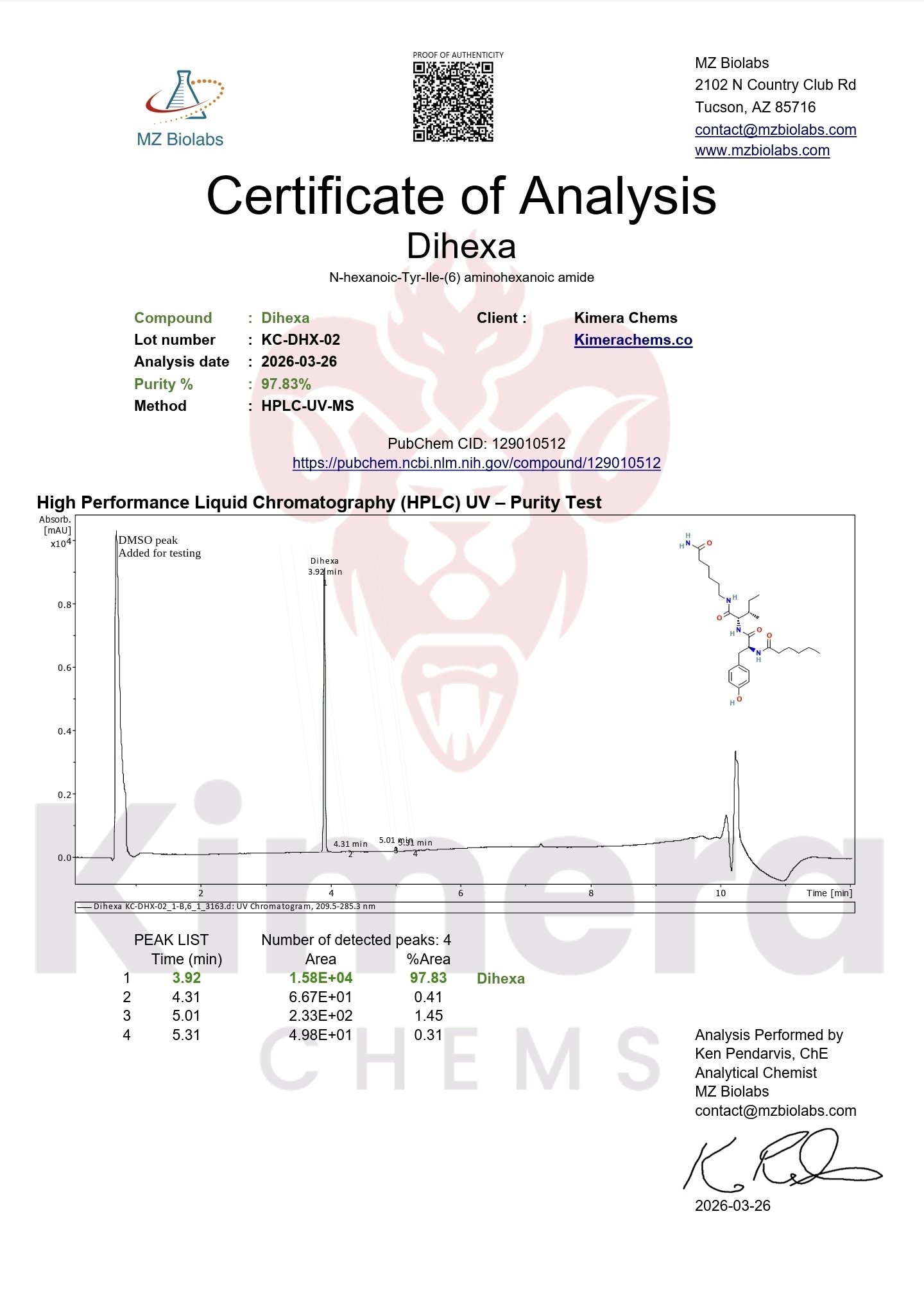
| Assay Purity | ≥98% (HPLC verified) |
| Physical Format | Fine crystalline white powder |
Research Applications & Mechanism of Interest
In non-clinical research environments, DIHEXA is primarily investigated for its unique capacity to allosterically bind and potentiate the hepatocyte growth factor (HGF) system. By pairing with native HGF, it promotes receptor dimerization and enhances autophosphorylation thresholds of the c-Met receptor tyrosine kinase—a key modulator of structural cellular growth.
Primary fields of exploratory laboratory study include:
-
HGF/c-Met Axis Activation Pathways: Mapping downstream cellular events, specifically the recruitment and activation of phosphatidylinositol 3-kinase (PI3K) and protein kinase B (Akt) signaling loops that regulate cellular survival profiles.
-
Synaptogenesis & Spinogenesis Dynamics: Utilizing primary hippocampal neuronal cultures to quantify variations in synaptic density, dendritic arborization, and the physical formation of new functional synaptic connections.
-
Comparative Neurotrophic Benchmarking: Serving as a high-potency control compound in cellular differentiation assays to track target signaling efficiency alongside endogenous growth factors like Brain-Derived Neurotrophic Factor (BDNF).
-
Blood-Brain Barrier Permeability Modeling: Investigating the physicochemical properties of peptide-derived small molecules to understand how modifications to the amino-terminal backbone alter membrane diffusion and structural stability under physiological constraints.
Storage & Handling Guidelines
To secure molecular configuration, protect the tyrosine-like core, and maintain strict consistency across long-term experimental cohorts:
-
Thermal Environment: Store the dry reference powder in a deeply frozen environment maintained strictly at -20°C for long-term archiving. Reconstituted working stock assays may be held temporarily at 2–8°C, avoiding repeated freeze-thaw cycles to prevent mechanical breakdown of the amide chains.
-
Solvent Reconstitution: DIHEXA displays reliable solubility boundaries in anhydrous organic solvents such as dimethyl sulfoxide (DMSO). Initial master stocks should be fully dissolved in research-grade DMSO before dilution into working laboratory assay buffers.
-
Atmospheric & Light Protections: Keep containers hermetically sealed in a dark environment with an active desiccant to prevent atmospheric moisture absorption or photolytic degradation.
-
Analytical Auditing Standards: Every batch is verified using a strict protocol combining High-Performance Liquid Chromatography (HPLC) and CHN elemental analysis to independently audit mass distribution, chemical uniformity, and structural purity.
Research Use Only Disclaimer: This compound is developed, synthesized, and distributed strictly as a Research Use Only (RUO) laboratory chemical. It is not an FDA-approved medication, drug formulation, clinical compound, or dietary supplement, and is strictly prohibited for human or veterinary consumption. Kimera Chems provides these reference materials exclusively to qualified institutional laboratories and certified scientific investigators for use within controlled in vitro and preclinical research frameworks.
Frequently Asked Research Questions
Is DIHEXA classified as a standard peptide?
While DIHEXA is structurally derived from core fragments of the native peptide angiotensin IV, its terminal modifications classify it as an organic peptidomimetic or small-molecule analog. This design minimizes rapid enzymatic cleavage by ambient aminopeptidases, delivering significantly enhanced baseline stability during prolonged in vitro tissue testing compared to unaltered natural peptides.
How does DIHEXA alter downstream signaling without direct receptor competition?
Preclinical binding assays indicate that DIHEXA acts as an allosteric enhancer rather than a traditional direct agonist. It binds specifically to the domain of the HGF molecule, stabilizing its active conformation and dramatically amplifying downstream c-Met phosphorylation even when endogenous growth factor levels sit below standard activation thresholds.
Scientific References
-
Benoist, C. C., Kawas, L. H., Kuhnot, A. M., Wayman, G. A., & Harding, J. W. (2014). “The procognitive and synaptogenic effects of angiotensin IV-derived peptides are dependent on activation of the hepatocyte growth factor/c-Met system.” Journal of Pharmacology and Experimental Therapeutics, 351(2), 390–402. DOI: 10.1124/jpet.114.218552.
-
Wright, J. W., Kawas, L. H., & Harding, J. W. (2015). “The development of small molecule angiotensin IV analogs as cognitive enhancers.” Progress in Neurobiology, 125, 26–46. DOI: 10.1016/j.pneurobio.2014.11.004.
-
Sun, X., et al. (2021). “AngIV-analog dihexa rescues cognitive impairment and recovers memory in the APP/PS1 mouse via the PI3K/AKT signaling pathway.” Brain Sciences, 11(11), 1487. DOI: 10.3390/brainsci11111487.
| CAS Number | 1401708-83-5 |
| Other Names | L-Isoleucinamide, N-(1-oxohexyl)-L-tyrosyl-N-(6-amino-6-oxohexyl)-; 9WYX65A5C2; N-hexanoic-Tyr-Ile-(6) aminohexanoic amide; PNB-0408 |
| IUPAC Name | (2S,3S)-N-(6-amino-6-oxohexyl)-2-[[(2S)-2-(hexanoylamino)-3-(4-hydroxyphenyl)propanoyl]amino]-3-methylpentanamide |
| Molecular Formula | C₂₇H₄₄N₄O₅ |
| Molecular Weight | 504.67 |
| Liquid Concentration And Solution | 20mg |
Product FAQs
What is DIHEXA supplied for?
This material is supplied strictly for controlled, non-clinical laboratory and analytical research. It is not intended for human or animal consumption.
Which formats are available for DIHEXA?
The current listing shows these options: 1 Gram Powder, Dry-Fill Capsule 10mg/60ct/600mg, Liquid 30mL/20mg Per mL/600mg, Transdermal 50ml/10mg Per ml/500mg. Availability can change, so confirm the selector above before ordering.
Where can I review product documentation?
Where available, batch documentation can be reviewed in the Certificate of Analysis library before ordering.
Research Documentation Guides
Review these supporting analytical guides before evaluating this material for a controlled research protocol:
Related products


Nootropics

Nootropics

Nootropics

Nootropics

Nootropics

Nootropics


Nootropics


Nootropics