




MOTS-C


$49.99
Kimerachems MOTS-C for sale. Intended for controlled laboratory and analytical research only.
Review available formats, product specifications and batch documentation before ordering. Not for human consumption.
1000 in stock
Kimerachems MOTS-C for sale. This material is supplied exclusively for controlled laboratory and analytical research. Review available formats, technical specifications and batch documentation before ordering. Not for human consumption.
MOTS-C (Mitochondrial-Derived Peptide) Research Standard
MOTS-C is a synthetic mitochondrial-derived peptide (MDP) encoded within the mitochondrial genome. As a short bioactive peptide, it functions as a signaling molecule that facilitates communication between the mitochondria and the nucleus. In laboratory research, MOTS-C is studied for its role in metabolic homeostasis, including the regulation of insulin sensitivity, glucose metabolism, and cellular stress responses. It serves as a specialized reference standard for investigating mitochondrial signaling loops and the therapeutic potential of MDPs in metabolic pathway mapping.
Technical Specifications
| Property | Specification |
| Product Name | MOTS-C |
| Chemical Formula | C101H152N28O22S2 |
| Molecular Weight | 2174.6 g/mol |
| Chemical Class | Mitochondrial-derived peptide (MDP) |
| Physical Appearance | White lyophilized powder |
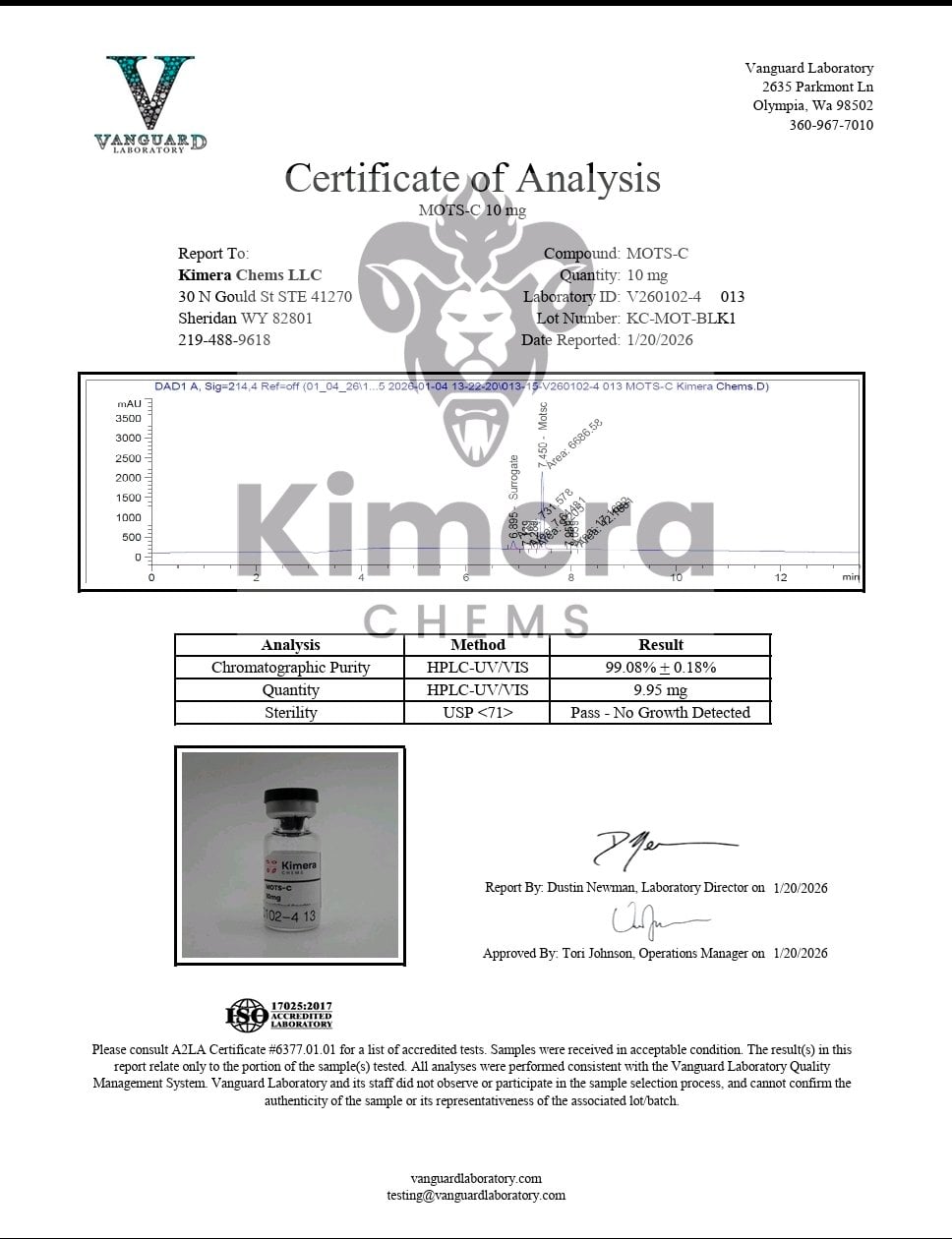
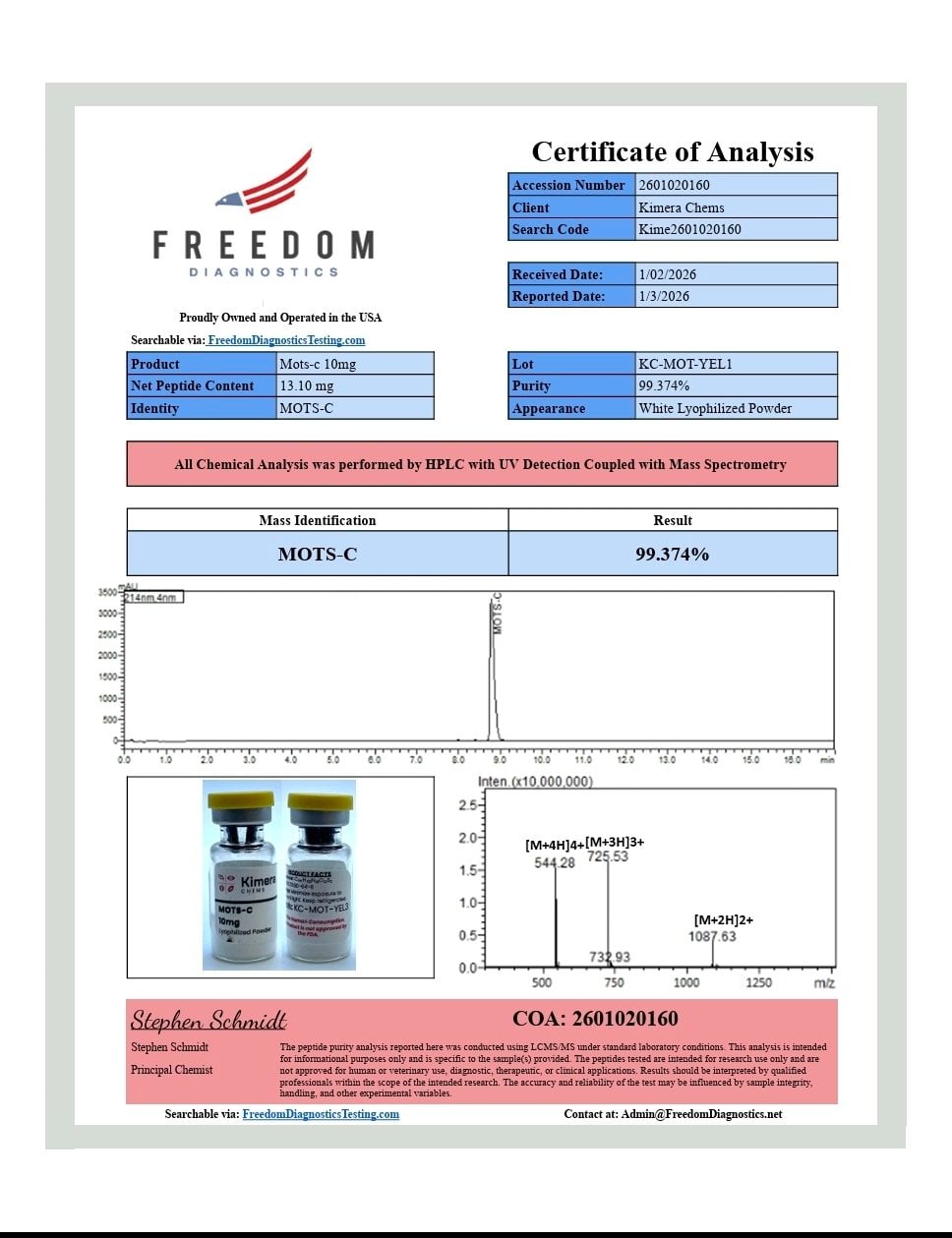
| Assay Purity | ≥98% (verified by HPLC and Mass Spectrometry) |
Mechanism of Action & Research Context
MOTS-C is unique in its origin, being encoded directly within the 12S rRNA region of the mitochondrial DNA.
-
Pathway Interaction: It modulates metabolic signaling by translocating from the mitochondria to the cell nucleus, where it can influence gene expression.
-
Signaling Loops: Researchers utilize MOTS-C to observe how it interacts with cytoplasmic and nuclear signaling pathways, specifically those regulating energy metabolism and inflammatory responses.
-
Metabolic Homeostasis: It is widely investigated for its potential to improve insulin sensitivity and mitigate metabolic dysfunction in controlled experimental models.
Research Applications
MOTS-C is a pivotal tool for exploring the crosstalk between mitochondrial function and nuclear gene expression.
Primary fields of in vitro laboratory investigation include:
-
Mitochondrial Pathway Mapping: Observing peptide-mediated interactions within mitochondrial signaling loops.
-
Nuclear Interaction Studies: Investigating the translocation dynamics of the peptide into the cell nucleus and its subsequent effect on transcriptional output.
-
Binding Affinity Assays: Measuring the interaction strength between MOTS-C and specific target proteins involved in metabolic regulation.
-
Molecular Stability Tests: Testing the integrity and half-life of the peptide chain under varying thermal and pH environments.
Storage & Handling Guidelines
To maintain the chemical stability and experimental viability of the lyophilized peptide:
-
Long-Term Storage: Store lyophilized vials in a freezer.
-
Short-Term/Reconstituted Material: Keep reconstituted samples in a refrigerator.
-
Environmental Control: Store at room temperature (if lyophilized, short-term) and ensure the material is kept away from direct light.
-
Aseptic Technique: Utilize clean laboratory equipment and sterile techniques to prevent cross-contamination during weighing and reconstitution.
-
Vial Integrity: Keep the container tightly sealed after each use to prevent atmospheric moisture and air entry.
References
-
Lee C, et al. (2015) The mitochondrial-derived peptide MOTS-c promotes metabolic homeostasis and reduces obesity and insulin resistance. Cell Metabolism. 21(3):443–454.
-
Kumagai H, et al. (2016) MOTS-c Reduces Appetite and Alters Body Composition and Energy Metabolism in Mice. JCI Insight. 1(10):e88029.
-
Hashimoto Y, et al. (2018) Mitochondrial-derived peptide MOTS-c improves insulin sensitivity and mitochondrial respiration in skeletal muscle. Am J Physiol Endocrinol Metab. 314(4):E333–E347.
Research Use Disclaimer
Research Use Only Disclaimer: This product is developed and distributed strictly as a Research Use Only (RUO) laboratory reference chemical intended exclusively for non-clinical analytical and scientific investigation. It is not an FDA-approved drug, medical treatment, dietary supplement, or food ingredient, and is strictly prohibited for human or animal consumption. Kimera Chems supplies this high-purity research material solely to qualified institutions and professional investigators for authorized laboratory research.
| CAS Number | 1627580-64-6 |
| Other Names | UNII-A5CV6JFB78, MOTS-c (human) (trifluoroacetate salt), A5CV6JFB78 |
| IUPAC Name | (4S)-4-[[(2S)-5-amino-2-[[(2S)-2-[[(2S)-2-[[(2S)-2-amino-4-methylsulfanylbutanoyl]amino]-5-carbamimidamidopentanoyl]amino]-3-(1H-indol-3-yl)propanoyl]amino]-5-oxopentanoyl]amino]-5-[[(2S)-1-[[2-[[(2S)-1-[[(2S,3S)-1-[[(2S)-1-[[(2S)-1-[(2S)-2-[[(2S)-1-[[(2S)-6-amino-1-[[(2S)-1-[[(1S)-4-carbamimidamido-1-carboxybutyl]amino]-4-methyl-1-oxopentan-2-yl]amino]-1-oxohexan-2-yl]amino]-5-carbamimidamido-1-oxopentan-2-yl]carbamoyl]pyrrolidin-1-yl]-3-(4-hydroxyphenyl)-1-oxopropan-2-yl]amino]-1-oxo-3-phenylpropan-2-yl]amino]-3-methyl-1-oxopentan-2-yl]amino]-3-(4-hydroxyphenyl)-1-oxopropan-2-yl]amino]-2-oxoethyl]amino]-4-methylsulfanyl-1-oxobutan-2-yl]amino]-5-oxopentanoic acid |
| Molecular Formula | C₁₀₁H₁₅₂N₂₈O₂₂S₂ |
| Molecular Weight | 2174.6 |
Product FAQs
What is MOTS-C supplied for?
This material is supplied strictly for controlled, non-clinical laboratory and analytical research. It is not intended for human or animal consumption.
Which formats are available for MOTS-C?
Available formats or options are shown in the product selector above. Current availability can change.
Where can I review product documentation?
Where available, batch documentation can be reviewed in the Certificate of Analysis library before ordering.
Research Documentation Guides
Review these supporting analytical guides before evaluating this material for a controlled research protocol:
Related products


Peptides

Peptides


Peptides
Peptides
Peptides


Peptides

Peptides

Peptides