

DSIP

$31.99
Kimerachems DSIP for sale. Intended for controlled laboratory and analytical research only.
Review available formats, product specifications and batch documentation before ordering. Not for human consumption.
1000 in stock
Kimerachems DSIP for sale. This material is supplied exclusively for controlled laboratory and analytical research. Review available formats, technical specifications and batch documentation before ordering. Not for human consumption.
DSIP (Delta Sleep-Inducing Peptide)
DSIP (Delta Sleep-Inducing Peptide) is a synthetic, well-characterized nonapeptide first isolated from the cerebral venous blood of rabbits in a induced-sleep state. In advanced neurochemistry and cellular biology, DSIP is studied as a prominent neuromodulatory agent. Rather than functioning as a direct sedative or classical neurotransmitter, this peptide is investigated for its capacity to interact with complex central nervous system (CNS) pathways, modulate endocrine signaling, and preserve physiological homeostasis under cellular stress. It serves as a high-precision chemical tool for mapping neuroregulatory systems and evaluating receptor-ligand kinetics in controlled laboratory environments.
Technical Specifications
| Property | Specification |
| Product Name | DSIP (Delta Sleep-Inducing Peptide) |
| CAS Number | 62568-57-4 |
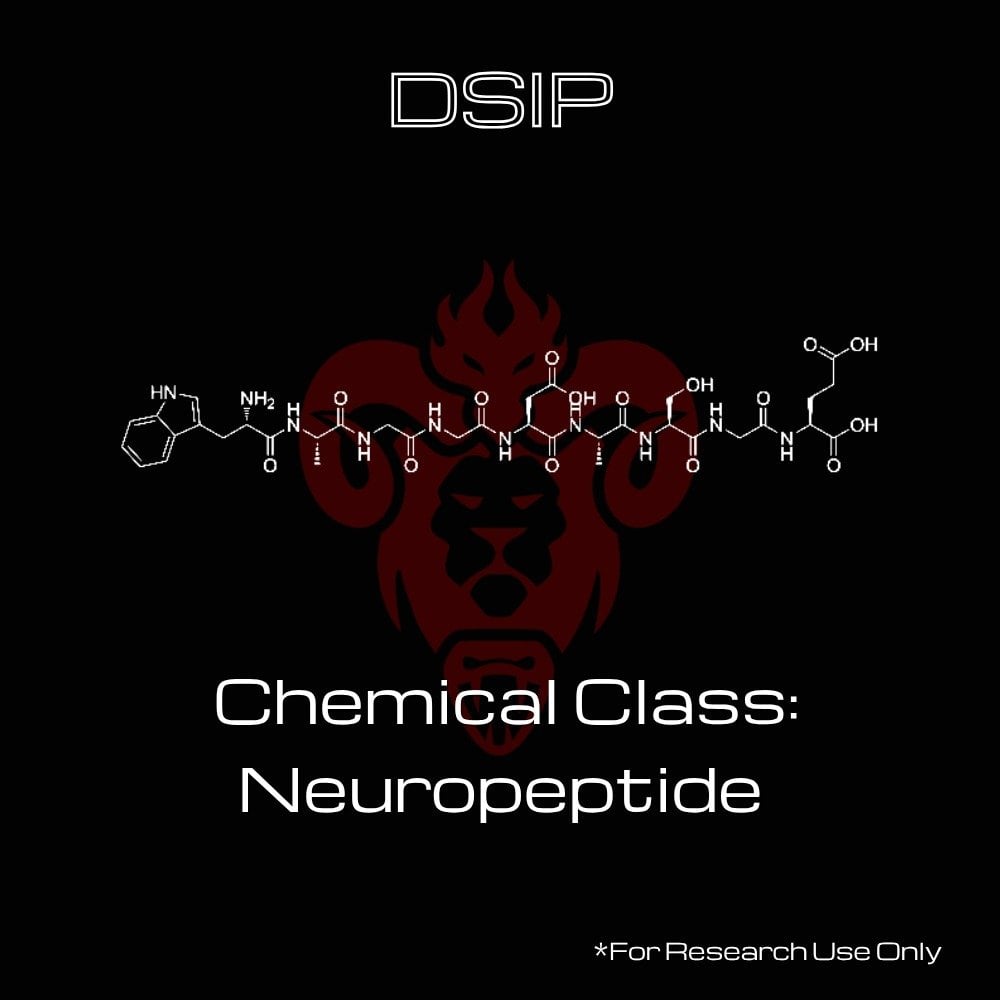
| Sequence | H-Trp-Ala-Gly-Gly-Asp-Ala-Ser-Gly-Glu-OH |
| Molecular Formula | C₃₅H₄₈N₁₀O₁₅ |
| Molecular Weight | 848.81 g/mol |
| Chemical Class | Synthetic Neuropeptide / Nonapeptide |
| Assay Purity | ≥98% (HPLC & CHN verified) |
| Physical Format | Lyophilized white to off-white powder |
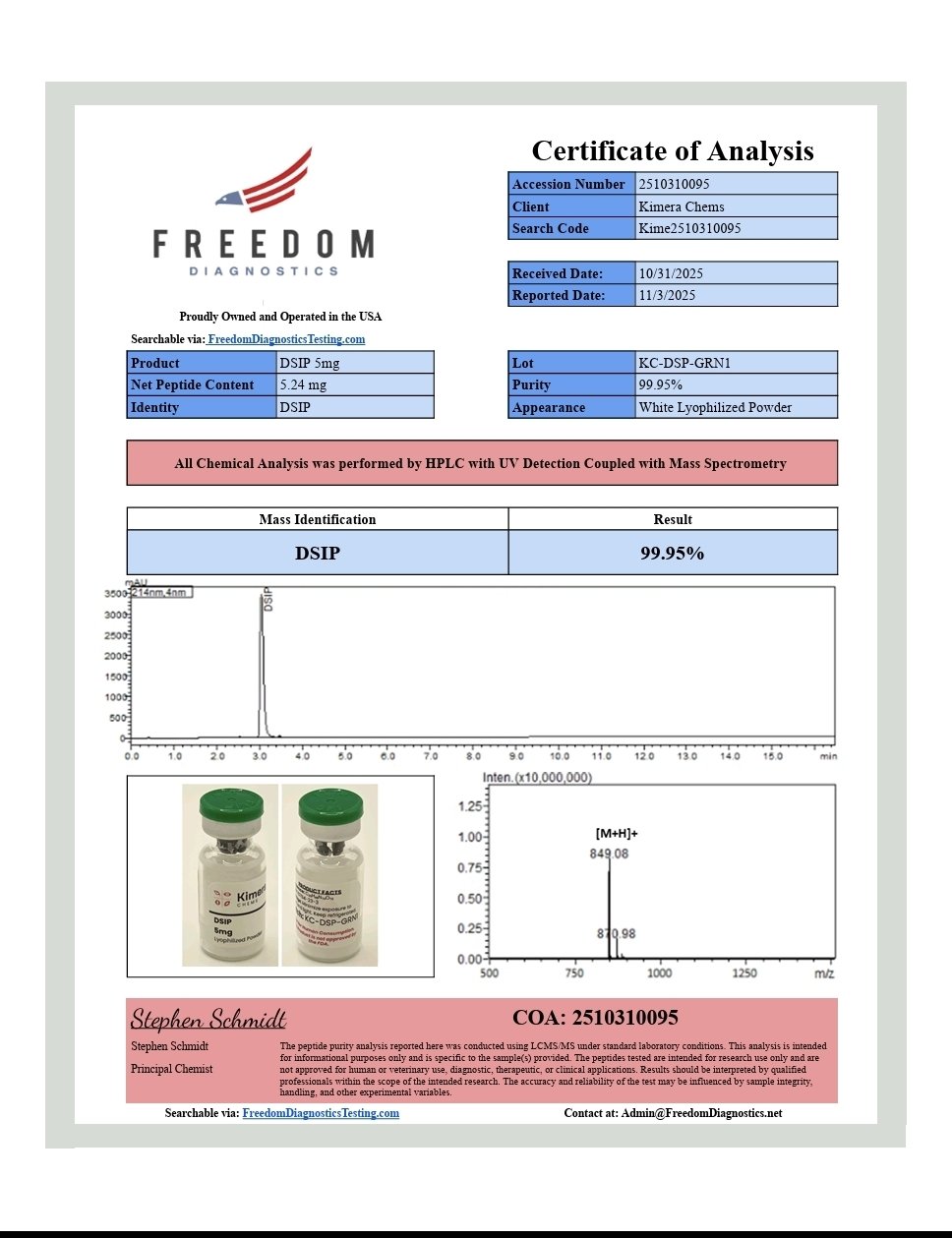
Note: Kimera Chems implements a strict dual-method verification protocol combining High-Performance Liquid Chromatography (HPLC) and CHN elemental analysis to independently audit the mass and purity of chemical products.
Research Applications & Mechanism of Interest
In laboratory settings, DSIP is widely used to explore the delicate regulatory feedback loops of the hypothalamic-pituitary-adrenal (HPA) axis and central sleep-wake cycles.
Primary fields of preclinical and in vitro laboratory investigation include:
-
Neuropeptide Signaling Studies: Mapping how the peptide interacts with central neurotransmitter pathways, particularly its modulating influence on glutamatergic, GABAergic, and monoaminergic systems.
-
Receptor Binding Assays: Utilizing cell-free matrices to measure binding affinity, transport mechanics, and potential downstream signaling cascades across targeted neural membranes.
-
Cellular Stress & Homeostasis Models: Evaluating the role of DSIP in protecting primary neuronal cell cultures from oxidative stress, temperature variations, and metabolic challenges.
-
Endocrine System Cross-talk: Investigating the peptide’s capacity to modulate the release of adrenocorticotropic hormone (ACTH), luteinizing hormone (LH), and growth hormone (GH) in in vitro endocrine models.
Storage & Handling Guidelines
To maintain complete peptide stability and prevent physical or chemical degradation over time:
-
Long-Term Storage: Store the dry, lyophilized powder in a deeply frozen state maintained strictly at -20°C or below.
-
Reconstituted Solution Handling: Once dissolved in sterile, molecular-grade laboratory water or compatible buffers, store the liquid assay continuously in the refrigerator at 2–8°C. Use within 14 days to prevent progressive peptide hydrolysis.
-
Atmospheric Protection: Keep the container hermetically sealed inside a desiccated chamber to protect the lyophilized cake from absorbing atmospheric moisture.
-
Photolytic Mitigation: Protect from direct light and ultraviolet (UV) exposure by utilizing opaque or high-grade amber laboratory containment vessels.
-
Reconstitution Protocol: Always apply sterile, aseptic techniques and instruments when preparing and transferring liquid assays to maintain compound integrity.
Research Use Only Disclaimer: This product is developed, manufactured, and distributed strictly as a Research Use Only (RUO) laboratory reference chemical. It is not an FDA-approved drug, licensed medication, active pharmaceutical ingredient, or dietary supplement, and is strictly prohibited for human or veterinary consumption. Kimera Chems supplies these reference standards exclusively to accredited institutional laboratories, academic research departments, and certified investigators for in vitro analytical research.
Frequently Asked Research Questions
Why is DSIP classified as a neuromodulator rather than a traditional sleep initiator?
In preclinical models, DSIP does not act as a classic receptor agonist that induces rapid, heavy sedation. Instead, it exhibits a stabilizing effect, modulating the natural release and reuptake of multiple neurotransmitters. This adaptive behavior helps maintain homoeostatic baselines rather than triggering a forced biological state.
What is the significance of using mass spectrometry (MS) alongside HPLC for DSIP verification?
While High-Performance Liquid Chromatography (HPLC) is highly effective for quantifying overall compound purity by identifying separate fractions, Mass Spectrometry (MS) checks the exact molecular weight. Pairing these two methods ensures that the nonapeptide’s unique amino acid sequence is structurally intact and completely matches the standard 848.8 g/mol profile before testing begins.
| CAS Number | 62568-57-4 |
| Other Names | Delta Sleep Inducing Peptide DSIP nonapeptide Emideltide [INN] DELTA SLEEP-INDUCING PEPTIDE emideltida |
| IUPAC Name | (2S)-2-[[2-[[(2S)-2-[[(2S)-2-[[(2S)-2-[[2-[[2-[[(2S)-2-[[(2S)-2-amino-3-(1H-indol-3-yl)propanoyl]amino]propanoyl]amino]acetyl]amino]acetyl]amino]-3-carboxypropanoyl]amino]propanoyl]amino]-3-hydroxypropanoyl]amino]acetyl]amino]pentanedioic acid |
| Molecular Formula | C₃₅H₄₈N₁₀O₁₅ |
| Molecular Weight | 848.8 |
Product FAQs
What is DSIP supplied for?
This material is supplied strictly for controlled, non-clinical laboratory and analytical research. It is not intended for human or animal consumption.
Which formats are available for DSIP?
Available formats or options are shown in the product selector above. Current availability can change.
Where can I review product documentation?
Where available, batch documentation can be reviewed in the Certificate of Analysis library before ordering.
Research Documentation Guides
Review these supporting analytical guides before evaluating this material for a controlled research protocol:
Related products

Peptides

Peptides


Peptides
Peptides

Peptides


Peptides


Peptides


Peptides